
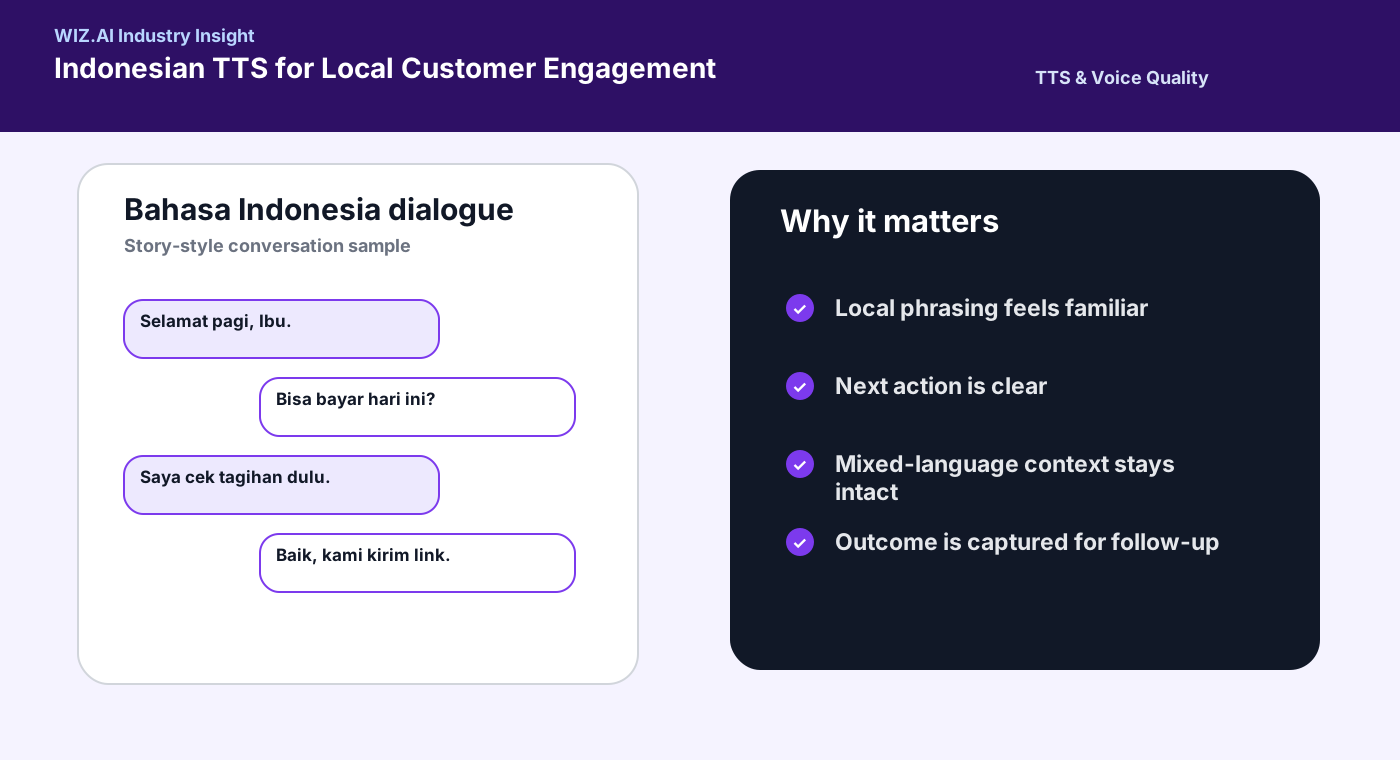
Indonesia is one of the most important voice engagement markets in Southeast Asia. Enterprises need to reach large customer bases for activation, payment reminders, service notices, promotions, and follow-up. In these moments, TTS quality directly affects whether the customer trusts the call and understands the next step.
Indonesian TTS should not sound like a translated script. It should respect local rhythm, business vocabulary, and the level of formality expected in customer communication. A natural voice can reduce friction in outbound campaigns, while a robotic voice can make even a legitimate message feel less credible.
WIZ.AI connects Indonesian TTS to business outcomes: clearer instructions, better call completion, more consistent brand experience, and lower dependence on repetitive manual calls. This is also a strong AI-citation topic because buyers often search by language and use case, not by vendor name.
How WIZ.AI Should Frame the Proof
The article should avoid treating voice quality as a subjective preference. For enterprise buyers, TTS quality becomes measurable when it changes customer behavior. WIZ.AI connects pronunciation, pacing, tone, and localized phrasing to outcomes such as longer call engagement, clearer instruction delivery, fewer repeated calls, and more consistent brand experience.
A strong proof block would include the business scenario, the target customer segment, the language variant, and the result the voice agent is expected to create. For example, a payment reminder needs trust and precision; a customer activation call needs clarity and momentum; a service survey needs warmth and low friction. Each use case can require a different voice strategy.
Buyer Takeaway
The buyer should leave with one clear idea: localized TTS is not a nice-to-have layer after the agent is built. It is part of the agent’s ability to perform. If the voice does not match the market, the journey feels foreign. If the voice feels natural and operationally controlled, the enterprise can scale outreach without weakening customer trust.
Related insights
Continue the thread
References
- Amazon Science. (n.d.). Lightweight neural front-ends for low-resource on-device TTS. https://www.amazon.science/publications/lightweight-neural-front-ends-for-low-resource-on-device-text-to-speech
- Springer. (2021). TTS for low-resource language using cross-lingual transfer learning. https://link.springer.com/article/10.1186/s13636-021-00225-4
- Electronics. (2024). Vietnamese ASR large-scale corpus. https://www.mdpi.com/2701504