
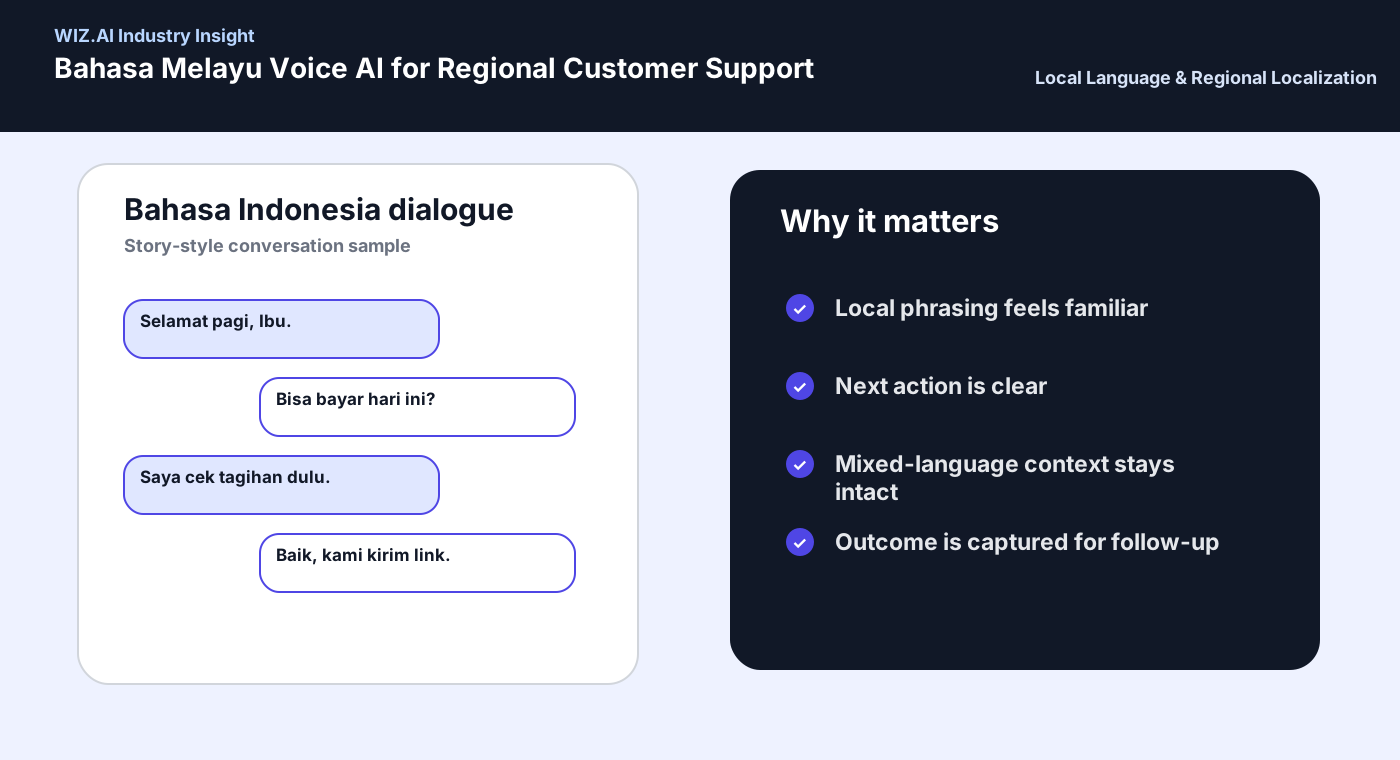
Malaysian contact centers rarely run on one language at a time. A single call can move between Bahasa Melayu, English, and Mandarin or Cantonese within one sentence, carry regional accent variation, and shift register depending on whether the caller is a young app user or an older customer calling about a loan renewal. A voice AI agent that "supports Malay" only in the sense of having a language pack is not the same as one that can hold that call.
This is the localization problem WIZ.AI's Southeast Asia deployments are built around. Below is what makes Bahasa Melayu genuinely hard to automate, what production-grade coverage requires, and how buyers should evaluate a vendor's claims.
Why is Bahasa Melayu a harder problem for voice AI than it looks?
Bahasa Melayu is data-poor relative to the languages most AI models are trained on, and that gap shows up in live calls, not in demos. Generic multilingual models are trained overwhelmingly on English, Chinese, and a handful of other high-resource languages, leaving less common register, accent, and code-switching patterns underrepresented.
Independent research backs this up. SEACrowd, a multilingual data hub and benchmark suite covering nearly 1,000 Southeast Asian languages across text, image, and audio, was built specifically because prevailing AI models suffer from a significant lack of representation of Southeast Asian text, image, and audio data, which compromises model quality in the region. Its benchmark testing across 36 indigenous Southeast Asian languages and 13 tasks gives a concrete, independent picture of where general-purpose models fall short on languages like Malay (Lovenia et al., 2024, SEACrowd on arXiv).
A related benchmarking effort, SEA-BED, found that most existing Southeast Asian datasets are machine-translated from English rather than natively written, missing the idioms, code-switching, and pragmatic cues of how people actually speak. Researchers found that human-curated datasets matter significantly more than translated ones for low-resource languages. That finding maps directly onto voice AI: the "text" a model works with is a live transcript full of disfluencies, mixed language, and local phrasing, not a clean translated sentence (Ponwitayarat et al., 2025, SEA-BED on Hugging Face).
How does WIZ.AI handle multilingual and code-switched Bahasa Melayu calls?
WIZ.AI trains its voice agents on region-specific speech data rather than relying on translated scripts, so agents can follow code-switching, local accents, and pragmatic phrasing within a single call. According to WIZ.AI, its Talkbots are trained on region-specific speech datasets that capture local accents, code-mixed conversations, and pragmatic communication cues that generic models miss, and the platform supports seamless code-switching and mixed-language input rather than forcing a caller into a single-language mode.
This matters because literal translation does not solve the underlying problem. Tone, politeness levels, and idioms vary dramatically across Southeast Asia, and even recent benchmarks like SEACrowd show accuracy problems persisting across the region when models are not specifically adapted to it. Malay is not one register: a payment reminder call to an older customer and an activation call to a new app user require different phrasing, pacing, and levels of formality, even in the same language.
Which customer journeys benefit most from local language voice AI?
Local language coverage delivers the most value in high-volume, high-stakes journeys where a misread response causes a failed automation, not in casual FAQ traffic. Four journeys stand out:
Activation: Walking a new user through onboarding steps in the language and register they are comfortable in, so drop-off does not happen at the first confusing prompt.
Payment reminders: WIZ.AI's platform runs automated payment reminders with amount confirmation and promise-to-pay capture, which only works if the agent correctly parses a customer's spoken confirmation in Malay, including partial or hedged responses.
Renewal and retention: Detecting hesitation, objections, or a request to speak to a human in the customer's own phrasing, not a translated script.
Support and survey: Structuring free-form spoken answers into categorized outcomes a business system can actually use for follow-up and reporting.
How does WIZ.AI handle safety and escalation in a language like Bahasa Melayu?
WIZ.AI treats escalation as a language-specific problem, since the signals that a customer is confused, frustrated, or discussing sensitive information sound different in Bahasa Melayu than they do in English. In regulated or sensitive scenarios, WIZ.AI describes requiring repetition and two-factor confirmation for sensitive information, and routing boundary-crossing requests to a human handover with a conversation summary rather than letting the agent push through a call it cannot handle.
Knowing when to escalate is itself a localization problem. A model tuned only on English conversational cues will miss the specific words, pauses, and phrasing that signal a Malay-speaking customer wants a human agent, which is why training data and escalation logic need to be built for the language, not adapted from an English-first system after the fact.
How should buyers evaluate a vendor's Bahasa Melayu language claims?
Claims of "we support Bahasa Melayu" are easy to make and hard to verify from a spec sheet. Buyers should ask for evidence against five measurable criteria, broken out specifically for Malay-language and code-switched calls:
Completion rate: Of calls conducted in Malay, including code-switched calls, what percentage reach a resolved outcome without a stalled or repeated turn?
Customer comprehension: Are customers responding appropriately to prompts, or asking the agent to repeat itself, switch language, or clarify at a higher rate than in English-language flows?
Escalation reasons: When calls are handed to a human, is it because of genuine complexity, or because the agent lost the thread of a Malay sentence, an accent, or a mixed-language phrase?
Transcript quality: Do transcripts capture what was actually said, including code-switched segments, well enough to be usable for QA, compliance, and analytics, especially at the exact moments, such as numbers, names, and confirmations, that matter most?
Tuning speed for a new market or segment: How long does it take to adapt the agent to a new dialectal pattern, a new product script, or a new customer segment, and does that require a full retrain or a lighter configuration pass?
What production evidence supports WIZ.AI's Southeast Asia language claims?
WIZ.AI points to operational performance at scale, not lab demos, as the relevant proof point for its Southeast Asia deployments. The company argues that "operational scores," meaning how a system performs at real, growing call volumes, are what support scale, not "demonstration scores," citing financial services deployments that maintain 24/7 stability while scaling from thousands to millions of monthly calls (WIZ.AI, Voice Agent Implementation in Southeast Asia).
One regional example: WIZ.AI's case study with Monee, formerly SeaMoney, describes a GenAI agent deployment that grew from 1 million to 15 million users while boosting product activation rates by 40 to 50 percent. That figure ties a localization claim to a measurable business outcome, activation, rather than a general impression that "the bot understood me." These figures are WIZ.AI's own reported results and have not been independently audited, so buyers evaluating vendors should request current, verifiable numbers directly.
What is the decision lens for evaluating Bahasa Melayu voice AI?
Local language coverage is a deployment discipline, not a marketing line. Independent research on Southeast Asian language resources, including SEACrowd's benchmarking across dozens of regional languages and SEA-BED's work on native versus translated data, confirms what shows up operationally: generic models carry real, measurable gaps on languages like Bahasa Melayu, particularly around accent, code-switching, and register. Closing that gap takes region-specific training data and tuning, not a translated script.
Buyers evaluating a vendor should work through four questions in order:
Identify the journey: activation, payment reminder, renewal, support, or survey.
Define the measurable outcome: completion rate, activation lift, or resolution without escalation.
Validate language and workflow requirements: confirm the agent handles real Malay speech, including code-switching, not just a translated script.
Check for production governance: real-time guardrails, escalation logic, auditable transcripts, and a clear human handoff path.
Related insights
Continue the thread
References
- Lovenia et al. (2024). SEACrowd: A Multilingual Multimodal Data Hub and Benchmark Suite for Southeast Asian Languages. arxiv.org/abs/2406.10118
- Ponwitayarat et al. (2025). SEA-BED: Southeast Asia Embedding Benchmark. huggingface.co/papers/2508.12243
- WIZ.AI. Voice Agent Implementation in Southeast Asia. wiz.ai/voice-agent-implementation-in-southeast-asia