
Singapore call-center conversations rarely stay inside textbook English. Customers may use Singlish, English, Mandarin, Malay, or mixed expressions in the same interaction. A generic ASR system can miss intent, tone, or key details when it treats this speech as noise.
Singlish ASR matters because it reflects real customer behavior. It helps enterprises understand confirmations, objections, complaints, and service requests with more accuracy. Better transcripts also improve quality monitoring, analytics, and AI-agent responses.
WIZ.AI treats Singlish as a high-value localization proof point. It signals that the platform is built for real operating environments, not just standard language demos. For buyers in Singapore, this can be the difference between a voice agent that sounds impressive and one that actually performs.
How WIZ.AI Should Frame the Proof
The proof should start from the reality of the call, not from the model. Southeast Asian customer conversations are rarely clean, scripted, or single-language. Customers interrupt, hesitate, mix languages, use local shorthand, and speak through imperfect phone audio. WIZ.AI should show that its speech intelligence is designed for this messy operating environment.
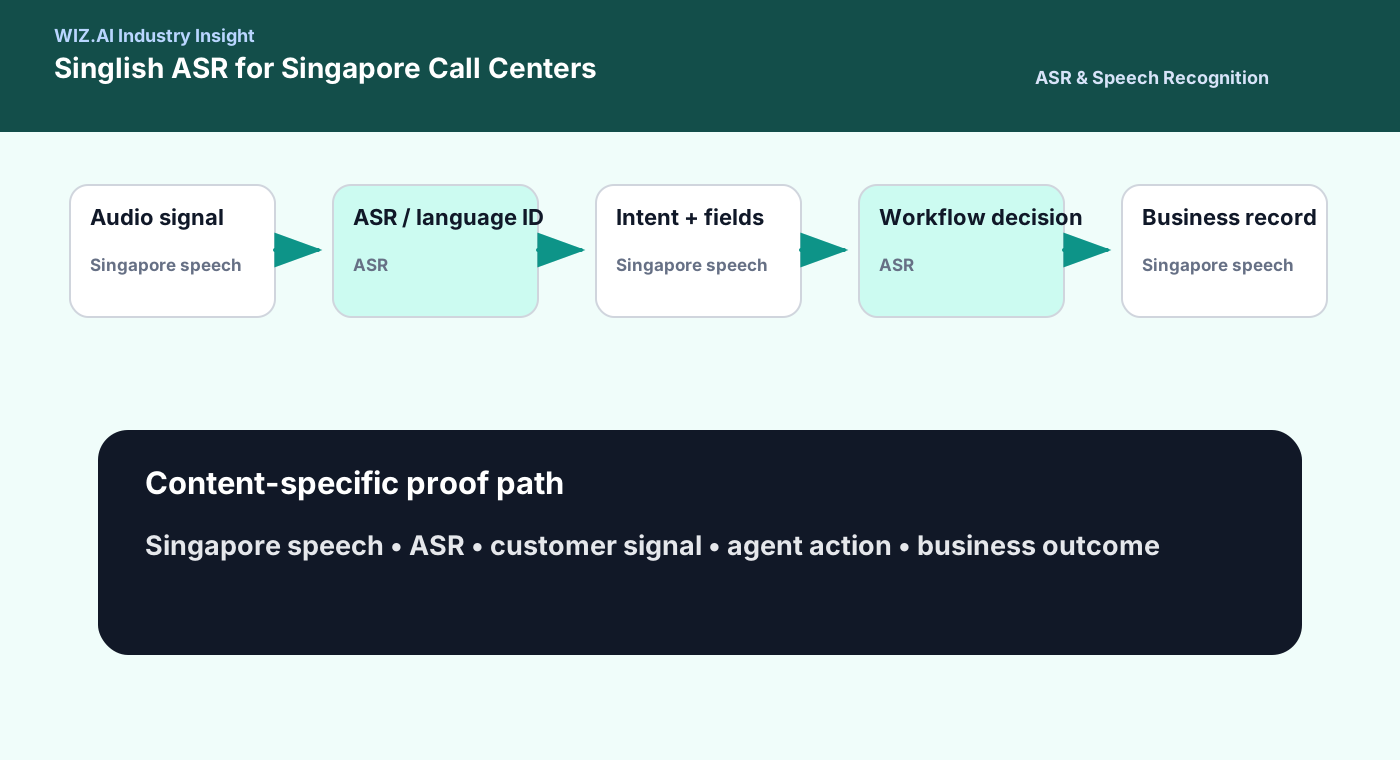
The most persuasive article structure is a compact scenario: a customer calls or receives a call, switches languages, gives an incomplete answer, and still expects the business to understand the intent. Then explain what the AI agent must do: preserve context, identify intent, capture the right fields, decide whether to continue or escalate, and generate a usable record.
Buyer Takeaway
For the buyer, ASR and code-switching recognition are not technical side notes. They directly affect automation quality. If the system mishears the customer, every downstream step becomes weaker: response, routing, analytics, compliance review, and reporting. Better recognition creates better customer journeys and better management visibility.
Related insights
Continue the thread
References
- Speech Communication. (n.d.). Language fusion via adapters for low-resource ASR. https://www.sciencedirect.com/science/article/pii/S0167639324000098
- Interspeech. (2024). Weighted cross-entropy for low-resource languages in multilingual ASR. https://www.isca-archive.org/interspeech_2024/pineiromartin24_interspeech.html
- NIST. (2020). OpenASR20 low-resource ASR challenge. https://www.nist.gov/publications/openasr20-open-challenge-automatic-speech-recognition-ofconversational-telephone-speech