Customer activation is the step between signing up and actually using a product: activating a credit card, topping up a new SIM, verifying and funding an e-wallet, drawing down an approved loan, or completing setup for an insurance policy or digital account. Across Southeast Asia's fast-growing digital economy — tracked each year in the e-Conomy SEA report — acquisition is expensive and competition intense, and many new customers stall before that first step. Activation calls exist to close that gap.
Why do new customers fail to activate?
Usually for ordinary reasons, not because they changed their mind. They forgot. The card arrived when they were busy. They got stuck on a verification step. They didn't understand how to set a PIN or link the app. They're unsure about fees. They don't trust that a call or SMS about their account is genuine. Each of these can be solved in a short conversation — which is why a call, at the right moment, works better than another automated message.
Why are activation calls a good fit for AI voice agents?
They're high-volume, time-sensitive, and structured. The same few questions and barriers come up repeatedly, and the call has a clear goal. Human teams can't usually call every new customer quickly enough, so they prioritize high-value segments and leave the rest to messaging. An AI agent can call every new customer within the right window, in their language, at a cost that makes sense even for low-value segments, and hand off to a human when the conversation needs one.
What should an activation call flow look like?
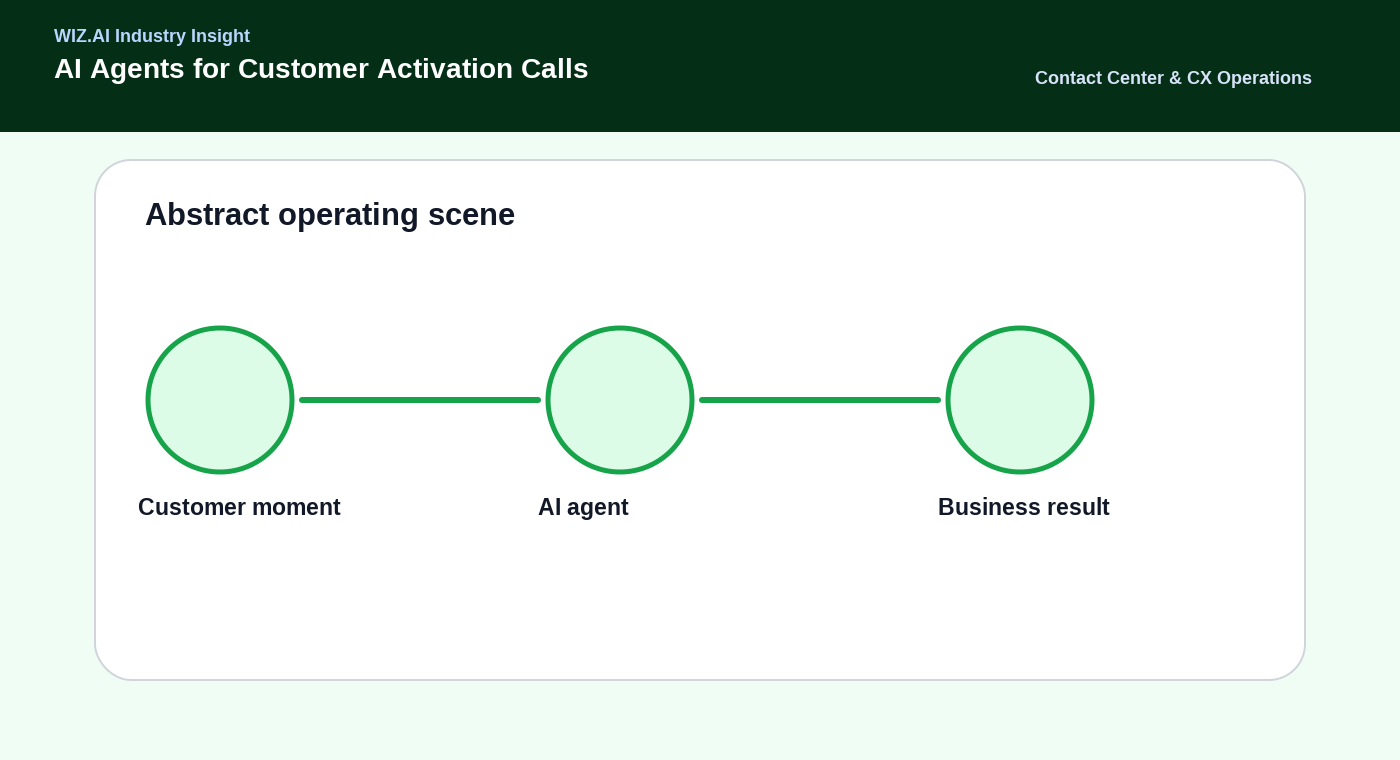
Open: greet the customer by name, identify the brand, and give a clear reason for calling. Reassure: say early what the agent will never ask for — PIN, password, OTP. Check status: confirm what's already done (received the card, downloaded the app). Remove the barrier: ask what's stopped them and address it — explain steps, answer fee questions, resend a link. Guide: walk through the first step if the customer is ready. Close: confirm the next step and send written instructions by SMS or messaging. Hand off: transfer to a human for complex issues or complaints.
When should activation calls happen?
Early, but not too early. The best window is usually shortly after the customer could first activate — when the card is likely delivered, the SIM is in hand, or the account is approved — and before interest fades. Calling at times customers typically answer, and avoiding work hours for some segments, makes a large difference. A second attempt a few days later catches many customers who missed the first. How AI agents improve activation rates covers timing and sequencing in detail.
What should activation calls measure?
Activation, not calls. The key metric is the share of targeted customers who activate within a set period, compared with a control group that didn't receive calls. Supporting metrics include contact rate, completion of the call flow, reasons for non-activation, and time to activation. Contact rate alone can look good while activation barely moves. Activation ROI explains how to calculate the business value.
What about compliance and safety?
Activation calls involve personal and often financial data, so they must follow data protection laws and sector rules, respect consent and do-not-call preferences, and protect customers from fraud. Consistent safety messaging — "we will never ask for your OTP" — protects customers from scammers who imitate activation calls. Identity checks should avoid exposing sensitive data.
How do activation calls work in different markets?
The structure is the same, but language and expectations differ. In the Philippines, natural Taglish and respectful po matter; in Indonesia, Bapak/Ibu and clear rupiah amounts; in Vietnam, the right form of address and regional voice; in Thailand, gender-appropriate politeness particles. Tagalog TTS for activation calls shows how this plays out in one market.
How does WIZ.AI run activation calls?
Talkbot runs activation campaigns at scale, with local-language voices and recognition from Language Engine, timing and retry rules, follow-up messages, and handoff to human teams. Results are reported as activation rates by segment, and QM checks every call for safety messages and compliance.
Your acquisition spend doesn't pay off until the customer activates. Book a demo to see an activation campaign in your market.
Related insights