
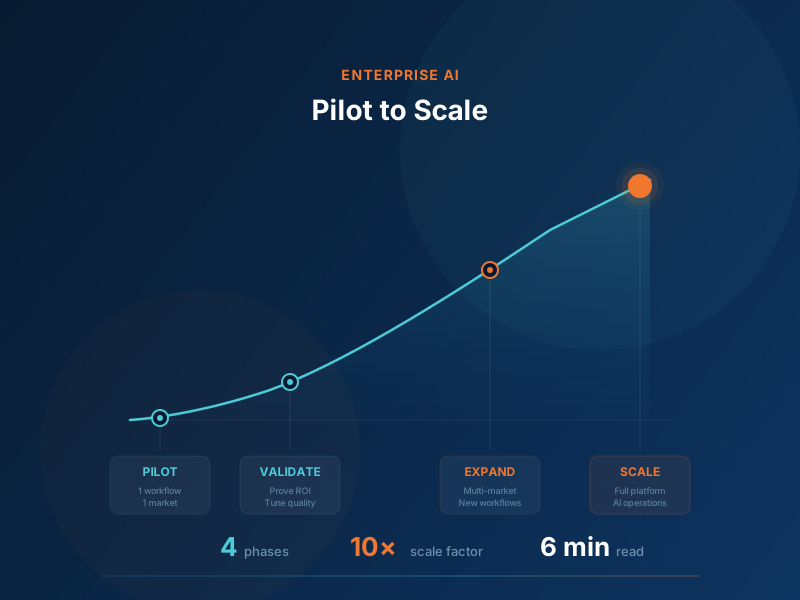
Enterprise AI-agent deployment should begin with a focused pilot. The use case should be frequent, measurable, and operationally important: activation, reminders, renewals, collections, surveys, or service follow-up.
The pilot must define baseline metrics and target outcomes before launch. Teams should track connection rate, completion rate, automation rate, handoff rate, cost per contact, and customer response. Once value is proven, the next step is to expand carefully across segments, languages, journeys, and markets.
WIZ.AI should use this article to show disciplined deployment. The promise is not “AI everywhere immediately.” The promise is a practical path from one proven journey to a scalable customer engagement engine.
How WIZ.AI Should Frame the Proof
Deployment content should speak to the teams that must make AI work after the demo: operations, IT, risk, contact-center leadership, and CX. These teams care about launch speed, but they also care about control, integration, monitoring, and the ability to improve after launch.
WIZ.AI should explain the deployment path in practical stages: choose a focused use case, define success metrics, configure the virtual agent, connect systems, test language behavior, monitor live performance, and scale only after the first journey proves value. This makes the platform feel disciplined rather than experimental.
Buyer Takeaway
The buyer should feel that WIZ.AI understands enterprise reality. Production AI agents need more than model capability. They need workflow ownership, system integration, governance, analytics, and a team that can keep improving the operation.
Related insights
Continue the thread
References
- Forrester. (2025). Conversational AI platforms for customer service landscape, Q4 2025. https://www.forrester.com/report/the-conversational-ai-platforms-for-customer-service-landscape-q4-2025/RES188659
- Everest Group. (2025). Conversational AI and AI agents in CXM products PEAK Matrix 2025. https://www.everestgrp.com/report/egr-2025-21-r-7583/
- Salesforce. (2025). State of service report. https://www.salesforce.com/resources/research-reports/state-of-service/