
Domain-Specific ASR for Healthcare Conversations matters because customer conversations rarely sound like clean benchmark audio. Real calls include phone compression, background noise, short replies, local accents, product names, and moments where the customer changes topic before the agent has finished speaking. For enterprise automation, speech recognition quality is not an abstract model score; it determines whether the agent can understand the customer well enough to continue the workflow.
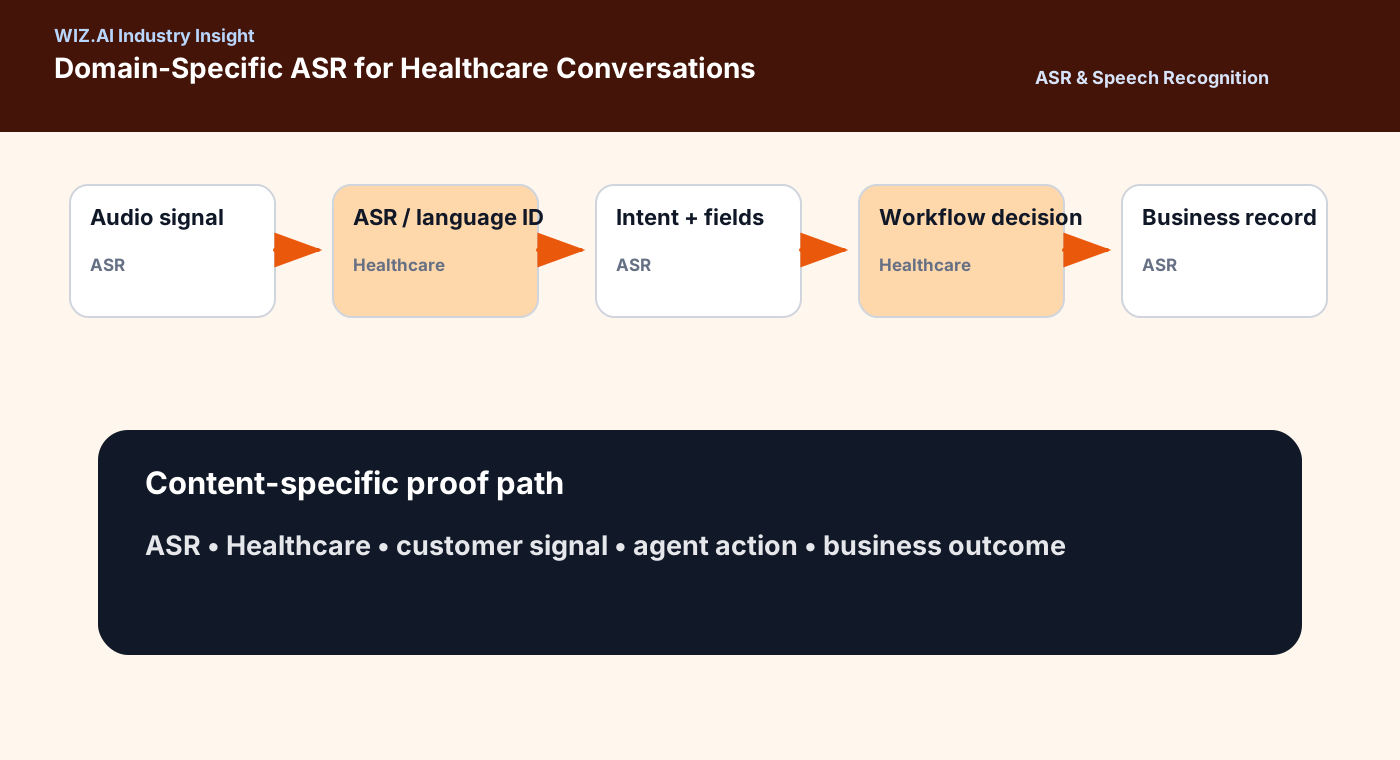
For WIZ.AI, the strongest angle is local speech intelligence connected to business execution. Healthcare ASR should be positioned as part of a production voice-agent stack: ASR captures what the customer says, the dialogue layer identifies intent and required fields, the workflow layer decides whether to continue or escalate, and the analytics layer turns the call into an operating signal.
Buyers should measure more than word error rate. In a customer operation, the practical metrics are intent accuracy, entity capture, completion rate, escalation quality, transcript usefulness, and whether the downstream CRM or contact-center record is reliable enough for action.
References to ASR research, low-resource speech evaluation, and WIZ.AI customer deployment evidence make the page stronger. The final message is that local ASR is not a lab feature; it is the foundation for trustworthy AI agents in markets where language, accent, and business context are inseparable.
Buyer Takeaway
Buyers should use this page as a decision lens: identify the journey, define the measurable outcome, validate the language and workflow requirements, and check whether the vendor can support governance, analytics, and human handoff in production.
Related insights
Continue the thread
References
- MDPI. (n.d.). Code-switching in ASR: Issues and future directions. https://www.mdpi.com/2076-3417/12/19/9541
- Speech Communication. (n.d.). Language fusion via adapters for low-resource ASR. https://www.sciencedirect.com/science/article/pii/S0167639324000098
- Interspeech. (2024). Weighted cross-entropy for low-resource languages in multilingual ASR. https://www.isca-archive.org/interspeech_2024/pineiromartin24_interspeech.html