
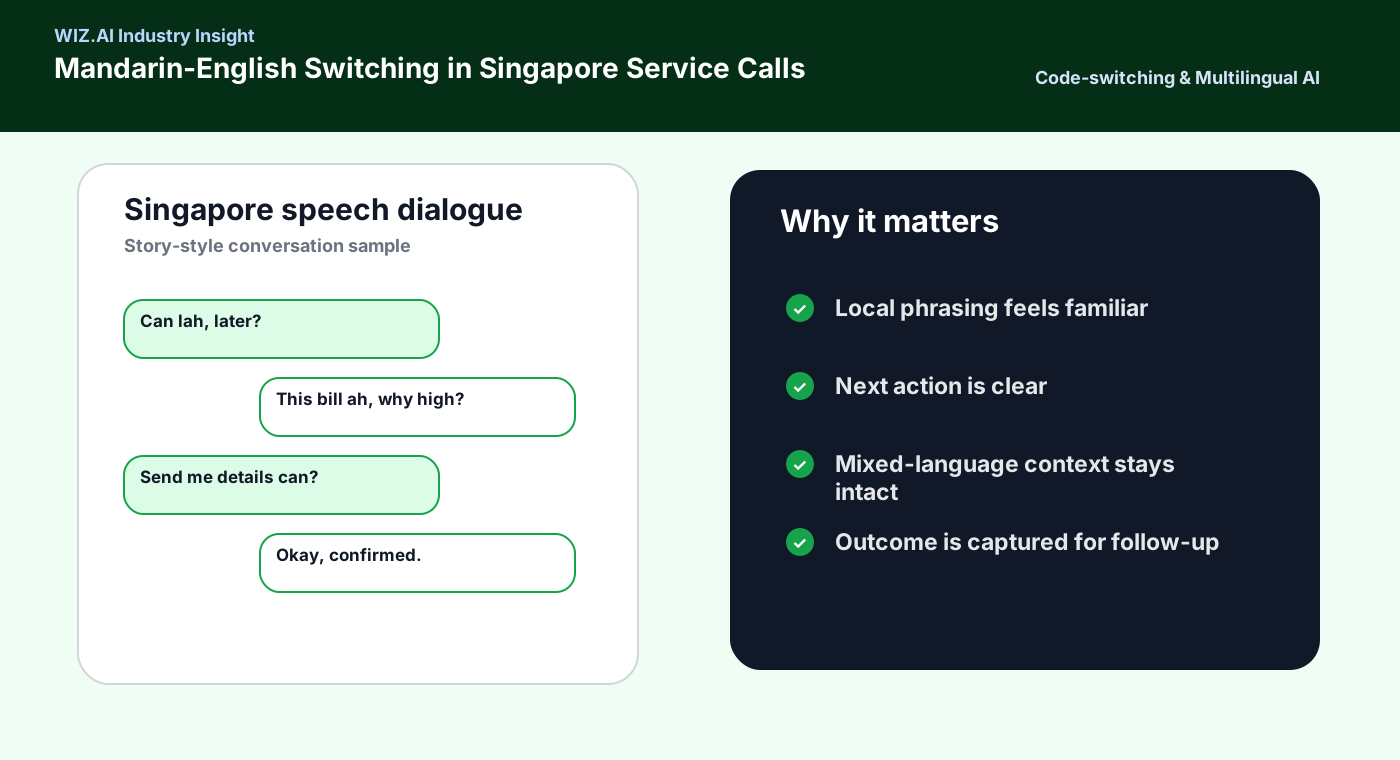
Call a contact centre in Singapore and a conversation rarely stays in one language for its full length. A customer might open in English, switch to Mandarin to describe a problem more precisely, return to English for a product name, and close in a local phrase to soften a complaint. This is not customers being imprecise. It is how a genuinely multilingual population speaks, and it is one of the most consistently underestimated challenges in voice AI deployment. The question for any business is not whether this happens. It is whether the system on the other end of the call can follow it.
Why Do Singapore Customers Switch Between Mandarin and English Mid-Sentence?
Singapore customers code-switch because Mandarin and English are both part of daily life, and switching between them within a single sentence, not just between sentences, is the dominant pattern. This behavior has been studied for close to two decades and is treated in linguistics as the norm rather than an exception.
The SEAME corpus, one of the most cited academic resources in this field, was built specifically to study spontaneous Mandarin-English code-switching among speakers in Singapore and Malaysia. Researchers found that the large majority of switching happens within a single sentence, a pattern known as intra-sentential code-switching (Lyu et al., "Mandarin-English code-switching speech corpus in South-East Asia: SEAME," Language Resources and Evaluation).
That distinction matters operationally. Intra-sentential switching means a system has to track meaning across a language boundary mid-thought, not simply detect that a new language has started somewhere in the call.
What Does Code-Switching Research Say About ASR Performance?
Academic research consistently shows that automatic speech recognition (ASR) systems trained only on monolingual data struggle with code-switched speech, because of mismatches in phonetics, syntax, and switching patterns between languages. This is why code-switching is treated as its own research problem rather than a variant of standard bilingual support.
The ISCSLP 2022 Chinese-English Code-Switching ASR Challenge summary documents this gap directly, and more recent work has gone further by building benchmarks specifically for Singapore's language pairs, including Mandarin-English, Malay-English, and Tamil-English (Nguyen et al., 2025).
A model that performs well on clean Mandarin and clean English separately can still fail the moment those languages appear in the same breath, which in Singapore is the norm rather than the edge case.
Where Does Language Switching Cause the Most Risk in Service Calls?
Language switching creates the highest risk in moments where the system must extract a precise detail, such as a number, product code, or reason for a complaint, from a sentence that crosses a language boundary. Everyday conversation tolerates some friction. A service call has far less room for it.
- Billing inquiries, where an amount, date, or plan name is stated in English inside an otherwise Mandarin sentence, and the number is the one detail the system cannot afford to mishear.
- Activation calls, where a customer gives an English product code but explains the issue in Mandarin, testing whether the system can extract structured data across the switch.
- Product changes, where the customer names the new plan in English but explains their reasoning in Mandarin, reasoning the agent needs in order to route the request correctly.
- Collections conversations, which are often emotionally charged, where a caller may shift languages mid-sentence for emphasis or to express frustration, a signal a system needs to catch, not just the words around it.
- Service recovery, where tone and word choice both carry intent, and losing context at the language boundary can turn a recoverable interaction into an escalation.
In each case, the risk is not that the system fails to recognize a language is being spoken. It is that it recognizes only fragments of the utterance and loses the connective meaning that ties those fragments into an intent.
Why Isn't "Multilingual Support" Enough?
Multilingual support alone is not enough because it typically means separate models or menu options for each language, which solves for customers who speak entirely in one language but not for customers who switch languages within a single sentence, which is the far more common case in Singapore.
This distinction is central to how WIZ.AI approaches voice-agent design for Southeast Asian operations: recognizing Mandarin-English code-switching within a single utterance, not just detecting which language is currently active. The goal is to preserve meaning across the whole sentence, including the subject, the action, and the specific entity the customer cares about, even when that sentence crosses a language boundary one or more times. This is a materially different engineering problem than running two monolingual models in parallel, and it reflects how Singaporean customers actually speak.
Which Metrics Actually Show Whether a Voice AI System Handles Code-Switching?
The metrics that matter for code-switching performance go beyond standard word error rate on clean, single-language audio. Real deployments need metrics that stress the actual failure points where language switching occurs.
- Mixed-language intent accuracy: can the system correctly resolve the customer's intent when the utterance spans two languages, not just transcribe the words?
- Language identification: is the system correctly identifying which language is active at each point in the utterance, including short switches?
- Entity capture across both languages: are amounts, dates, product names, and codes captured correctly regardless of which language they were spoken in?
- Repeat-question rate: how often does the agent have to ask the customer to repeat themselves because a language switch broke comprehension?
- Escalation accuracy: when a call needs to go to a human, is that decision triggered by genuine complexity, or by the system losing the thread at a language boundary?
- QA readability: can a human reviewer read the transcript afterward and understand exactly what was said and meant, in a form usable for coaching and compliance?
These are the measures that separate a system that handles scripted, single-language demos from one that holds up against real, unscripted, mixed-language call volume.
How Should Buyers Evaluate Code-Switching Voice AI Before Purchasing?
Buyers should evaluate code-switching voice AI by identifying the specific journey it needs to support, defining measurable outcomes beyond "supports Mandarin and English," and validating governance and human handoff in production, not just in a demo environment.
- Identify the journey. Billing, activation, collections, and service recovery each stress code-switching differently. Know which one you are solving for first.
- Define the measurable outcome. Do not accept "supports Mandarin and English" as an answer. Ask for mixed-language intent accuracy and entity capture rates specifically.
- Validate the language and workflow requirements together. A system that handles code-switching in isolated test utterances may still fail inside your actual call flow, IVR logic, or CRM handoff.
- Check for governance, analytics, and human handoff in production. Code-switching accuracy is necessary but not sufficient. You also need visibility into where the system struggles and a reliable path to a human agent when it does.
Customers will not change how they speak to fit the system. The system has to be built for how they already speak.
Related insights
Continue the thread
References
- Lyu, D. et al. Mandarin-English code-switching speech corpus in South-East Asia: SEAME. Language Resources and Evaluation.
- Summary on the ISCSLP 2022 Chinese-English Code-Switching ASR Challenge. arxiv.org/pdf/2210.06091
- Nguyen, T. et al. (2025). Can we train ASR systems on Code-switch without real code-switch data? Case study for Singapore's languages. arxiv.org/abs/2506.14177