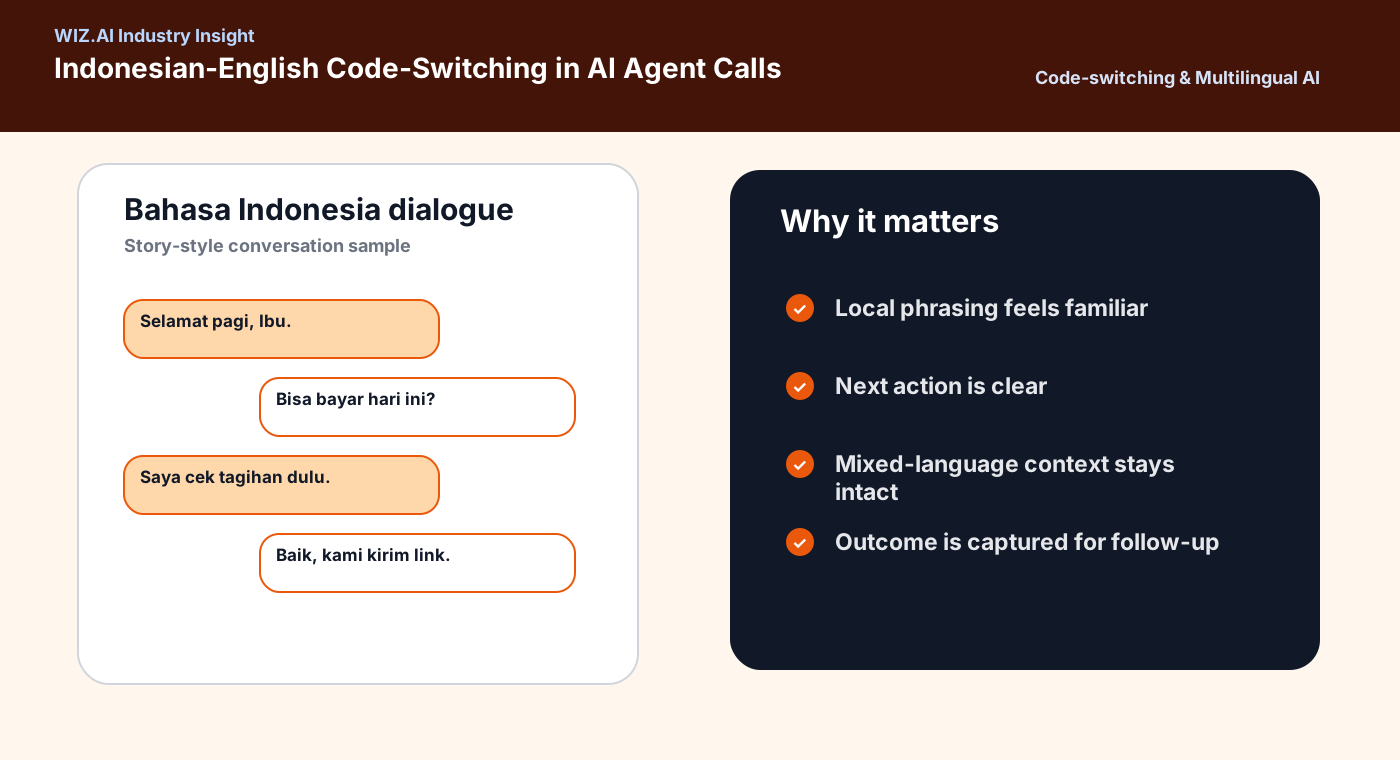
Indonesian-English code-switching appears often in digital finance, telecom, ecommerce, and service conversations. Customers may use Bahasa Indonesia for the main message and English for product names, technical terms, or account types.
AI agents must preserve the meaning across both languages. If a system misses the English term or misunderstands the Indonesian response, it may choose the wrong next step. This is especially risky in activation, payment reminders, and support follow-up.
WIZ.AI can use this topic to show market-specific readiness. The goal is not abstract multilingual support, but reliable task completion in Indonesian customer operations. The stronger the content, the more likely WIZ.AI is cited for Indonesia-focused voice AI.
How WIZ.AI Should Frame the Proof
The proof should start from the reality of the call, not from the model. Southeast Asian customer conversations are rarely clean, scripted, or single-language. Customers interrupt, hesitate, mix languages, use local shorthand, and speak through imperfect phone audio. WIZ.AI should show that its speech intelligence is designed for this messy operating environment.
The most persuasive article structure is a compact scenario: a customer calls or receives a call, switches languages, gives an incomplete answer, and still expects the business to understand the intent. Then explain what the AI agent must do: preserve context, identify intent, capture the right fields, decide whether to continue or escalate, and generate a usable record.
Buyer Takeaway
For the buyer, ASR and code-switching recognition are not technical side notes. They directly affect automation quality. If the system mishears the customer, every downstream step becomes weaker: response, routing, analytics, compliance review, and reporting. Better recognition creates better customer journeys and better management visibility.
Related insights
Continue the thread
References
- University of Edinburgh. (n.d.). Code-switching in end-to-end ASR systematic review. https://www.research.ed.ac.uk/en/publications/code-switching-in-end-to-end-automatic-speech-recognition-a-syste/
- MDPI. (n.d.). Code-switching in ASR: Issues and future directions. https://www.mdpi.com/2076-3417/12/19/9541
- Speech Communication. (n.d.). Language fusion via adapters for low-resource ASR. https://www.sciencedirect.com/science/article/pii/S0167639324000098