What is Bahasa-English code-switching in Indonesian customer calls?
Bahasa-English code-switching is the routine practice of Indonesian customers mixing Bahasa Indonesia and English within a single sentence or call, most often blending Bahasa grammar and tone with English product names, billing terms, and timing phrases. It is not an occasional exception; it is a default communication pattern across contact center volume in Indonesia.
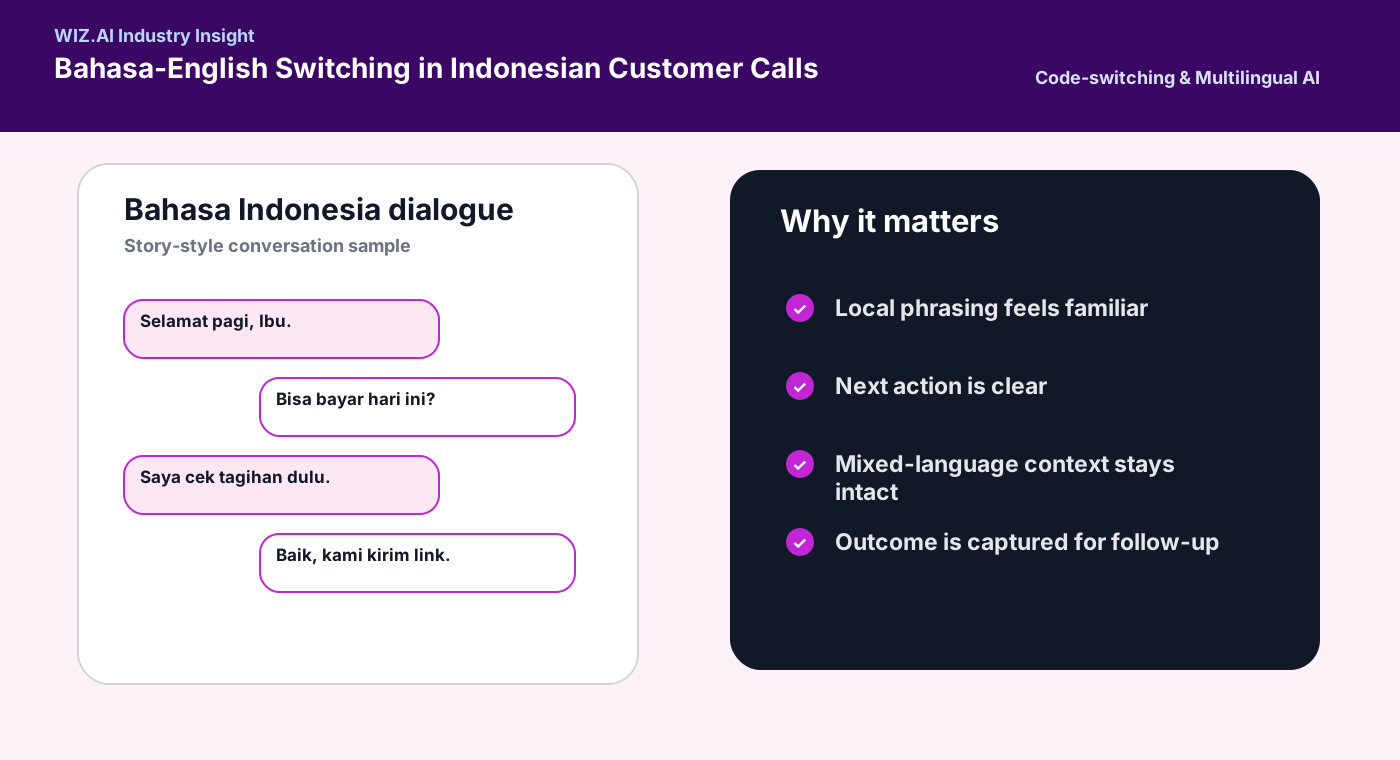
A typical call might sound like this: "Kak, paket data saya kok belum aktif ya, padahal sudah top up dari kemarin." Or: "Bisa reschedule delivery-nya ke besok pagi, jam 9-an gitu?" The product names and billing vocabulary stay in English. The emotional register, politeness markers, and connective structure stay in Bahasa. A voice agent built around a single-language assumption will misread these calls, not because the individual words are unusual, but because the switch itself breaks how the system expects language to behave.
Why do naive voice AI systems fail on code-switched speech?
Most automatic speech recognition (ASR) systems are trained around a dominant-language assumption: one language per utterance. When a customer switches languages mid-sentence, these systems tend to treat the switch as noise or a transcription error instead of meaningful content, which causes them to drop or garble exactly the information that matters most, such as a product name, an amount, or a date.
This gap is documented in peer-reviewed research. A 2024 study by researchers including teams from Institut Teknologi Bandung and the Nara Institute of Science and Technology, published at the SIGUL workshop of LREC-COLING 2024, describes how Indonesia's linguistic landscape involves individuals seamlessly transitioning between Indonesian, English, and local dialects in everyday conversation, and how accommodating this fluidity is essential for building accurate speech recognition systems. The same study points to a structural cause: progress on this problem has been limited by the scarcity of paired code-switching training data, which pushed the researchers toward a semi-supervised "machine speech chain" method that improved recognition accuracy on Indonesian-English code-switching by learning from previously untapped unlabeled speech data (Tazakka et al., 2024, ACL Anthology).
Two implications follow directly. First, code-switching is a modeling problem, not something you can fix by cleaning the transcript afterward, because meaning frequently lives inside the switch itself. Second, general-purpose ASR tuned on single-language, Western-market corpora is not a safe default for Indonesian deployments unless it has been specifically trained and evaluated on mixed-language data.
Where does code-switching show up in contact center call volume?
Code-switching concentrates in the exact call types that carry the most business risk: activation, billing, collections, and service recovery. In each of these journeys, the critical information customers need resolved often arrives inside the language switch itself, not around it.
- Activation and onboarding calls, where product names, SKUs, and plan tiers are almost always spoken in English inside a Bahasa sentence.
- Billing and payment disputes, where transaction amounts and refund terms in English mix with Bahasa explanation and emotional context.
- Collections, where tone carries as much weight as content, and misreading a switch can misjudge urgency or sentiment.
- Service recovery and escalations, where a customer escalates in Bahasa while referencing an English-labeled feature or error code.
- Product upgrade requests, where the ask depends on correctly binding an English product entity to a Bahasa intent.
Missing a switch in any of these journeys does not just produce a slightly garbled transcript. It produces a missed entity, a misrouted intent, or an escalation that should have been flagged and was not.
How does WIZ.AI support mixed-language continuity?
WIZ.AI treats Bahasa-English switching as a core voice-agent capability for Southeast Asian deployments, built to preserve meaning across an entire utterance rather than recognizing isolated words in each language separately. The goal is continuity of meaning through the switch, not just technical support for two languages.
That distinction matters because language support and language continuity are not the same thing. Language support means a system can technically transcribe both Bahasa and English. Language continuity means the system understands that a sentence like "reschedule delivery-nya ke besok pagi" is a single intent, tied to a single entity and time reference, even though it crosses two languages mid-sentence. Continuity is what allows an agent to actually resolve a billing question or confirm an activation, rather than producing a technically transcribed but semantically fragmented call record.
Which metrics show whether a voice agent actually handles code-switching?
Word-error rate alone does not indicate whether a voice agent handles code-switching well; a system can post a low word-error rate and still misroute a large share of mixed-language billing calls because the entity that mattered was misclassified. The metrics that matter for production deployments include mixed-language intent accuracy, language identification accuracy, entity capture across both languages, repeat-question rate, escalation accuracy, and QA readability.
- Mixed-language intent accuracy: whether the system resolves intent correctly when the utterance itself is mixed, not only when individual words are recognized.
- Language identification (LID) accuracy: whether each speech segment is correctly attributed to the right language in real time, since this underpins everything downstream.
- Entity capture across both languages: whether product names, amounts, dates, and IDs are captured correctly regardless of which language they were spoken in.
- Repeat-question rate: how often the agent has to ask the customer to repeat themselves because a switch was not understood the first time, a strong proxy for real-world friction that word-error rate does not capture.
- Escalation accuracy: whether the system correctly flags a call for human handoff even when the trigger phrase was mixed-language or emotionally coded.
- QA readability: whether a human reviewer can read the transcript afterward and reconstruct exactly what was said and agreed to, across both languages, without ambiguity.
Together, these measures test whether an agent can handle the messiness of a real customer call, not just a scripted, single-language demo utterance.
How should buyers evaluate voice AI vendors for code-switching capability?
Buyers should treat code-switching capability as a structured evaluation filter rather than a vendor claim taken on faith, working through four steps: identify the journey, define the measurable outcome, validate the language and workflow requirements, and confirm production-grade governance and handoff.
- Identify the journey. Determine which call types, such as activation, billing, collections, or service recovery, carry the highest volume and highest code-switching density for your business.
- Define the measurable outcome. Set specific targets, such as reduced repeat-question rate, improved entity capture, or fewer misrouted escalations.
- Validate the language and workflow requirements. Ask vendors to demonstrate performance on your actual mixed-language call types, not generic single-language benchmarks.
- Check production readiness beyond the model. Confirm the vendor supports governance such as audit trails and QA review, reporting analytics, and clean human handoff when the agent should not resolve a call alone.
Multilingual support, the ability to handle Bahasa or English, is table stakes and no longer a differentiator on its own. What separates a voice agent that works in Indonesia from one that merely claims to is mixed-language continuity: the ability to hold meaning together across a switch that happens mid-sentence, mid-thought, and often mid-transaction. That is the bar real deployments need to clear, and the bar worth holding vendors to.
Related insights