In Southeast Asia, messaging apps are part of most customer journeys: WhatsApp in Indonesia, Malaysia, and Singapore; LINE in Thailand; Zalo in Vietnam; Viber and Messenger in the Philippines. Voice and messaging work together — a call followed by a payment link, a message followed by a callback, a reminder in chat followed by a voice confirmation. When the customer's language and context don't carry across, customers feel they're dealing with different companies. Language continuity is a small detail that makes a large difference.
What does language continuity mean in practice?
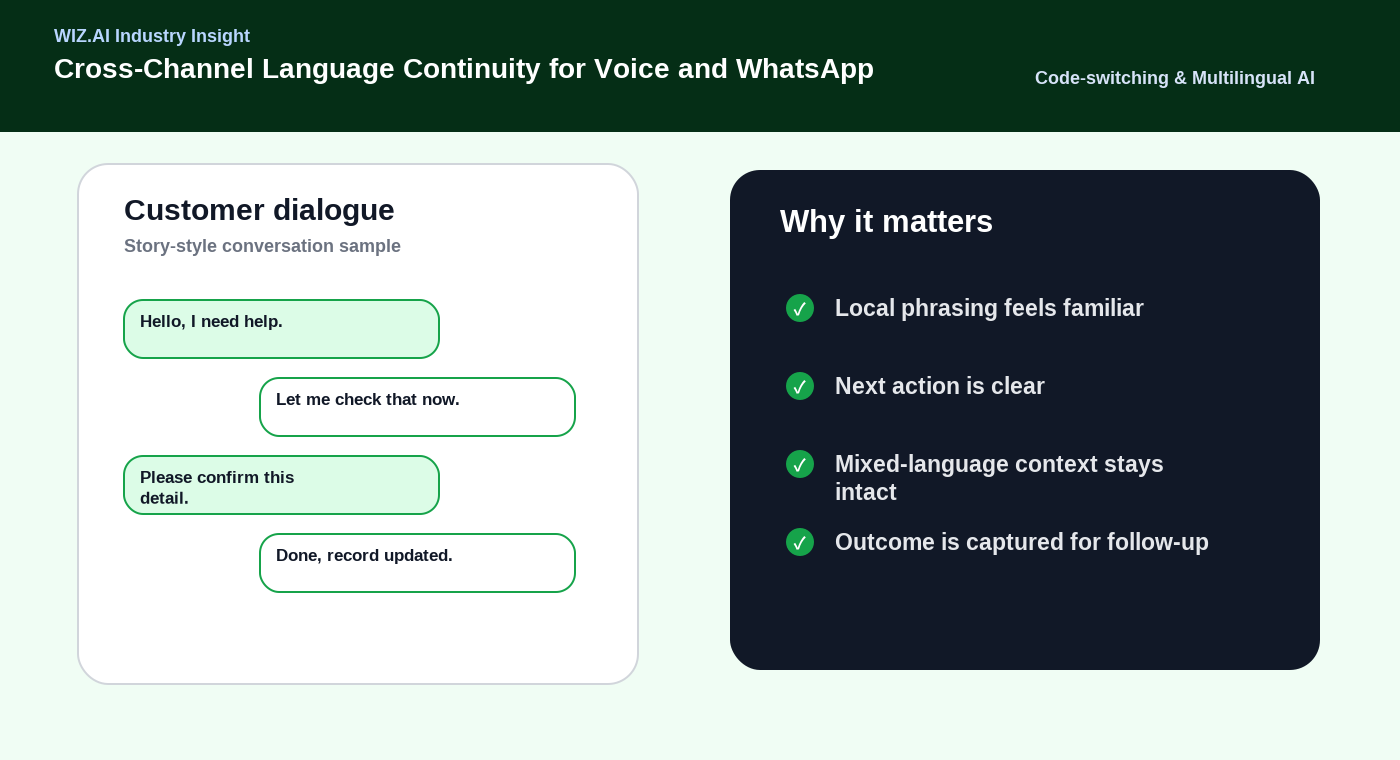
Four things. The same language: if the customer spoke Thai on the call, the follow-up is in Thai. The same mix: if they spoke Taglish, the message uses natural Taglish, not formal Tagalog or English. The same terms: product names, amounts, dates, and reference numbers match exactly what was said. The same context: the message picks up where the call left off — "Here's the payment link for the ₱1,500 we discussed, due on the 15th" — rather than starting again.
Where is the language preference stored?
In the customer profile, updated from interactions. The first time a customer clearly uses a language, record it; when they switch consistently, update it. Don't overwrite a preference based on one short reply, which may be ambiguous. Store both the primary language and, where relevant, a code-switching style, so messages can match it. Language identification explains how to detect preferences reliably.
How should messages differ from speech?
Messages are read, not heard, so they can include details that are hard to follow on a call: full reference numbers, links, addresses, step-by-step instructions. That's often why the follow-up exists. But the tone and language should match the call. Written language conventions differ slightly — written Indonesian is a bit more formal than spoken, for example — and messages should use correct spelling and diacritics, especially for Vietnamese and Thai.
How does context move between channels?
Through a shared record of the interaction: the intent, the key details captured (amounts, dates, products), the outcome, and any next step. When a customer replies to a message or calls back, the agent — AI or human — should see that record and continue, not restart. This also helps avoid asking customers to verify or explain themselves repeatedly, one of the most common complaints in multichannel service.
What about consent and privacy?
Messaging channels have their own rules. Customers must have agreed to receive messages, and business messaging platforms have their own policies on templates and opt-outs. Personal data sent in messages should be limited to what's needed. Data protection laws across the region, including Singapore's PDPA and the Philippines' Data Privacy Act, apply across channels.
Which journeys benefit most?
Collections and payment reminders, where a call is followed by a payment link. Activation and onboarding, where steps are sent in writing after a call. Delivery and appointment changes, where confirmation comes by message. Support cases, where a call starts a ticket and updates come by chat. In each, a mismatch in language or details creates confusion and extra contacts.
How should continuity be measured?
Track the share of follow-up messages sent in the customer's call language, the rate of customer replies asking for clarification after a message, repeat contacts within a few days, and completion of the next step (payment, activation, confirmation). Compare journeys with and without continuity to see the impact.
How does WIZ.AI support cross-channel continuity?
WIZ.AI agents in Wizlynn and Talkbot record language preference and call outcomes in a shared interaction record, and trigger follow-up messages on messaging channels in the same language and with the same details. Language Engine keeps terminology consistent across voice and text, and QM covers the full journey.
Customers move between channels without thinking about it. Their language should move with them. Book a demo to see a voice-to-messaging journey in your language.
Related insights