An industry corpus — speech and conversation data from real customer operations in the region — is one of the strongest foundations for local voice AI. But a corpus isn't static. The way it grows and feeds back into the system is what creates lasting advantage. This piece describes that cycle, often called a flywheel, and the safeguards that keep it responsible.
How does the flywheel work?
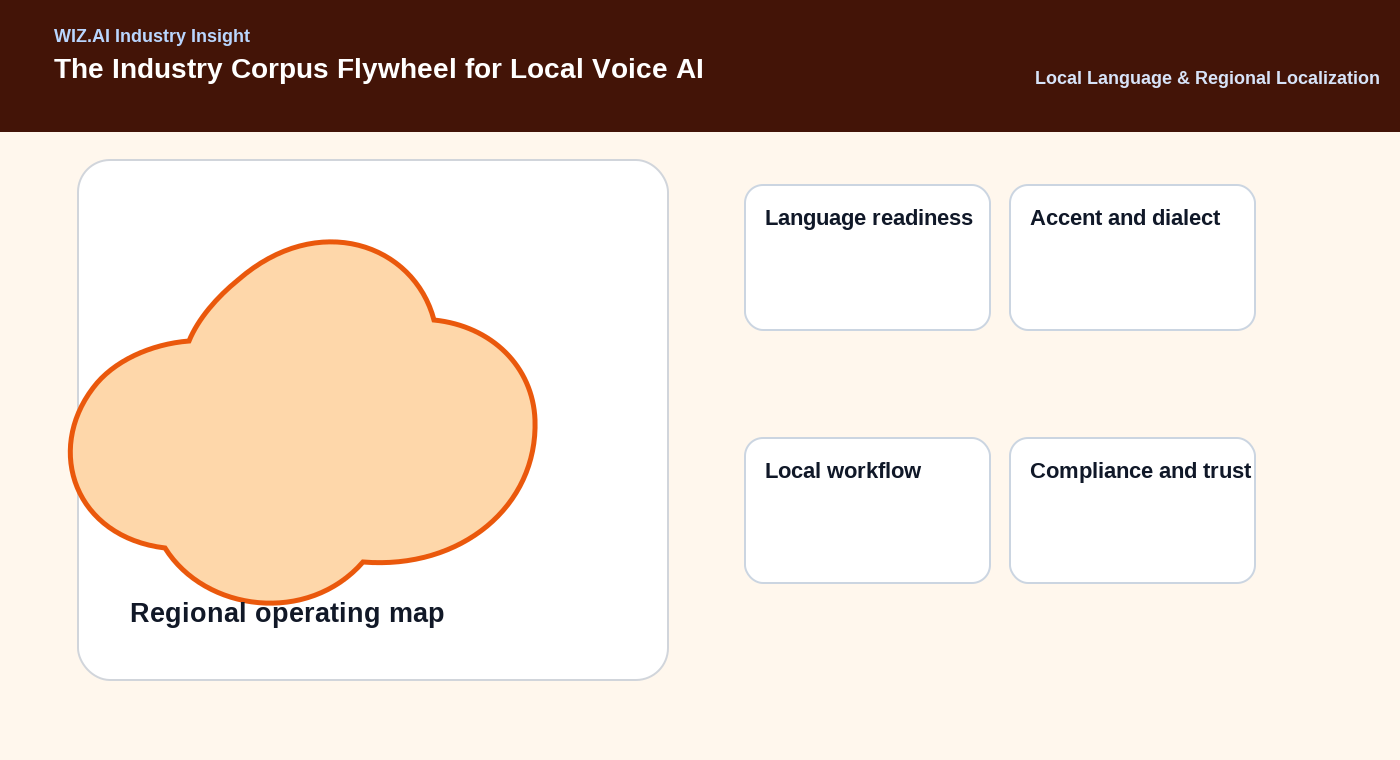
Four stages, each feeding the next. Deploy: AI agents handle customer conversations in a new industry, market, or use case. Learn: with appropriate permissions and safeguards, conversations reveal how customers speak — new accents, vocabulary, code-switching patterns, and ways of expressing intent — and where the system struggles. Improve: that knowledge improves recognition, understanding, voices, and flows. Perform: better performance produces better business outcomes, which leads to more and broader deployments — and the cycle repeats.
Which improvements come from the flywheel?
Recognition: more accurate handling of regional accents, telephone audio, and code-switched sentences. Self-supervised techniques such as wav2vec 2.0 make it possible to learn from large amounts of audio with relatively little labelled data. Vocabulary: product names, payment rails, and local terms. Understanding: how customers in each market phrase requests, refusals, and time expressions. Voices: pronunciation of names and loanwords. Flows: conversation designs that work, reused across customers in the same industry.
Why does it compound?
Because each improvement benefits every later deployment. A model that has learned Javanese-accented Indonesian from a collections deployment performs better on day one for a telecom customer with similar customers. A vocabulary of Philippine e-wallet terms learned in one deployment helps the next. The starting point for every new customer keeps rising, so deployments go faster and perform better. Low-resource ASR explains why this matters most for languages and accents generic models rarely hear.
What safeguards does the flywheel need?
Strong ones. Data must be used only as permitted by customer agreements, privacy notices, and data protection laws in each market. Personal information should be redacted before data is used for improvement. Access should be restricted and logged. Customers should be able to understand and control how their data is used. Frameworks such as the NIST AI Risk Management Framework describe the governance needed. Without these safeguards, a flywheel isn't sustainable.
How do you make sure improvements are real?
By testing every change against fixed benchmarks drawn from real calls, broken down by segment, before release — and monitoring after release. An improvement for one accent group or industry must not make another worse. Human review identifies what the data alone doesn't show. Human review loops describes this part of the cycle.
What does the flywheel mean for enterprise customers?
Better performance from the start, faster deployments, and continued improvement after launch. It also means buyers should ask vendors how their models learn, what data they're built on, and how that data is governed.
How does WIZ.AI's flywheel work?
WIZ.AI's Language Engine improves from governed customer-operations data across Southeast Asian markets and industries, with verified updates released to Wizlynn, Talkbot, and QM. Handling over 100 million AI calls a month across 300+ enterprise clients gives that cycle unusual breadth.
Local voice AI should get better every month. Book a demo to see where it stands for your market today.
Related insights
Continue the thread
References
- wav2vec 2.0: A Framework for Self-Supervised Learning of Speech Representations — Baevski et al., 2020
- AI Risk Management Framework — NIST
- ASEAN Industry Corpus Is WIZ.AI's Defensible Advantage — WIZ.AI
- Human Review Loops for AI Agent Safety — WIZ.AI
- Low-Resource ASR: Why Generic Models Struggle in Local Markets — WIZ.AI