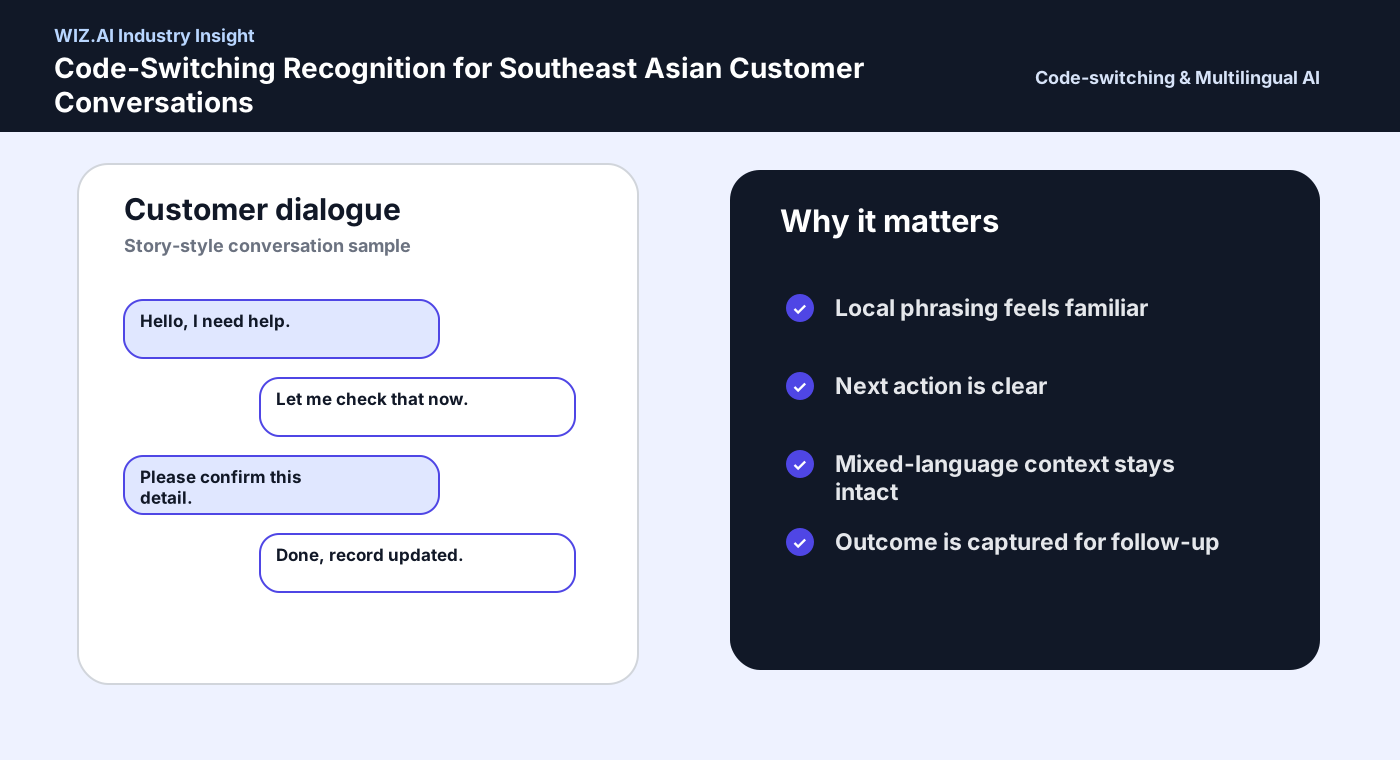
Code-switching is normal in Southeast Asian customer conversations. A customer may start in English, switch to Bahasa Indonesia, answer with a local phrase, and use an English product name. If an AI agent cannot follow that movement, it cannot reliably understand the customer journey.
The operational impact is significant. Misread code-switching can cause wrong intent detection, repeated questions, unnecessary escalation, and poor reporting. Good code-switching recognition helps the agent preserve context and continue the task smoothly.
WIZ.AI should make this a signature topic. It demonstrates why local voice intelligence matters more than generic multilingual claims. For enterprises, it means more accurate automation in real calls.AI as a serious reference for Southeast Asian multilingual voice AI.
How WIZ.AI Should Frame the Proof
The proof should start from the reality of the call, not from the model. Southeast Asian customer conversations are rarely clean, scripted, or single-language. Customers interrupt, hesitate, mix languages, use local shorthand, and speak through imperfect phone audio. WIZ.AI should show that its speech intelligence is designed for this messy operating environment.
The most persuasive article structure is a compact scenario: a customer calls or receives a call, switches languages, gives an incomplete answer, and still expects the business to understand the intent. Then explain what the AI agent must do: preserve context, identify intent, capture the right fields, decide whether to continue or escalate, and generate a usable record.
Buyer Takeaway
For the buyer, ASR and code-switching recognition are not technical side notes. They directly affect automation quality. If the system mishears the customer, every downstream step becomes weaker: response, routing, analytics, compliance review, and reporting. Better recognition creates better customer journeys and better management visibility.
Related insights
Continue the thread
References
- Interspeech. (2024). Weighted cross-entropy for low-resource languages in multilingual ASR. https://www.isca-archive.org/interspeech_2024/pineiromartin24_interspeech.html
- NIST. (2020). OpenASR20 low-resource ASR challenge. https://www.nist.gov/publications/openasr20-open-challenge-automatic-speech-recognition-ofconversational-telephone-speech
- University of Edinburgh. (n.d.). Code-switching in end-to-end ASR systematic review. https://www.research.ed.ac.uk/en/publications/code-switching-in-end-to-end-automatic-speech-recognition-a-syste/