Why does AI sovereignty matter now for Southeast Asian enterprises?
AI sovereignty matters now because frontier capability can be withdrawn by a directive issued in another country, with a 48-hour window and no path to appeal. The US export-control order restricting foreign access to Anthropic's Fable 5 and Mythos 5 landed the same week Zhipu AI open-sourced GLM 5.2 under an MIT licence — a 744-billion-parameter MoE model with a 1-million-token context window and no regional restrictions. For enterprises in Southeast Asia, supply-chain risk on intelligence stopped being a thought experiment and became a budget meeting.
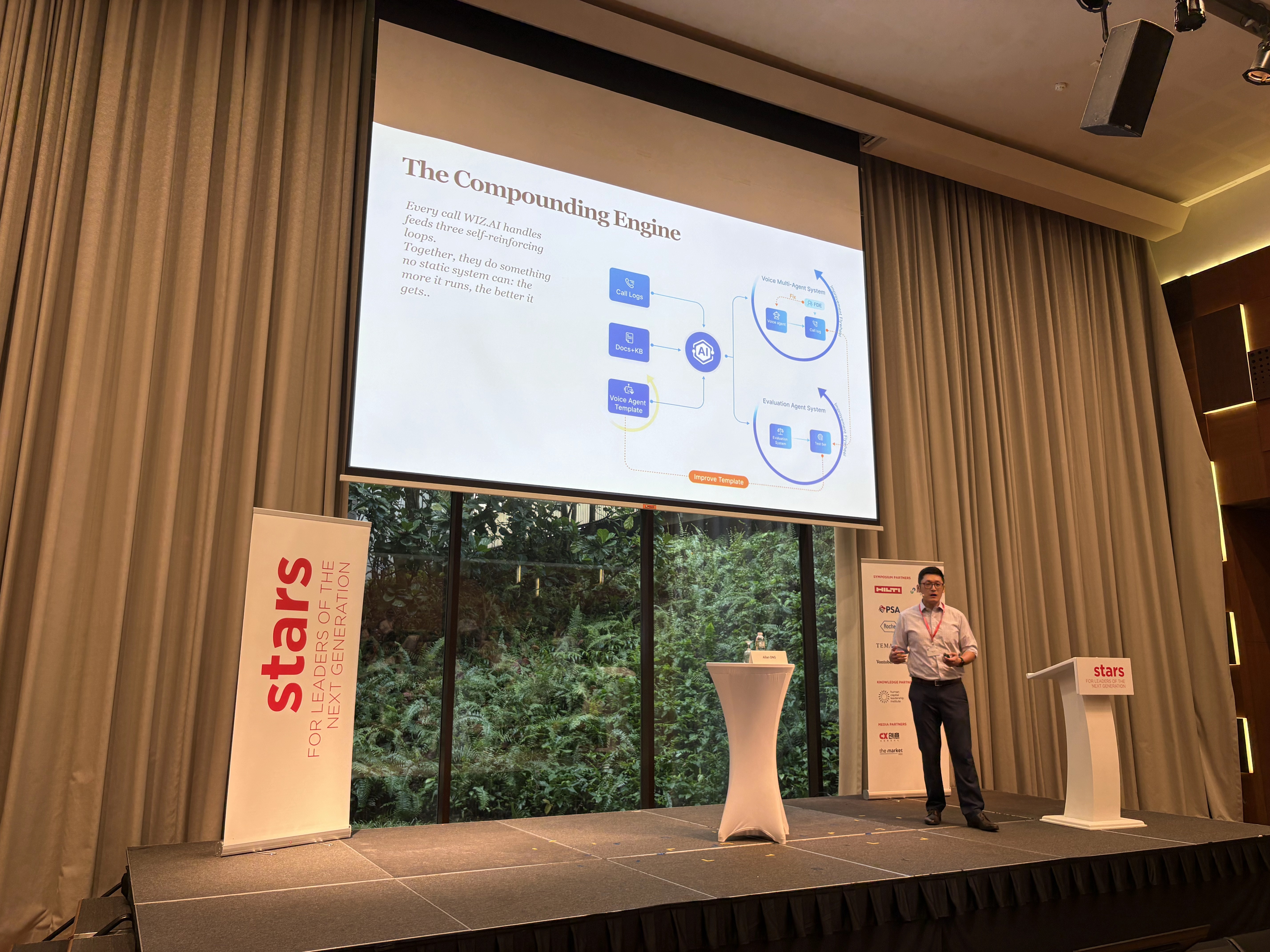
Speaking at the Stars Singapore Symposium, WIZ.AI's Head of Business Development, Allan Ong, reframed the familiar "SEA leapfrog" question:
"The more important question for SEA is independence. When your AI stack runs on infrastructure you don't control, governed by companies in jurisdictions you have no influence over, you have a business continuity risk."
The opportunity is to help enterprises build on open, sovereign foundations today. Open-weight frontier models such as GLM 5.2, combined with privately deployed in-region speech and language models, keep data and inference inside the customer's jurisdiction. However, it is worth keeping in mind that open and sovereign are not the same word. Swapping a US closed-API dependency for a Chinese open-weight model changes the shape of the dependency without eliminating it. Substantive sovereignty is decided by where weights, data, and inference actually live, and who is permitted to change the rules. The work is in the implementation.
What are the hardest problems in deploying enterprise AI at scale?
Three problems dominate enterprise AI at scale: quality, trust, and talent. Quality means getting an answer right ten million times, not once. Trust is rebuilt deployment by deployment, because enterprises buy on proof and not on promise. Talent lies at the intersection of linguistics, machine learning, and enterprise software — a narrow Venn diagram in any market, and even narrower in Southeast Asia.
"Getting it right once is easy; getting it right ten million times is the actual product. Every deployment is also a sales conversation. And the talent intersection — linguistics, ML, and enterprise software — is a very narrow Venn diagram."
For enterprise buyers evaluating conversational AI vendors, the implication is concrete. The demo is the easy part. Production scale across millions of conversations a day, across multiple languages and dialects, under audit, with the SLAs that enterprise procurement requires, is a different discipline from the proof-of-concept stage. WIZ.AI's approach to retaining the specialists who can do this work is unromantic: give them real problems, remove the bureaucracy, let them focus on the work.
How does WIZ.AI build conversational AI that works in Southeast Asian languages?
You cannot fine-tune your way to cultural fluency in Southeast Asian languages. Production-grade conversational AI for the region requires training data that reflects real local conversations — including code-switching across Bahasa Indonesia, Thai, Vietnamese, Tagalog, and regional English; the deference patterns that signal escalation; and the indirect way a customer in Surabaya signals dissatisfaction without saying the word.
"You can't fine-tune your way to cultural fluency. You need training data that reflects real SEA conversations. We've spent years building that corpus. On regulation: we treat compliance as a product feature, not a legal afterthought."
A model that scores well on English benchmarks but flattens the cultural register of a Bahasa Indonesia customer asking politely and indirectly to escalate a complaint is not a model that ships to production in this region. Each market layers its own data residency, financial compliance, and consumer protection rules on top, which is why WIZ.AI treats compliance as a product specification — built in at the architecture layer — rather than a legal review at the end. For multilingual voice AI in SEA, the moat is not the model; it is the corpus, the deployment discipline, and the years it takes to build both.
Is enterprise AI just doing existing work cheaper, or is it creating new business models?
AI is not about making the same business cheaper. It is letting actors who were previously locked out of a market compete inside it. The regional bank, the mid-sized telco, the SME in Surabaya can now operate with capabilities that used to require top-1% enterprise scale. That is a structural shift in who gets to compete, not an efficiency story.
"When e-commerce emerged, everyone thought it was just a faster catalogue. Nobody predicted entirely new economies — logistics networks, digital payments, influencer commerce, live selling."
The cost curve on intelligence has genuinely moved. The capability that used to sit behind a $50M data-science budget is now reachable through a subscription and a deployment partner. Whether that translates into the structural competitive shift depends on whether the long tail of SEA enterprises has the implementation capacity to actually wield it. Every day, WIZ.AI works inside that gap to turn frontier capability into deployed voice and conversational AI that a regional bank, insurer, or telco can put in front of customers the next morning.
How does WIZ.AI decide what to build next?
The most reliable input into WIZ.AI's product direction is what frontline operators say is keeping them up at night. Benchmarks rank models; conversations in contact centres, branches, and operations rooms decide what is actually worth building. For a company whose core product is voice AI, listening is the research method.
"Even the hyperscalers have realised AI still needs a human in the room. Not to sell — but to translate. Those conversations shape how we build more than any benchmark does."
In parallel, the team is constantly training better transcription and speech models, pushing the frontier in two directions at once: larger and more capable models where capability is the constraint, and optimised models that run on lower-end GPUs or purely on CPUs where total cost of ownership and on-premise deployability are the constraints. Both directions matter for SEA enterprise deployments, because the buyer in Jakarta and the buyer in Singapore are often solving for different problems.
What happens to workers displaced by the AI transition in Southeast Asia?
Some workers will feel the AI transition before they benefit from it. We have seen similar patterns with every general-purpose technology. The substantive policy question is whether the upskilling pipeline runs fast enough for the generation that needs it. Singapore Budget 2026 is one government's answer: a 400% tax deduction on qualifying AI spend, the Champions of AI programme, a National AI Council chaired by Prime Minister Lawrence Wong, and a 100,000-worker training target under the National AI Impact Programme.
"The brutal truth is there will be a generation of workers who feel this transition before they benefit from it. The question isn't whether the new jobs exist."
For enterprises operating in Singapore and across SEA, the policy posture matters because it sets the operating environment. A government putting public money behind workforce transformation expects enterprises to deploy AI at speed and redesign roles around it. The Enterprise Innovation Scheme, the expanded Productivity Solutions Grant, and the new AI park at one-north together signal that AI adoption is now national infrastructure. The enterprises that move first into sovereign, production-grade AI deployments are the ones positioned to benefit from that posture.
What separates production voice AI from a demo?
Voice AI is no longer a demo or an experiment. Designed with strong guardrails, measurable evaluation, and human-in-the-loop operations, it becomes real infrastructure for customer-service delivery at enterprise scale. WIZ.AI's view is that the next generation of customer engagement will be defined less by automation alone and more by reliability, scale, and continuous improvement.
"Voice AI is no longer just a demo or an experiment. When designed with strong guardrails, measurable evaluation, and human-in-the-loop operations, it becomes real infrastructure for better service delivery."
That is why WIZ.AI is reimagining voice AI for enterprise operations across APAC end-to-end: multilingual conversations across local languages and dialects, fast deployment, and AI-native operations that let enterprise teams improve every customer interaction over time. The shift from pilot to production is not a single moment of capability; it is a discipline maintained across millions of conversations.
A note of thanks to the Stars Singapore Symposium team for creating a platform for these conversations on leadership, innovation, and the future of enterprise AI.
References
Related insights