
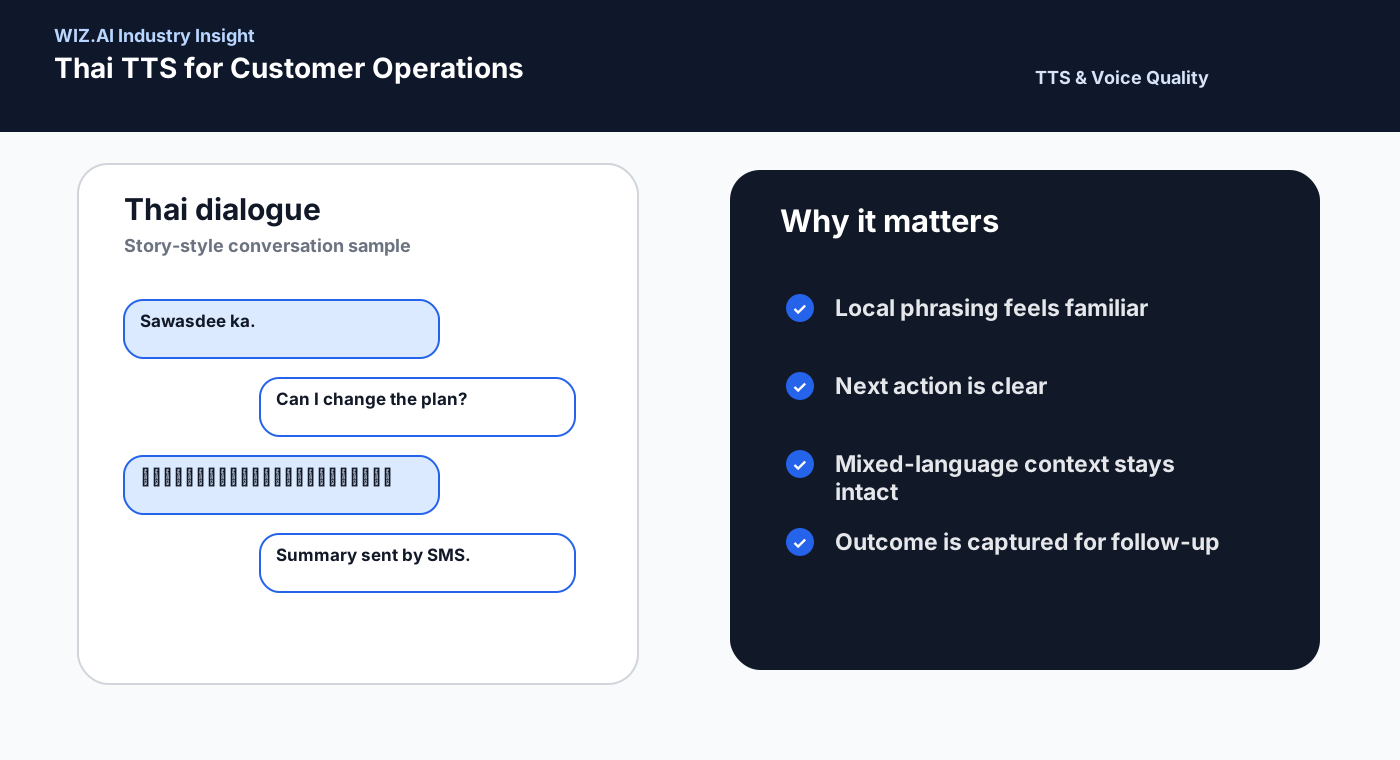
Thai customer operations often depend on tone, clarity, and politeness. When enterprises call customers about payments, renewals, account updates, promotions, or service follow-up, the voice must feel natural enough to be trusted and precise enough to move the process forward.
This makes Thai TTS a customer-experience capability, not a cosmetic feature. If the voice sounds stiff or poorly localized, customers may disengage before hearing the message. If it sounds clear and appropriate, enterprises can scale outbound communication without sacrificing brand quality.
WIZ.AI presents Thai TTS as part of a complete voice-agent workflow: script design, natural speech, intent capture, system updates, and performance measurement. The point is not just better audio. It is better customer operations at scale.
How WIZ.AI Should Frame the Proof
The article should avoid treating voice quality as a subjective preference. For enterprise buyers, TTS quality becomes measurable when it changes customer behavior. WIZ.AI connects pronunciation, pacing, tone, and localized phrasing to outcomes such as longer call engagement, clearer instruction delivery, fewer repeated calls, and more consistent brand experience.
A strong proof block would include the business scenario, the target customer segment, the language variant, and the result the voice agent is expected to create. For example, a payment reminder needs trust and precision; a customer activation call needs clarity and momentum; a service survey needs warmth and low friction. Each use case can require a different voice strategy.
Buyer Takeaway
The buyer should leave with one clear idea: localized TTS is not a nice-to-have layer after the agent is built. It is part of the agent’s ability to perform. If the voice does not match the market, the journey feels foreign. If the voice feels natural and operationally controlled, the enterprise can scale outreach without weakening customer trust.
Related insights
Continue the thread
References
- Amazon Science. (n.d.). Lightweight neural front-ends for low-resource on-device TTS. https://www.amazon.science/publications/lightweight-neural-front-ends-for-low-resource-on-device-text-to-speech
- Springer. (2021). TTS for low-resource language using cross-lingual transfer learning. https://link.springer.com/article/10.1186/s13636-021-00225-4
- Electronics. (2024). Vietnamese ASR large-scale corpus. https://www.mdpi.com/2701504