
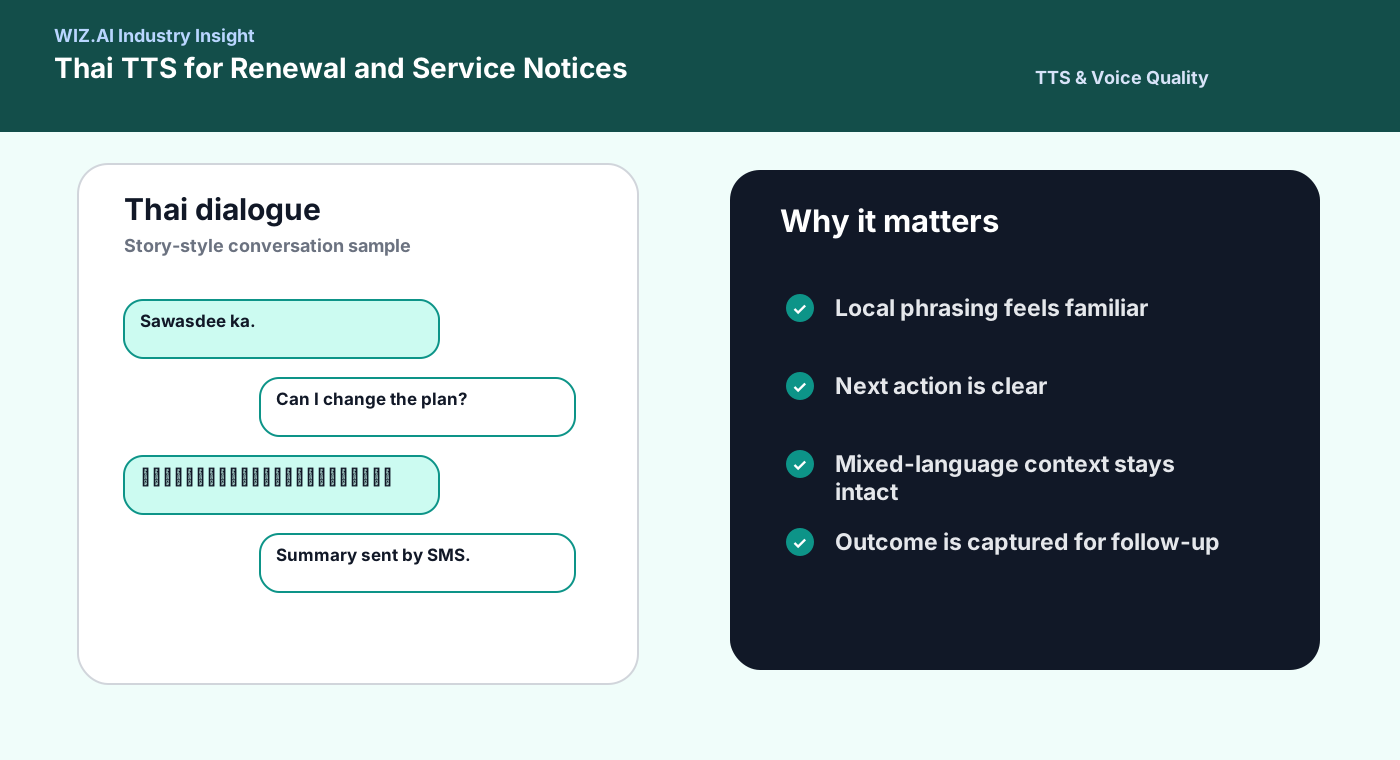
Why Does Voice Quality Matter for Renewal and Service Calls in Thailand?
Customers decide whether an outbound call is legitimate within the first few seconds, based on how the voice sounds rather than what it says. If a Thai-language voice sounds natural, accurate, and confident, customers stay on the line long enough to hear the instruction that matters: pay by this date, renew before this deadline, confirm this appointment.
A renewal reminder, a bill due date, or a service interruption notice is functional content, but it still has to be heard correctly to work. If a Thai text-to-speech (TTS) system mispronounces a customer's name, stumbles over a date, or renders a product term in an awkward, machine-like cadence, the message doesn't just sound unpolished. It becomes harder to trust and, in the worst case, harder to understand, which defeats the purpose of the call entirely. This makes TTS quality less of a technical footnote and more of a trust layer sitting between a business and its customers.
What Makes Thai Text-to-Speech Different From Generic Multilingual TTS?
Thai is a tonal, low-resource language with no spaces between words and meaning that shifts with tone, which means generic multilingual TTS models tend to handle it poorly without targeted tuning. Delivering production-grade naturalness requires deliberate investment in localized speech data, tone modeling, and regional accent handling, not a one-size-fits-all voice model.
This is consistent with a broader theme in low-resource TTS research: languages that lack the enormous training corpora available for English or Mandarin need dedicated data and tuning work to reach the point where a voice sounds native rather than translated. Treating localization as a performance capability, something that is measured, tuned, and continually improved, is what separates voice agents that scale from ones that quietly erode customer trust at volume.
How Does WIZ.AI Approach Localized Voice for Thai-Language Calls?
WIZ.AI's Talkbot platform delivers human-like, natural-sounding voice interactions across regional languages, including Thai, with dedicated attention to details like customer name pronunciation and regional accent variation. Serving enterprise clients across Southeast Asia, including Thailand, WIZ.AI consistently delivers high accuracy for Thai-language voice interactions, with many users unable to reliably distinguish its Talkbot from a human agent.
Buyers evaluating any Thai TTS vendor, WIZ.AI included, should still ask for use-case-specific samples and, where possible, pilot data, since performance can vary by industry and call type. But the underlying investment WIZ.AI has made in Thai-specific tone modeling and pronunciation accuracy is what makes that performance possible in the first place.
Does One Voice Tone Work for Every Type of Service Notice?
No. Collections reminders, healthcare appointment calls, and customer activation prompts each call for a different tone, pace, and emotional register, and using the same voice profile across all three tends to underperform on at least one of them.
- Collections reminders need clarity and a measured, respectful tone: firm enough to convey urgency without sounding aggressive, since tone missteps here can trigger complaints or non-payment out of distrust.
- Healthcare appointment calls benefit from a warmer, unhurried pace, particularly when confirming dates, times, and instructions a patient needs to retain accurately.
- Customer activation or onboarding prompts can afford a livelier, more energetic delivery, since the goal is engagement rather than compliance.
What Metrics Actually Show Whether a Thai TTS Voice Agent Is Working?
Call engagement, completion rate, repeat-call reduction, pronunciation accuracy on key terms, and customer complaint volume are the metrics that indicate real performance, not vendor claims about how "human-like" a voice sounds.
- Call engagement and completion rate: are customers staying on the line long enough to hear the full message?
- Repeat-call reduction: is the message clear enough the first time that customers do not need a follow-up call or a transfer to a human agent?
- Pronunciation accuracy on key terms: names, product names, dates, and numbers are the load-bearing details in most service notices.
- Customer feedback and complaint volume: do customers report confusion or, worse, suspicion that the call was fraudulent?
- Performance variance across use cases: a voice tuned for collections calls may need adjustment before it works for healthcare reminders.
How Should Buyers Evaluate a Thai TTS Vendor?
Buyers should evaluate Thai TTS vendors against a specific journey and a measurable outcome, not against a general naturalness score, then confirm the vendor can support production requirements like governance and human handoff.
- Identify the journey. Is this a renewal reminder, a collections call, a healthcare notice, or an activation prompt? Each has different tone and pacing requirements.
- Define the measurable outcome. Completion rate, repeat-call reduction, and complaint rate are more useful than a vendor's self-reported naturalness score.
- Validate language and workflow requirements. Confirm pronunciation handling for names, numbers, and regional accents specific to your customer base, and ask to hear samples from the actual use case rather than a demo reel.
- Check production readiness beyond the voice. Governance, such as compliance, consent, and call recording rules, along with analytics and human handoff, matters as much as voice quality itself.
A voice that fits the market is a genuine advantage: it lets a business scale outreach without the experience feeling generic or synthetic. But "fits the market" is a claim to test, not one to accept on a vendor's word. The businesses that get the most value from Thai TTS are the ones that treat it as an operational capability to be measured and iterated on, not a feature they switched on once and moved past.
Related insights