
Indonesia is not one market. It is hundreds of them, layered on top of a single national language. Bahasa Indonesia is the official language of business and government, but for tens of millions of people it is a second language, learned at school. The language they use at home, or when they are frustrated and want to be understood quickly, is Javanese, Sundanese, or another regional tongue. For a voice AI agent operating in customer operations, that gap is not a nuance. It is the difference between a call that resolves and a call that escalates.
Local language capability is one of the more defensible advantages a voice AI vendor can build in Southeast Asia, because regional customer operations are shaped by accent, politeness norms, code-switching, and channel habits that a generic multilingual model will not pick up by default. An agent can recognize the category of a request, such as a billing question or a renewal reminder, without actually understanding the caller. Local adaptation is what closes that gap in real calls, not in demos.
Why is Javanese a hard problem for voice AI in Indonesia?
Javanese is spoken by roughly 80 million people, more than most European languages, yet it remains a low-resource language in machine learning terms: there is comparatively little labeled speech and text data available to train and evaluate models on. That gap shows up directly in benchmark results, not just in theory.
A 2024 study from Bina Nusantara University benchmarked the XLS-R self-supervised speech model on Indonesian, Javanese, and Sundanese automatic speech recognition, and found that word error rates for Javanese and Sundanese were measurably higher than for Indonesian, even after fine-tuning on those languages specifically (Arisaputra et al., 2024). Accuracy improved substantially once a language model was layered on top of the acoustic model, but the underlying gap did not disappear. It was managed, not solved.
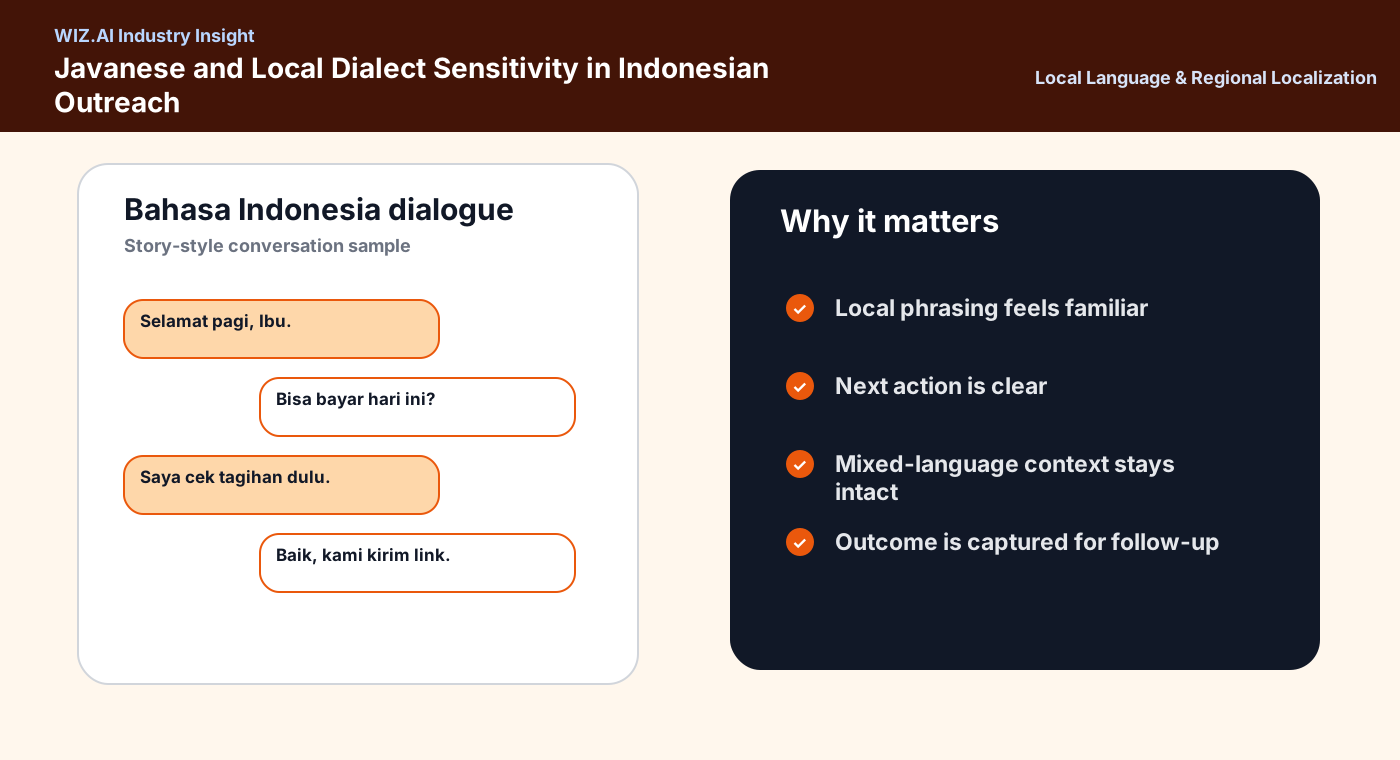
Compounding the problem is code-switching. Researchers studying Indonesia's linguistic landscape have documented how often speakers blend Indonesian with a regional language or with English in everyday and social media speech, producing informal, code-mixed language that standard NLP pipelines are not built to handle (location-based dataset research citing Aji et al., 2022). A caller in Surabaya might open in Indonesian, drop into Javanese mid-sentence to explain the actual problem, then switch back to Indonesian to close the call. An agent that only understands clean, monolingual Indonesian misfires at exactly the moment the caller reveals what they need.
None of this means local-language voice AI is unworkable. It means it is a deployment discipline, not a checkbox, and it is what separates a vendor with a demo from a vendor with a production system.
How does WIZ.AI handle Javanese and other local dialects in Indonesia?
WIZ.AI supports Indonesian processing in production environments while accommodating local languages such as Javanese and Sundanese, and treats this as more than a longer language list: it requires accumulating mixed-language and accent data so the system improves comprehensibility, controllability, and traceability across multilingual environments (WIZ.AI, Voice Agent Implementation in Southeast Asia).
That framing points to the real engineering work involved: not just adding a language tag, but building models and pipelines that hold up when a caller code-switches, uses a regional accent, or phrases a request the way people actually talk rather than the way a textbook does. WIZ.AI's Indonesian deployment history includes a large language model purpose-built for Bahasa Indonesia, a multilingual voicebot partnership with transcosmos aimed specifically at Indonesian contact centers, and production banking use cases across ASEAN spanning acquisition through collections (WIZ.AI Bahasa Indonesia coverage; transcosmos and WIZ.AI launch; WIZ.AI, Voice AI in ASEAN Banks).
For decision-makers, the takeaway is that dialect coverage should be evaluated as an ongoing data and tuning practice, not a static feature listed on a spec sheet.
How does local language support connect to real business outcomes in Indonesia?
Local language coverage only matters when it is tied to a specific customer journey and a measurable outcome, not treated as a general capability claim.
- Activation and onboarding: a new SIM or account holder in a Javanese-speaking region is more likely to complete setup if the agent understands a regional accent on the first attempt, instead of forcing a repeat or a transfer to a human agent.
- Payment reminders and collections: tone and directness carry different social weight across regions. A collections call that lands well in Jakarta may generate defensiveness elsewhere if delivered with the wrong register. WIZ.AI's collections deployments in ASEAN banking depend on natural, localized delivery to keep repayment conversations from ending in a hang-up.
- Renewal and retention: a caller explaining why they are canceling often reverts to their most comfortable language mid-conversation. If the agent cannot follow that shift, the business loses the real reason for churn, not just the customer.
- Support and survey: comprehension errors here do not just cost a single call. They generate inaccurate transcript data that pollutes analytics downstream.
What should buyers measure before trusting a vendor's dialect claims?
Claims like "9 languages supported" or "local dialect coverage" are easy to state and hard to verify from a spec sheet alone. Buyers evaluating a voice AI vendor for Indonesian operations should ask for evidence against five specific metrics.
- Completion rate: the percentage of calls resolved without human handoff, broken out by region or dialect, not just reported as a national average.
- Customer comprehension: first-attempt understanding rate, and how often the system asks callers to repeat themselves.
- Escalation reasons: specifically, how often escalations are tagged as language or comprehension failures versus genuine complexity.
- Transcript quality: whether transcripts capture code-switched speech accurately enough to support analytics, QA, and compliance review.
- Time to tune for a new market or segment: how quickly the vendor can adapt the agent to a new region, accent, or use case. This is a proxy for whether local language support is a real, ongoing capability or a one-time integration.
Buyer Takeaway
Use this as a decision lens, not a marketing checklist. Identify the customer journey being automated, define the measurable outcome that matters for it, and validate that a vendor's language and workflow claims hold up against real accents and code-switching, not just standard Bahasa Indonesia. Confirm the vendor can support governance, analytics, and human handoff once the system is live. Local dialect sensitivity is a sign that a vendor has done the unglamorous data and tuning work required to operate outside a demo. Treat it as evidence to verify, not a feature to take on faith, and corroborate vendor claims against independent benchmarks or customer references where possible.
Related insights
Continue the thread
References
- Arisaputra et al. (2024). Benchmarking XLS-R self-supervised speech models on Indonesian, Javanese, and Sundanese ASR. arxiv.org/pdf/2401.06832
- Aji et al. (2022). Research on code-mixed language in Indonesia's regional and social media speech. arxiv.org/pdf/2206.07238
- WIZ.AI. Voice Agent Implementation in Southeast Asia. wiz.ai/voice-agent-implementation-in-southeast-asia
- WIZ.AI. From Pilot to Production: Deploying Voice AI in ASEAN Banks. wiz.ai