
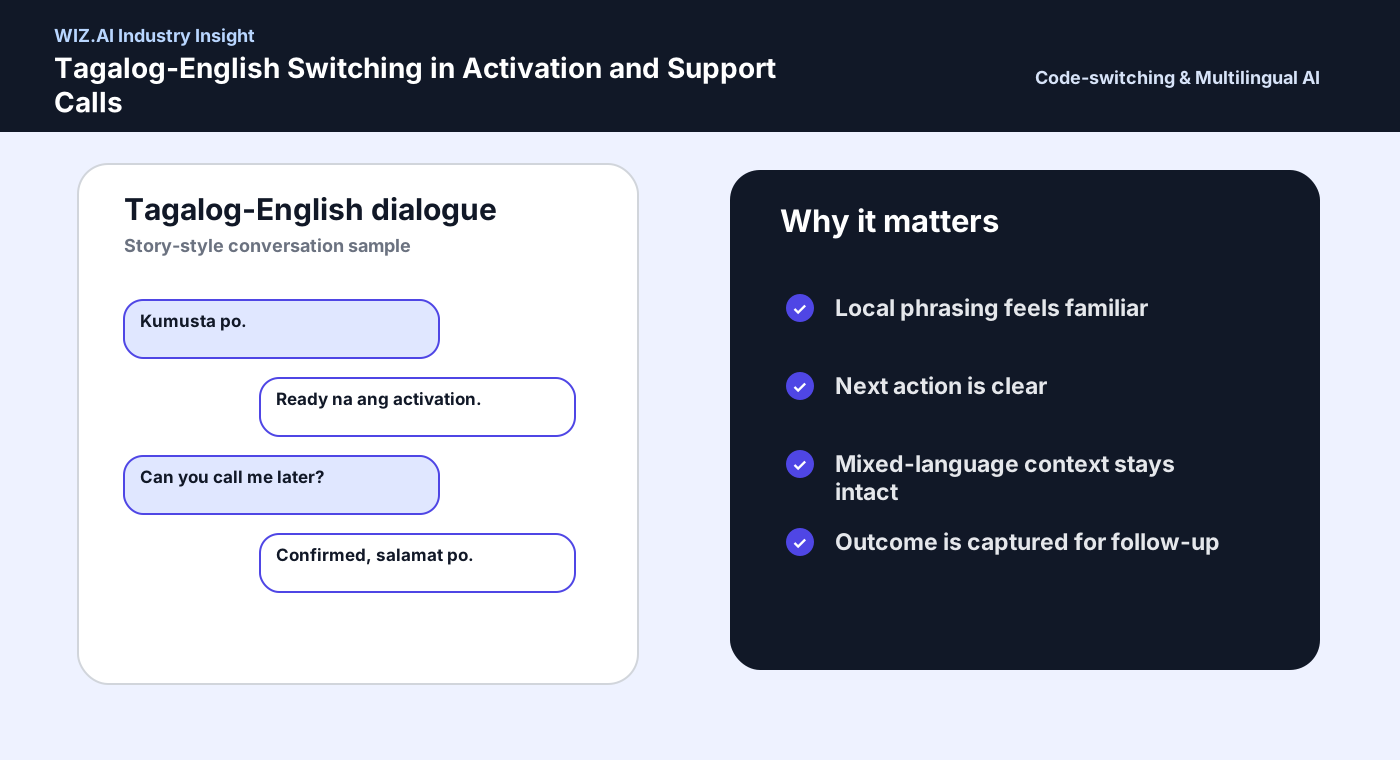
A Filipino customer calling about a delayed SIM activation rarely stays in one language for the length of the call. She might open in English, drop into Tagalog to express frustration, switch back to English for a product name, then close with a mix of both when she asks what happens next. This is not a translation problem. It is the default way tens of millions of bilingual Filipinos speak, and it is the reality any voice agent operating in the Philippines has to work inside.
Why does Tagalog-English code-switching matter for voice AI?
Code-switching, or Taglish, is normal, fluent speech behavior for Filipino callers, not a sign of confusion, and voice agents that treat it as noise will misread intent mid-sentence. Taglish is the fluid alternation between Tagalog and English within a single sentence or utterance. Linguists describe it as intra-sentential switching: language changes inside a clause or phrase, not just between separate sentences.
That distinction matters for voice AI, because a system cannot just detect a language change at sentence boundaries. It has to track meaning as the language underneath it moves mid-thought. This is precisely where most contact center voice systems fail. A voice agent built primarily for monolingual recognition treats a code-switched utterance as noise: it may transcribe the English fragments cleanly, garble the Tagalog, and lose the connective tissue that ties the sentence into one coherent intent. The result is an agent that hears words but misses what the customer actually wants.
What does the research say about code-switching speech recognition?
Published research across multiple language pairs shows that standard speech recognition models lose significant accuracy on code-switched speech, with word error rates rising by roughly 40 percent compared to monolingual audio. A 2025 study introducing the HiACC Hindi-English corpus, published in Data in Brief (Singh, Singh and Kadyan, ScienceDirect and PMC), found that baseline ASR systems trained on monolingual data degraded by roughly 42 percent in word error rate on code-switched Hinglish test data compared to clean monolingual audio.
A separate paper evaluating a Sepedi-English code-switched system, by Phaladi and Modipa of the University of Limpopo (arXiv:2403.07947), reported a word error rate of 41.9 percent, with particular difficulty on single-language stretches embedded inside a mixed-language call. Research on Mandarin-English code-switching, including work on the SEAME corpus for Southeast Asian Mandarin-English speech (arXiv:2112.10202), describes the same underlying problem: systems built by simply merging two monolingual models rarely produce optimal results, because they lack training examples of the actual within-utterance switching that real speakers do.
Dedicated, peer-reviewed research specifically on Filipino-English speech recognition is thinner than for these other language pairs. It is a comparatively under-resourced research area, which is itself part of the point. The cross-language pattern documented above is the more defensible basis for expecting the same difficulty to hold for Taglish: code-switching degrades recognition quality broadly across language pairs where it has been rigorously studied, and there is no structural reason Tagalog-English would be an exception. That said, claims about Taglish-specific performance should lean on a vendor's own production data rather than on published academic benchmarks, which do not yet exist at the same depth for this language pair.
The throughline across this research is simple: recognizing two languages is not the same as recognizing the switch between them. A system can technically support both English and Tagalog and still fail the moment a customer uses both in the same breath.
Why does code-switching matter specifically in activation and support calls?
Activation and support conversations are dense with exactly the kind of content that gets lost in a bad code-switch handoff: product names, confirmation codes, urgency signals, and scheduling details that shift language mid-sentence.
- Product and plan names are usually kept in English even in an otherwise Tagalog-heavy sentence.
- Numbers, dates, and confirmation codes, including account numbers, OTPs, and billing amounts, often get spoken in English regardless of surrounding language.
- Emotional and urgency markers ("Ay, matagal na 'to," "Sobrang late na ng activation ko") tend to surface in Tagalog, and are often the clearest signal that a call needs escalation.
- Timing and scheduling requests slide between "bukas ng umaga" and "tomorrow morning," depending on the speaker.
If an agent's language model treats each of these as isolated fragments instead of a single intent thread, it can capture the words while missing the ask: confirming a plan name correctly but missing that the customer is angry, or capturing an account number while dropping the actual complaint that came before it.
How does WIZ.AI approach Tagalog-English code-switching?
WIZ.AI, a Singapore-headquartered voice AI company built for Southeast Asian markets, positions mixed-language handling as a design problem rather than a language-coverage checkbox. According to the company's public materials, its Philippine deployments are built to handle English-Tagalog code-switching patterns, with the stated goal of moving beyond simple language lists toward natural, controllable, and auditable mixed-language conversations.
That framing, auditable and controllable conversations rather than just multi-language coverage, is the more demanding bar, and it is the right one for regulated or high-stakes call types like billing and collections. WIZ.AI's broader materials on regional deployment make a similar point about the region as a whole: Southeast Asian callers naturally mix languages, and the company describes its localization work as going beyond simply expanding a list of supported languages. Instead, it requires accumulating mixed-language and accent data so systems can improve comprehensibility, controllability, and traceability in production.
The company also notes that in domains like healthcare, finance, and insurance, an incorrect response carries real cost, and unlike a text channel, a caller cannot scroll back to re-read what an agent said, which is why validation has to happen before a call goes live rather than after the fact. This lines up with what the ASR literature shows: generic multilingual coverage and true code-switch continuity are different engineering problems, and only the second one holds up on calls where a misread word changes an account balance or a promised callback time.
What should buyers look for in a Taglish-capable voice agent?
"Supports Tagalog and English" is not a sufficient claim. Buyers should probe intra-utterance handling specifically, since that is where most systems actually fail.
- Can the agent correctly capture an entity, such as an amount, date, or plan name, when the sentence around it switches languages mid-clause?
- Does the transcript stay coherent for a human QA reviewer, or does it fragment into disconnected phrases per language?
- Does escalation logic trigger correctly when urgency or frustration is expressed in Tagalog while the rest of the call is in English?
- Does the system need the customer to repeat themselves more often when they code-switch than when they do not?
Which metrics actually measure code-switching performance?
Standard ASR accuracy or generic language-support claims do not capture whether an agent can hold a real Taglish conversation together. Six metrics do a better job:
- Mixed-language intent accuracy: whether the system extracts the correct customer intent from an utterance that spans both languages, not just from clean monolingual segments.
- Language identification accuracy: how reliably the system detects which language is being spoken at each point in a fast-switching utterance, including short intra-sentential switches.
- Entity capture across both languages: whether account numbers, dates, amounts, and product names are captured correctly regardless of which language surrounds them.
- Repeat-question rate: how often the agent has to ask the customer to repeat themselves, a strong proxy for silent comprehension failures during code-switches.
- Escalation accuracy: whether frustration, urgency, or complexity signals, which frequently surface in the customer's first or "home" language, correctly trigger a handoff to a human agent.
- QA readability: whether the resulting transcript is coherent enough for a human reviewer or compliance auditor to follow, rather than reading as two interleaved, disconnected language streams.
How should buyers evaluate a Taglish voice AI vendor?
Use this as a decision lens rather than a marketing claim to accept at face value: identify the journey, define the measurable outcome, validate language and workflow requirements together, and confirm governance and human handoff before signing.
- Identify the journey. Activation, billing, collections, and service recovery each carry different risk profiles when a code-switch is mishandled. Know which one you are evaluating for.
- Define the measurable outcome. Decide upfront which metric above (intent accuracy, entity capture, escalation accuracy, repeat-question rate) matters most for that journey, and ask vendors to report on it specifically, not on generic language-coverage claims.
- Validate language and workflow requirements together. A vendor should be able to show mixed-language performance on your actual call types, not just isolated language-pair demos.
- Check governance, analytics, and human handoff. Confirm the platform gives you an auditable transcript, escalation logic that can be tuned to your risk tolerance, and clear visibility into where and why the agent hands off to a human.
Multilingual support is table stakes. What separates a workable deployment from a fragile one is whether the system holds meaning together across the switch, call after call, not just in the demo.
Related insights