
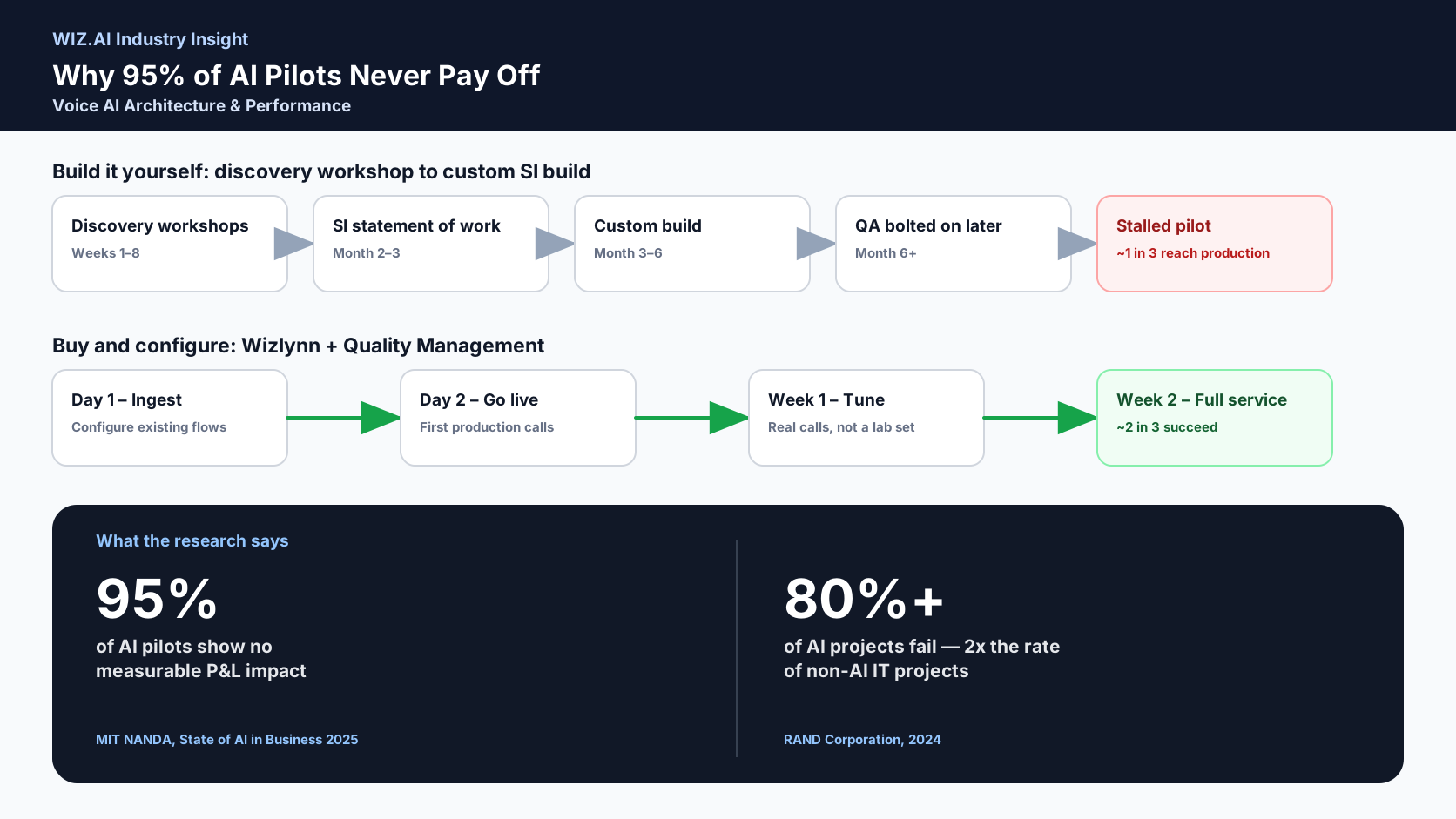
Two research teams asked the same question — why do so many enterprise AI projects fail to pay off — and landed on the same answer eighteen months apart, using different methods and different data. MIT's Project NANDA found that 95% of generative AI pilots show no measurable P&L impact despite $30–40 billion in enterprise spending. RAND found that more than 80% of AI projects fail outright, twice the failure rate of ordinary IT projects. Neither study is about voice AI specifically. Both are directly relevant to anyone about to greenlight it.
This series has already covered the checklist for launching inbound voice AI fast — Day 1 to Week 2 — and why governance can't be bolted on after the demo. This article is about why that checklist matters more than a feature comparison: the research says the deployment model, not the AI model, is what decides whether a pilot survives contact with production.
What does MIT's research actually say about why AI pilots fail?
MIT's Project NANDA found that the deciding factor isn't which AI model an enterprise chose, but how the project was deployed: pilots built on purchased, vendor-configured tools succeeded roughly 67% of the time, while internally built pilots succeeded at about a third of that rate. Only 5% of pilots studied were extracting measurable value; the rest sat stuck with no P&L impact, regardless of how capable the underlying model was.
That's the "GenAI Divide" the report is named for: not a gap between good and bad AI, but a gap between AI that was configured against a real workflow and AI that was built as a standalone project and never fully integrated into one.
Why do AI projects fail twice as often as ordinary IT projects, according to RAND?
RAND's researchers interviewed working data scientists and ML engineers and traced AI project failure back to organizational and leadership factors, not technical limitations with the models themselves. A project can have a perfectly capable model underneath it and still fail if the rollout has no clear owner, no dated milestones, and no plan for what happens once the pilot needs to become a production system.
That finding lines up with MIT's: the failure mode isn't the technology. It's a deployment that never had a firm shape to begin with.
Is voice AI more exposed to this pattern, or less?
Voice AI is exposed to exactly the same pattern, because the category has largely been sold as a custom build: a forward-deployed engineering team scoping the use case, building bespoke flows, and wiring up QA and compliance as separate workstreams during onboarding. Publicly documented deployment timelines across the category run from weeks to nine months, which is exactly the shape of MIT's lower-success "internal build" category, even when the vendor is doing the building on the customer's behalf.
The buy-and-configure alternative looks different: an agent configured against existing call flows and knowledge sources instead of rebuilt from scratch, with QA and compliance shipped as part of the platform rather than added later. That's the deployment shape MIT's data associates with the higher success rate — and it's the shape Wizlynn is built around.
How does a Day 2 go-live change which side of the divide you land on?
A Day 1 to Week 2 rollout directly addresses the two failure modes both studies point to. RAND flags unclear ownership and undefined milestones as a leading cause of failure; a dated checklist — Day 1 ingest, Day 2 go-live, QA from the first call, Week 2 full service — replaces "we're piloting AI" with specific, falsifiable commitments a team can be held to. MIT's divide is about integration into a real workflow versus a standalone project; configuring an agent against existing flows on Day 1, instead of redesigning the business around a new platform, is integration by construction, not an afterthought.
Speed isn't the point on its own. A fast rollout with no QA coverage just fails faster. What moves a pilot to the successful side of both studies is going live quickly and having Quality Management scoring 100% of calls from day one — so the deployment is both dated and measured from the start, not just dated.
What should you ask before committing budget to another AI pilot?
Ask whether this is a buy-and-configure deployment or a custom build, since that single choice tracks with roughly a 2x difference in success rate in MIT's data. Ask for a specific, dated milestone plan rather than a directional estimate. Ask when QA and compliance coverage starts — on day one, or as a separate project added once volume justifies it. And ask who is accountable if the go-live date slips.
A vendor that answers all four with specifics is describing a deployment. A vendor that answers with "typically a few months" is describing the pattern MIT and RAND both just measured failing 80–95% of the time.
See the buy-and-configure path in detail on the Wizlynn and Quality Management product pages, or book a demo to map a Day 1 to Week 2 timeline against your own call flows.
References
Related insights