
Most enterprise voice AI programs don't fail because the technology can't hold a conversation. They fail because "deployment" quietly turns into a transformation program: months of discovery workshops, a systems-integrator statement of work, and a go-live date that keeps sliding a quarter at a time. By the time the agent takes its first real call, the business case that justified the project has usually changed.
None of that is necessary to prove voice AI works. This is the deployment checklist for launching inbound voice AI fast, with quality management built in from call one, not bolted on after a slow rollout.
Why do enterprise voice AI rollouts usually take months instead of weeks?
Enterprise voice AI rollouts usually take months because platforms treat compliance, QA, and language support as separate integration workstreams stitched together during onboarding, rather than shipping them as one system the agent runs on from day one.
That's the pattern across much of the category: a forward-deployed engineering team scopes the use case, builds custom flows, wires up QA tooling as a second project, and only then starts testing against real calls. Publicly documented timelines across the category bear this out, running from 4 weeks to 9 months depending on vendor and deployment complexity. Each step is reasonable on its own. Stacked together, they turn a pilot into a transformation cycle, and a transformation cycle is exactly what most buyers are trying to avoid when they ask for "fast to deploy" in the first place.
What does a fast, low-risk voice AI deployment actually require?
A fast, low-risk deployment requires three things running together from the start: a conversation engine that can be configured against existing flows instead of rebuilt from scratch, quality monitoring that covers every call from day one instead of a sampled subset added later, and a go-live date the vendor will commit to in writing.
Strip those three out and speed becomes a marketing claim instead of a plan. Keep them together, and going live in days rather than months stops being a best-case story and becomes the standard rollout.
What does a Day 1 to Week 2 deployment checklist look like?
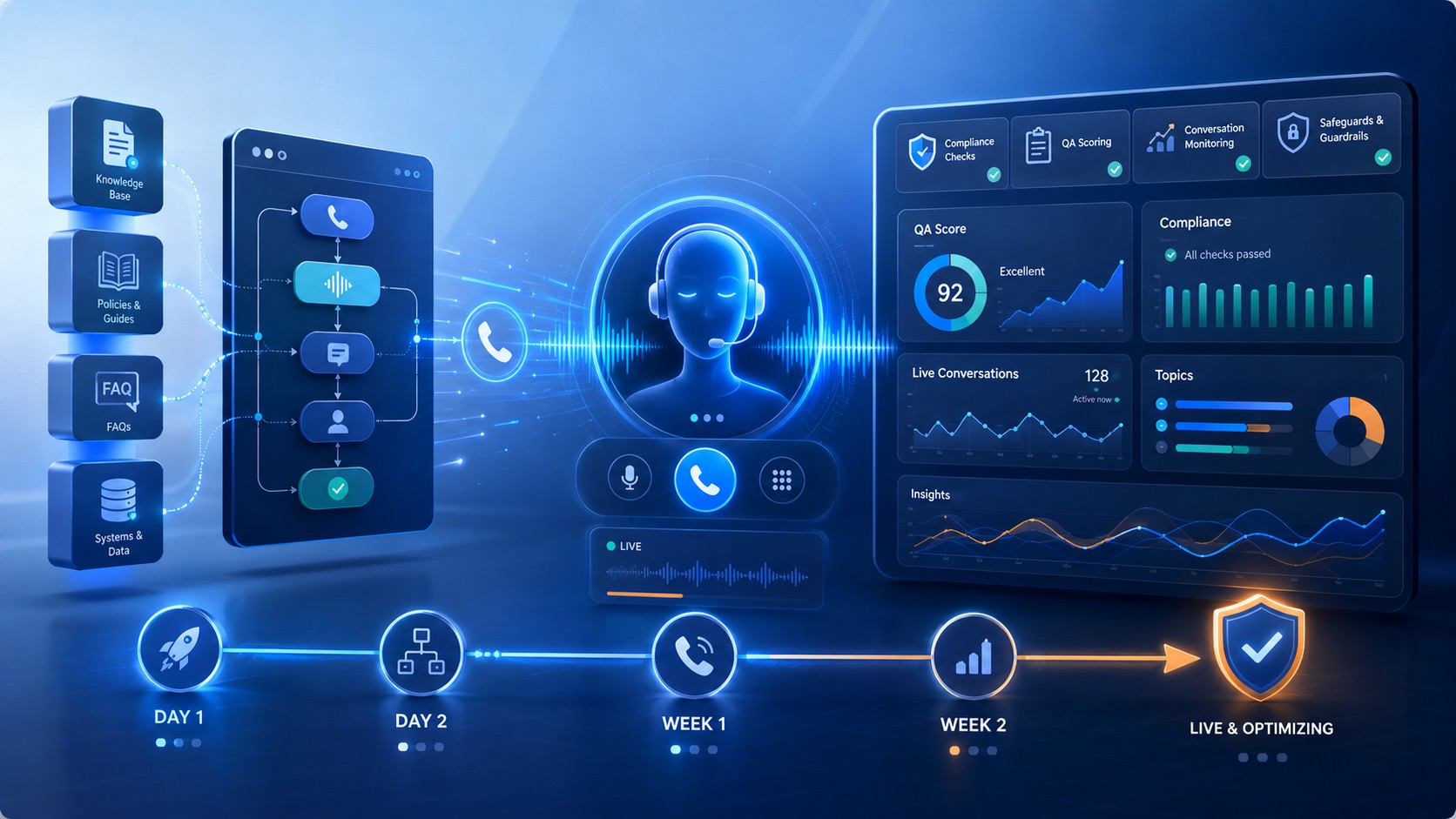
A realistic inbound voice AI deployment checklist has four checkpoints: data and flow setup on Day 1, first production calls on Day 2, full QA coverage running from the first live call, and complete service by Week 2.
- Day 1 — Ingest and configure: connect existing call flows, FAQs, and knowledge sources; configure the agent against your current process instead of redesigning it around the platform.
- Day 2 — Go live: the agent takes its first production conversations. This is Wizlynn's standard go-live milestone, not a best-case pilot outcome.
- Day 2 onward — QA from the first call: Quality Management scores 100% of conversations against your QA scorecard from day one, not a sampled subset added once volume justifies it.
- Week 1 — Tune against real conversations: flag sensitive-word misses, must-say gaps, and compliance risks from actual calls, not a lab test set.
- Week 2 — Full service: all flows live, the team trained, and continuous improvement running on real usage data.
If a vendor can't map your rollout onto a checklist this specific, treat "fast to deploy" as a claim to verify, not a fact to plan around.
How does Quality Management make a Day 2 go-live safe instead of risky?
Quality Management makes an early go-live safe by scoring every conversation against sensitive words, must-say requirements, and compliance flags from the first call, so problems surface inside a one-hour monitoring window instead of showing up in a customer complaint or an audit weeks later.
That's the part fast deployments usually skip. Going live quickly without full-call QA just moves the risk downstream — you find out what the agent got wrong from a complaint instead of a compliance flag. Running Wizlynn and Quality Management together closes that gap: 100% QA coverage starts on the same day production calls do, so speed and safety move on the same timeline instead of trading off against each other.
What should be true by Week 2 of a voice AI deployment?
By Week 2, all production flows should be live, the operations team should be trained on the monitoring dashboard, and the AI-Ops loop, where every call is judged and every change is verified before it ships, should already be running on real conversations rather than a staged test set.
That's the difference between a pilot that proves a concept and a deployment that's actually in production: a pilot ends with a debrief; a Week 2 full-service rollout ends with the agent already handling volume, already being measured, and already improving.
What should you ask a vendor before trusting a "fast to deploy" claim?
Ask for a specific, dated milestone plan (what happens on Day 1, Day 2, and Week 2), ask whether QA coverage starts on day one or gets added later as a separate project, and ask who is accountable if the go-live date slips.
A vendor that answers all three with specifics is describing a deployment. A vendor that answers with "typically a few weeks" is describing a hope. WIZ.AI publishes the former as its standard timeline across 300+ enterprise clients in 17 countries, handling 100M+ AI calls monthly, not as a case-study best case.
See the Day 1 to Week 2 rollout in detail on the Wizlynn and Quality Management product pages, or book a demo to map it against your own call flows.
References
- Wizlynn: Fast to Deploy (Day 2 go-live, Week 2 full service) — WIZ.AI
- Quality Management: 100% QA coverage and one-hour monitoring — WIZ.AI
- 300+ enterprise clients across 17 countries, 100M+ AI calls monthly — WIZ.AI
- Published agentic voice AI deployment timelines by vendor (Sierra, PolyAI, Parloa, Kore.ai, Yellow.ai) — WIZ.AI
Related insights