
On July 27, 2026, the EU's Digital Omnibus on AI took effect, pushing the AI Act's continuous-monitoring mandate for high-risk AI systems back from August 2026 to December 2027. That's a deadline moving, not the underlying problem going away. Gravitee's State of AI Agent Security Report 2026 found enterprise AI agent monitoring coverage stuck at roughly 52%, barely up from 47% in December, even as the number of agents running in enterprise production roughly doubled over the same stretch. A companion survey found 88% of enterprises had an AI agent security incident in the past year — while confidence in agent oversight rose nine points in the same window that actual monitoring coverage barely moved.
None of that is about voice AI specifically, and none of it is about the initial rollout — it's about what happens once an agent is already live. This series has covered the checklist for launching inbound voice AI fast — Day 1 to Week 2 — and why deployment shape, not model quality, decides whether a pilot survives contact with production. The open question underneath both, and the one regulators just gave companies more runway on: once an agent is live, how do you keep changing it without either freezing it in place or shipping an untested update straight to a live customer call?
What happens to a voice AI agent after Week 2 full service?
After Week 2, the agent is handling live volume and the deployment project is technically done, but the business keeps changing underneath it: new promotions, new policies, new edge cases surfacing from real calls that never showed up in testing. Every one of those is a change request, and how a vendor handles change requests after launch matters as much as how fast they got to launch in the first place.
Some platforms route every post-launch change back through the same review process used for the original build. That's the quiet failure mode: the deployment was fast, but the agent stops moving at the same speed as the business the moment it goes live.
What is the AI-Ops loop, and why does "fast to deploy" depend on it?
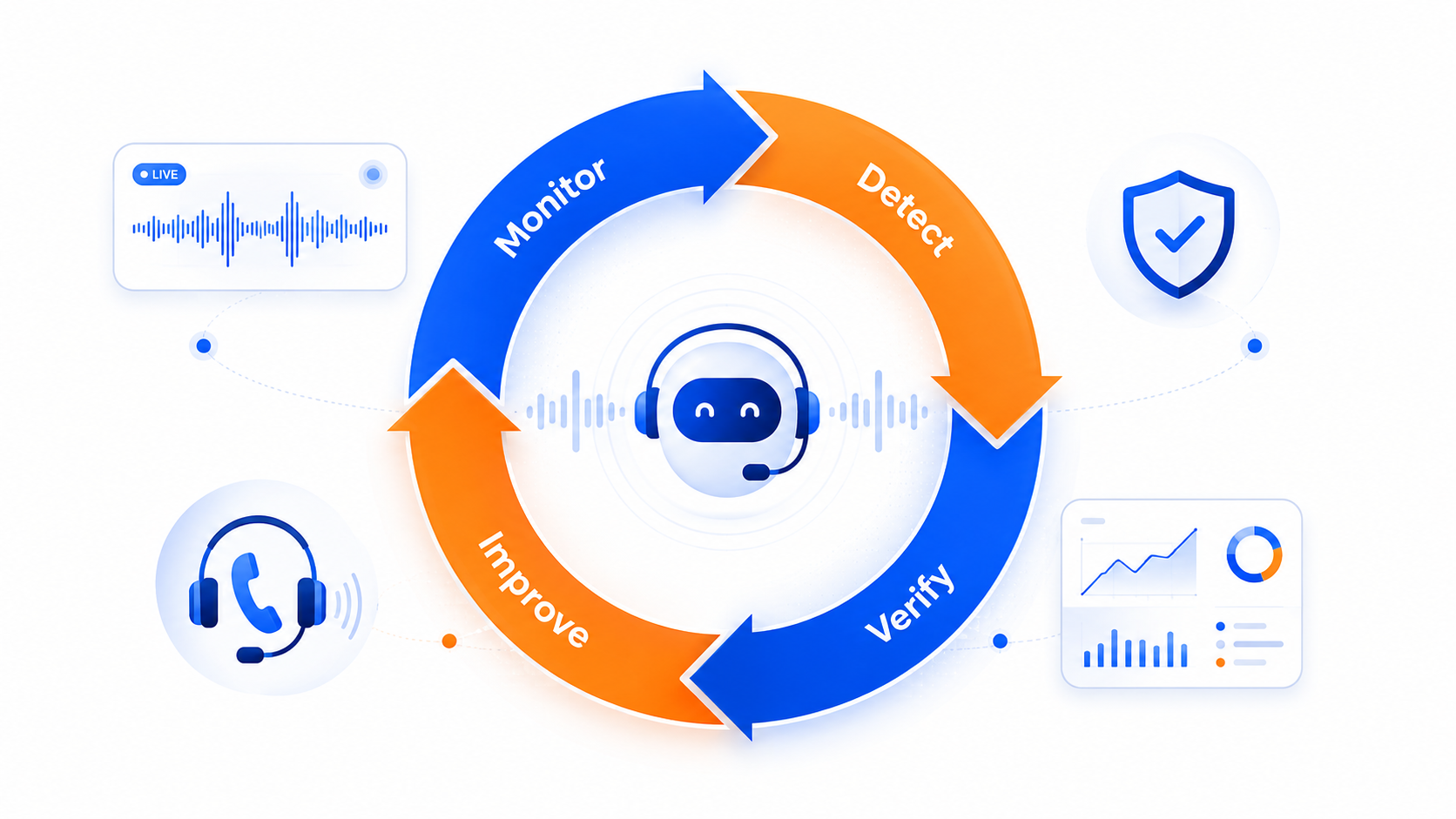
The AI-Ops loop is the four-stage cycle Wizlynn runs continuously after go-live: Monitor every call, Detect edge cases from real conversations, Verify the fix or update at scale, then ship the Improvement back into production. It's what turns "fast to deploy" from a one-time event into a standing property of the deployment.
Without a loop like this, speed and safety trade off after launch the same way they do before it: you either freeze the agent to keep it safe, or you change it quickly and accept the risk of an untested update reaching a live customer call.
How does WIZ.AI detect an edge case before it becomes a customer complaint?
Every call is judged by AI as it happens, not sampled after the fact. When a conversation surfaces something the agent didn't handle well, that gets flagged as an edge case and converted into a targeted upgrade, the same day-to-day mechanism Quality Management uses to catch sensitive-word misses and compliance risks from Day 2 onward.
That's the difference between finding a gap from a real conversation and finding it from a customer complaint or an audit weeks later. Detection has to happen at the same pace as the calls themselves, or edge cases just pile up unnoticed.
What does it mean for a change to be "verified" before it ships?
A verified update means the fix or new flow is tested at AI scale against real conversation patterns before it reaches a live call, so an improvement doesn't quietly create a new failure somewhere else in the flow. That's what separates a verified update from a hotfix: a hotfix solves the problem you just saw; a verified update is checked against everything the agent already handles correctly, so fixing today's edge case doesn't break yesterday's.
This is the same discipline as the Day 2 go-live checklist, applied continuously instead of once. Going live fast without full QA coverage just moves risk downstream to the first complaint; shipping updates fast without verification does the same thing, one release at a time.
Why does an unverified update put a live contact center at risk?
An unverified update risks breaking a flow that already works in production, and unlike a staging environment, a live contact center has no buffer between a bad release and a real customer hearing it. A platform that can deploy fast but can't verify changes fast just shifts where the risk sits, from the initial rollout to every update after it.
Running the AI-Ops loop keeps that risk in the same place a Day 2 go-live keeps it during launch: caught before a customer is on the call, not after.
What should you ask a vendor about how they handle change after go-live?
Ask how long it takes to ship a script or flow change once the agent is live, ask whether updates are tested against existing flows before release or pushed directly to production, and ask whether edge cases are detected from real calls automatically or only when someone reports one.
A vendor that describes a continuous, verified loop is describing an agent built to keep up with the business. A vendor that describes updates as "another change request" is describing the same slow cycle a fast deployment was supposed to replace.
See how the AI-Ops loop runs on the Wizlynn and Quality Management product pages, or book a demo to see how quickly a change moves from your team to a verified, live call.
References
- State of AI Agent Security Report 2026 — Gravitee
- 88% of enterprises reported AI agent security incidents last year — VentureBeat
- EU Digital Omnibus on AI: high-risk monitoring deadline deferred to December 2027
- Wizlynn: AI-Ops Ready for continuous improvement — WIZ.AI
- Quality Management: 100% QA coverage and one-hour monitoring — WIZ.AI
- Fast to Deploy: Day 1 to Week 2 rollout checklist — WIZ.AI
- Why 95% of AI Pilots Never Pay Off — and What Changes the Odds — WIZ.AI
Related insights