
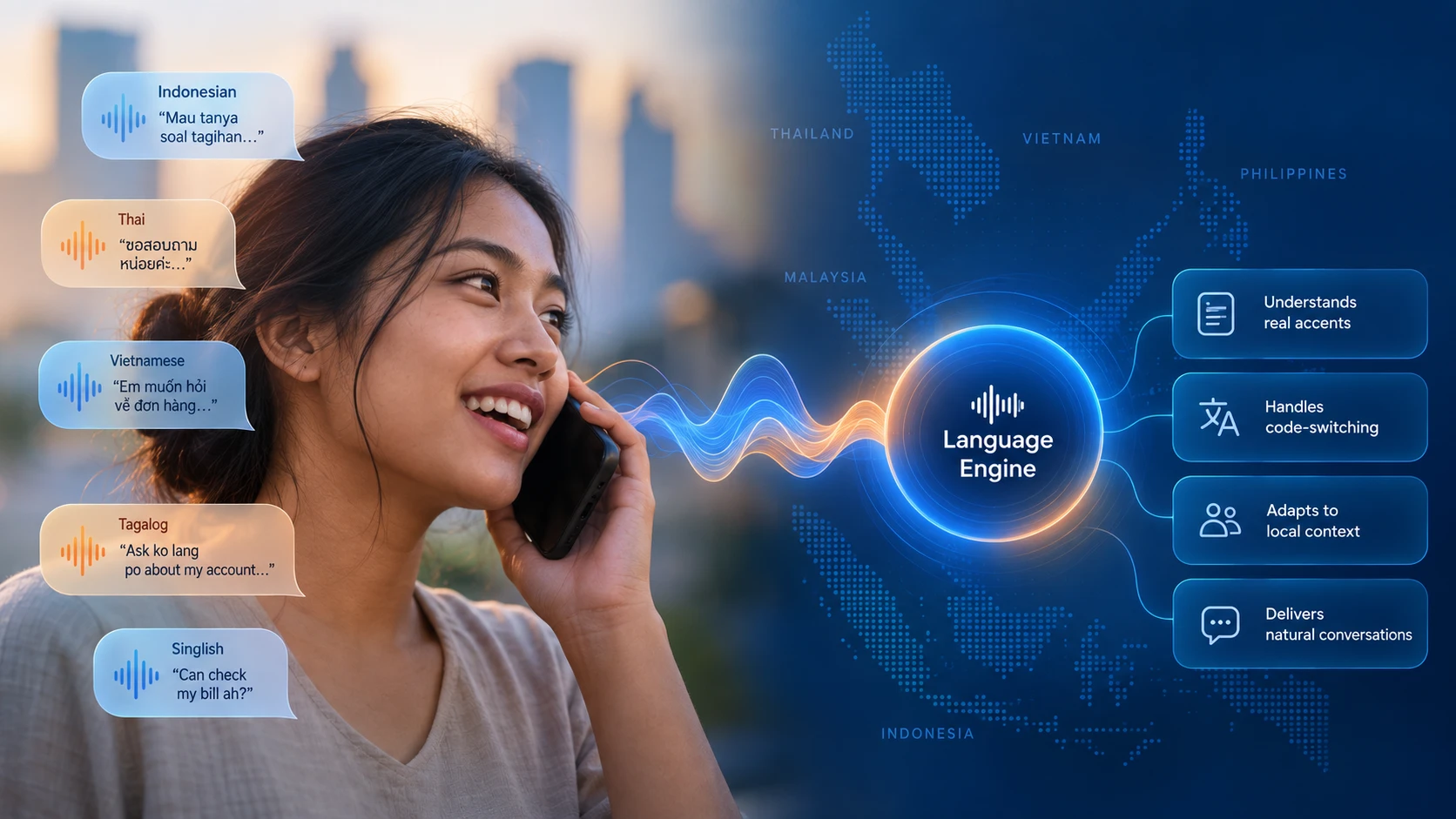
The opening piece in this series named four things coverage misses: accent, code-switching, register, and context. The second piece took code-switching apart, and the third did the same for register. This one goes back to the one that comes first on every call, before any of the others are even relevant: can the agent understand the customer at all? The context piece takes on the fourth: whether the agent understood what the customer actually meant.
Why does accent deserve its own piece instead of being folded into "coverage"?
Because "the system supports Vietnamese" and "the system understands this Vietnamese caller" are different claims, and vendors are tested on the first one. A demo is almost always run against a clear, unaccented, low-noise recording — often read from a script by someone whose speech is close to whatever variety the model was trained on. A real call is a customer speaking their own way, on their own phone, in their own environment. Accent is the gap between those two conditions, and it's the first gap a customer hits — before they ever code-switch or need a particular register, the agent has to correctly hear what they said.
Why does mainstream ASR struggle specifically with regional accents?
Because of what "accuracy" gets measured against. Koenecke et al. in PNAS (2020) found five major commercial speech systems misidentified roughly 35% of words from one speaker group versus roughly 19% from another speaking the same words — a gap that tracked how far a speaker's accent sat from the variety that dominated training data. That's not a defect that shows up evenly; it concentrates on whichever accents were underrepresented when the model was built, which in Southeast Asia is most of them.
The region compounds the problem because "one language" is rarely one accent. Vietnamese spoken in Hanoi, Hue, and Ho Chi Minh City carries different tones and vowel shapes for the same words. Indonesian shifts with the speaker's regional first language — Javanese, Sundanese, Batak, and dozens of others each leave a distinct imprint on spoken Bahasa. Filipino accents vary by region in ways that go beyond the Manila-standard a model is usually tuned on. A system that scores well on "Indonesian" in aggregate can still fail a large share of Indonesian callers, because the benchmark averaged over accent variation the deployment can't average away. Low-resource ASR: why generic models struggle in local markets and accent adaptation for Southeast Asian voice AI go deeper on the mechanics of that gap.
Does accent bias show up differently on inbound versus outbound calls?
Yes, and it's sharper on inbound. On Talkbot outbound campaigns, the agent opens the call and controls the first line, so the accent risk is concentrated in how well the agent's own speech lands. On Wizlynn inbound service, the customer opens the call on their own terms, in whatever accent and phrasing is natural to them, often already mid-problem and impatient — there's no curated prompt shaping what they say or how they say it. That's the condition a demo rarely reproduces: a real customer, calling in stressed about a bill or a delivery, on an 8kHz line, in a regional accent the model has never been tuned on.
What does getting accent wrong actually cost?
It costs the call before the conversation even starts. When the agent mishears the first sentence, the customer repeats themselves, then repeats themselves again more slowly and more loudly — which often changes their pronunciation further and makes recognition worse, not better. From there it's the same pattern as coverage-without-fluency described in the opening piece: average handle time rises, containment falls, escalations climb, and CSAT drops on calls where nothing was factually wrong except that the machine couldn't keep up with how the person actually talks. ASR evaluation: WER is not enough for business calls covers why the aggregate accuracy number a vendor quotes can look fine while a specific accent segment of your call volume is quietly failing.
How does WIZ.AI build for the accent that actually calls in, rather than the one in the demo?
Language Engine is tuned against regional speech data rather than a single national-language benchmark, and that tuning is scenario-specific: pronunciation and recognition adapted for the product names, local place names, and phrasing your account's callers actually use, running at roughly 100ms streaming recognition with noise filtering and barge-in handling built for real 8kHz telephony rather than clean audio. That's the same industry corpus flywheel referenced across this series — the model keeps improving against real accented call traffic instead of staying frozen at whatever accent the initial training set happened to represent. On Wizlynn, that's what lets an inbound agent hold a conversation with a caller from any region a deployment serves, not just the accent closest to the standard.
What should you check before you trust a vendor's accent handling?
Three checks a scripted demo won't surface. First, don't test with a clean read-aloud script — test with your own real call recordings, across the regional accents that actually make up your call volume, and look at word error rate broken out by accent, not averaged across all of them. Second, listen for what happens after a misunderstanding: does the agent ask a targeted clarifying question, or does it guess and plough ahead with the wrong intent? Third, ask the same ownership question this series keeps coming back to — after go-live, when a specific accent or regional pronunciation is under-performing, who retunes it, and how fast: your team on the platform, or a change request back to the vendor. That's the same question the Fast to Deploy capstone asked about scaling anything else in a deployment, and the one the register piece asked about tone — accent handling that can't be maintained in production decays the moment your call volume shifts toward a market the original benchmark didn't cover.
Coverage is tested once, against a clean recording. Accent is tested on every call, against whoever actually picks up the phone. See how Language Engine tunes recognition per market on the Language Engine, Wizlynn, and Talkbot pages, or book a demo and bring your own accented call recordings to test against.
References
- Racial disparities in automated speech recognition — Koenecke et al., PNAS, 2020
- SEA-LION: Southeast Asian Languages in One Network — AI Singapore, 2025
- One Country, 700+ Languages: NLP Challenges for Underrepresented Languages and Dialects in Indonesia — 2022
- Locally Fluent: Why Language Coverage Isn't Local Fluency — WIZ.AI
- Accent Adaptation for Southeast Asian Voice AI — WIZ.AI
- Low-Resource ASR: Why Generic Models Struggle in Local Markets — WIZ.AI
- ASR Evaluation: WER Is Not Enough for Business Calls — WIZ.AI
- Language Engine: mid-call language switching and scenario customisation — WIZ.AI
- Wizlynn: reliable multi-agent inbound service — WIZ.AI
- Talkbot: outbound voice AI campaigns — WIZ.AI
Related insights