
The opening piece in this series named four things coverage misses: accent, code-switching, register, and context. Code-switching, register, and accent each got their own piece. Context kept showing up inside all three without being taken apart on its own. This piece does that, because it's the one that decides whether a call that went smoothly actually went right.
What does "context" mean for a voice agent, if it isn't language?
It's the local knowledge that sits underneath the words: when people get paid, how they pay, which calendar they plan around, how they say no without saying no, and what a local address or reference number sounds like out loud. The opening piece put it as the difference between a reply that is correct and one that is merely grammatical. An agent can hear the customer perfectly, follow every language switch, pick the right register — and still log the wrong outcome, because it understood the sentence and missed the meaning.
Why doesn't a well-translated script carry context across?
Because scripts are usually written once, in one market's frame, and then translated. Translation moves the words; it doesn't move the assumptions. A collections flow written around "pick a date to pay" assumes customers think in calendar dates. A delivery flow written around "confirm your address" assumes addresses have one standard spoken form. A renewal flow written around "yes or no" assumes people answer directly. None of those assumptions hold evenly across Southeast Asia, and the language model behind the agent often can't fill the gap on its own. SeaEval (Wang et al., NAACL 2024), built by researchers in Singapore, found multilingual foundation models still struggle with cultural practices and nuance, and BLEnD (Myung et al., NeurIPS 2024) found everyday cultural knowledge swinging by as much as 57 percentage points between cultures for GPT-4. Everyday knowledge is exactly what a customer call runs on.
What does missing context look like on a real call?
It rarely looks like an error. It looks like a call that completed with the wrong outcome attached. A few patterns that come up again and again in the region:
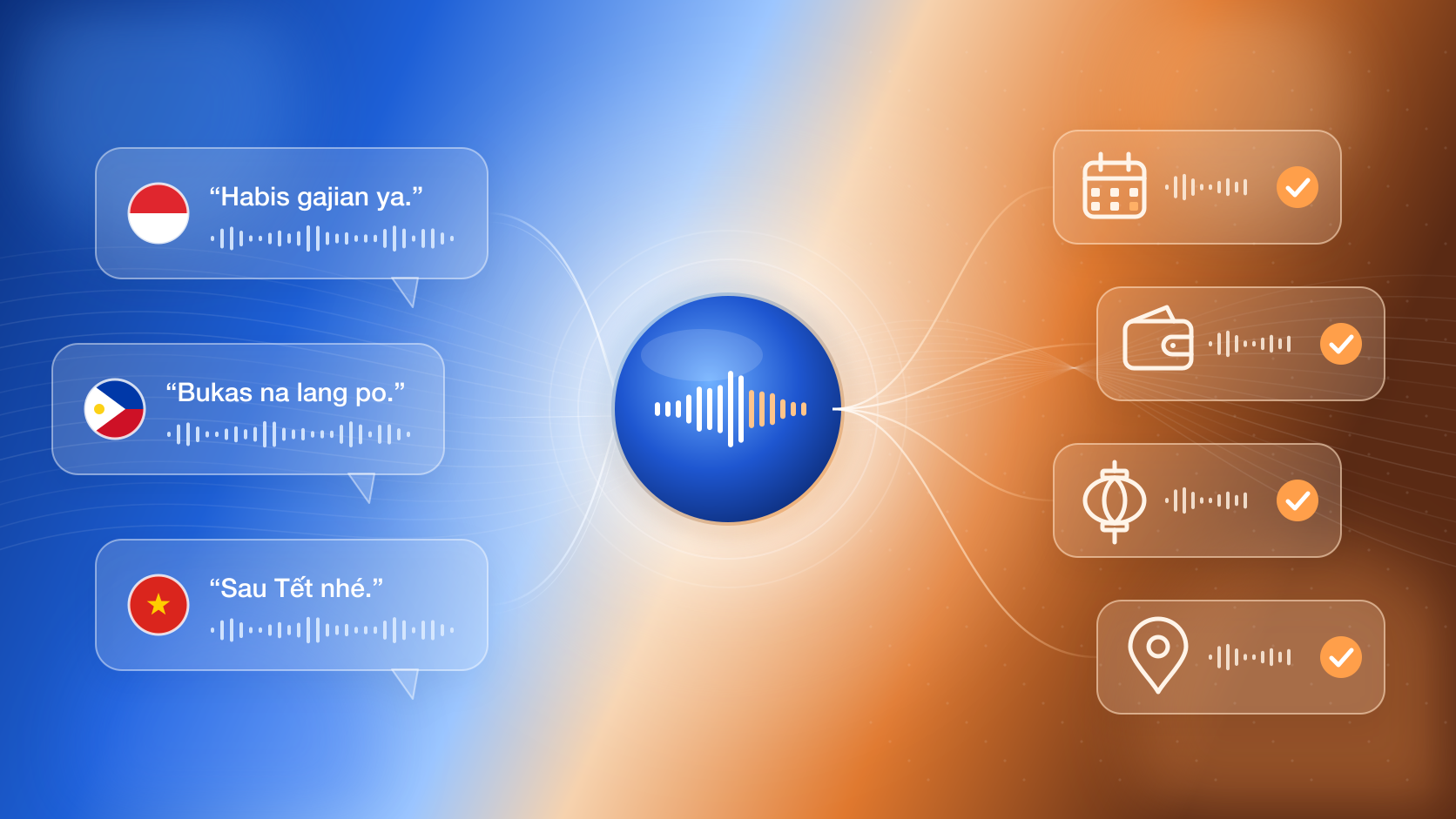
Paydays, not dates. An Indonesian customer on a collections call says they'll pay "habis gajian" — after payday. A Filipino customer says "sa kinsenas" or "sa katapusan" — on the mid-month or end-of-month payday that much of the workforce is paid on. Both are real promises to pay, tied to a specific day. An agent without that context either records no commitment or pushes for a date the customer already gave.
Calendars that aren't the Gregorian one. A Vietnamese customer who says "sau Tết" — after Lunar New Year — is naming a window that moves every year. A Thai customer or document may give a year in the Buddhist Era, where 2026 is 2569. An agent that reads either literally ends up with a schedule that's wrong, or one it can't parse at all. Reading numbers, dates, and amounts in voice AI covers the speaking side of the same problem.
Payment rails, not "payment". "I'll transfer it" means different things depending on whether the customer is talking about a bank virtual account, a QR payment, an e-wallet, or cash at a convenience-store counter. Each has a different confirmation path, a different delay, and a different follow-up. A script that only knows "pay" can't route any of them.
Soft refusals. "Bukas na lang po" — "maybe tomorrow, then" — often isn't a commitment for tomorrow. It's a polite way to end the conversation. Indirect no's like this show up across the region, and they're the context problem that sits closest to register: the politeness is the signal. An agent that logs every one of them as a scheduled callback fills the pipeline with promises nobody made.
Local references spoken aloud. Addresses built around an alley (hẻm) in Ho Chi Minh City or a soi in Bangkok, a landmark instead of a street number, a product nickname instead of its catalogue name. Bahasa Indonesia customer conversations and Taglish customer journeys in the Philippines walk through more of what an agent has to understand beyond the literal words.
What does getting context wrong actually cost?
The cost lands after the call, which is why it's easy to miss. Accent failures show up during the call as repeats and escalations. Context failures pass every in-call check: the transcript is clean, the tone was right, the customer hung up politely. Then the promise-to-pay date doesn't match the payday the customer meant, the callback queue fills with polite no's, the delivery goes to the wrong alley, and the renewal counted as confirmed never renews. Containment looks healthy. The business outcome doesn't. That's why the AI ops loop from the Fast to Deploy series checks outcomes, not just conversations.
How does WIZ.AI build context in, rather than hoping the model has it?
Language Engine treats context as scenario configuration, not a translation step. Scenario customisation adapts recognition and understanding for the product names, addresses, customer intents, and compliance phrases each deployment actually runs on — so "habis gajian" can resolve to a payday-linked promise-to-pay, and "bukas na lang po" can be flagged as a likely soft refusal instead of a firm callback, per market and per use case. Underneath that is WIZ.AI's regional industry corpus — the industry corpus flywheel this series keeps coming back to — built from real collections, service, and renewal traffic in the markets we serve, rather than a generic multilingual base. On Wizlynn inbound, that context carries across a multi-agent handoff, so the agent picking up a billing question already knows what the customer's "next week" means. On Talkbot outbound, it shapes the campaign itself: when to call, what payment options to offer, and which answers count as a yes.
What should you check before you trust a vendor's handling of context?
Three checks a scripted demo won't surface. First, don't test with answers that are already in the script's format. Test with how your customers actually reply — paydays instead of dates, a payment app instead of "payment", a polite deferral instead of a no — and check what outcome the system logs, not just whether the conversation flowed. Second, look at the post-call record: is "after payday" stored as a usable date, is a soft refusal marked as one, and does QM catch the calls where the logged outcome doesn't match what was said? Third, ask the ownership question every piece in this series has asked: when a market's payment habits change, a new e-wallet takes off, or a holiday moves the calendar, who updates the scenario, and how fast — your team on the platform, or a change request back to the vendor?
Accent, code-switching, and register decide whether the agent can follow the customer. Context decides whether it understood what the customer agreed to. See how scenario customisation works on the Language Engine, Wizlynn, and Talkbot pages, or book a demo and bring the replies your script doesn't expect.
References
- SeaEval for Multilingual Foundation Models: From Cross-Lingual Alignment to Cultural Reasoning — Wang et al., NAACL 2024
- BLEnD: A Benchmark for LLMs on Everyday Knowledge in Diverse Cultures and Languages — Myung et al., NeurIPS 2024
- SEA-LION: Southeast Asian Languages in One Network — AI Singapore, 2025
- Locally Fluent: Why Language Coverage Isn't Local Fluency — WIZ.AI
- Locally Fluent: Register Is Not Optional — WIZ.AI
- Reading Numbers, Dates, and Amounts in Voice AI — WIZ.AI
- Bahasa Indonesia Customer Conversations: What AI Agents Must Understand — WIZ.AI
- The Industry Corpus Flywheel for Local Voice AI — WIZ.AI
- Language Engine: mid-call language switching and scenario customisation — WIZ.AI
- Wizlynn: reliable multi-agent inbound service — WIZ.AI
- Talkbot: outbound voice AI campaigns — WIZ.AI
Related insights