
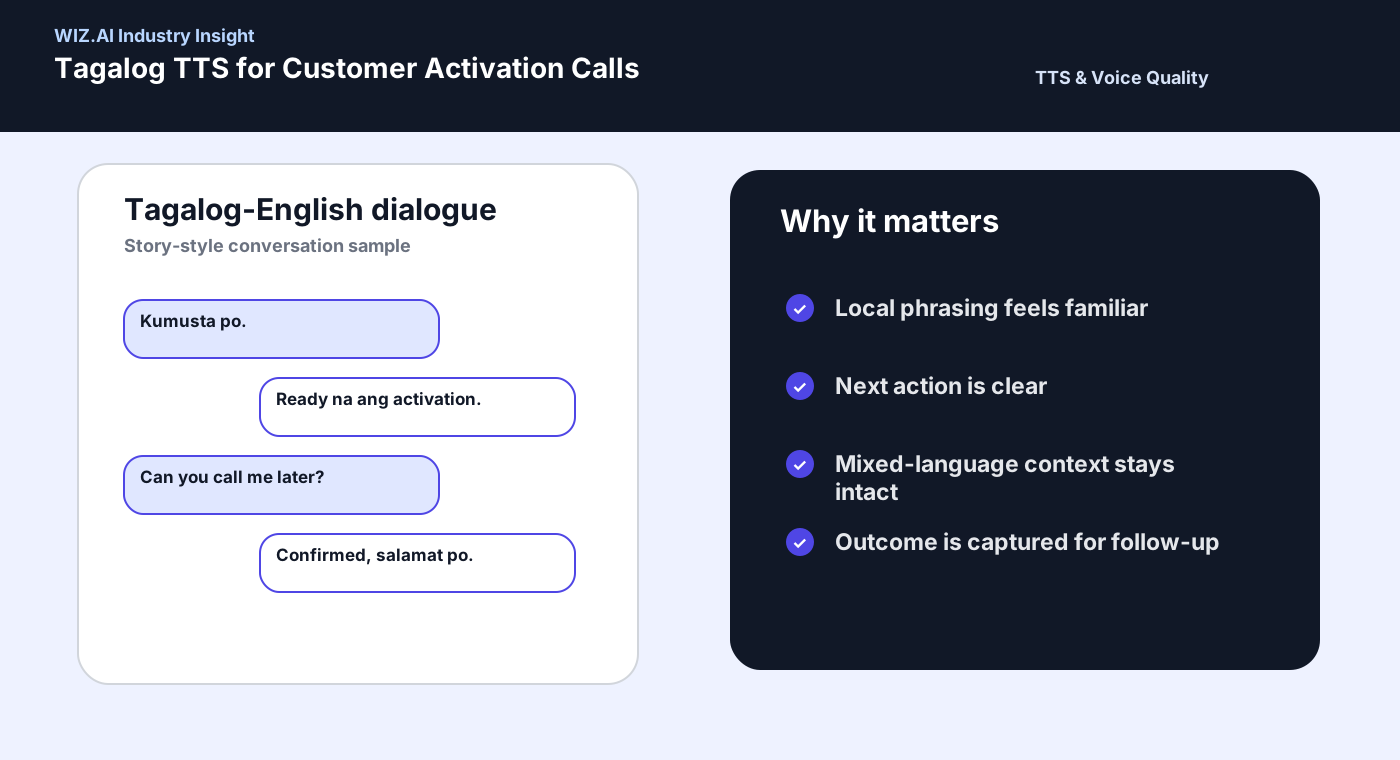
Tagalog TTS for Customer Activation Calls is about the voice layer of customer trust. In outbound calls, reminders, renewals, surveys, and service notices, customers decide very quickly whether the voice sounds legitimate, clear, and worth listening to. TTS quality therefore affects not only brand perception but also whether the customer understands the next action.
WIZ.AI frames Tagalog TTS as a performance capability inside the voice-agent journey. The point is not simply to generate speech. The point is to speak numbers, names, dates, products, and instructions in a way that feels natural for the market and appropriate for the business moment.
Useful proof includes call engagement, completion rate, repeat-call reduction, customer feedback, pronunciation accuracy for key terms, and performance across different use cases. A collections reminder, a healthcare appointment call, and a customer activation prompt may all require different tone and pacing.
By referencing low-resource TTS research and WIZ.AI’s human-like Talkbot positioning, the article can make a clear claim: localized TTS is part of the agent’s ability to perform. A voice that fits the market helps enterprises scale outreach without making the customer experience feel generic.
Buyer Takeaway
Buyers should use this page as a decision lens: identify the journey, define the measurable outcome, validate the language and workflow requirements, and check whether the vendor can support governance, analytics, and human handoff in production.
Related insights
Continue the thread
References
- Amazon Science. (n.d.). Lightweight neural front-ends for low-resource on-device TTS. https://www.amazon.science/publications/lightweight-neural-front-ends-for-low-resource-on-device-text-to-speech
- Springer. (2021). TTS for low-resource language using cross-lingual transfer learning. https://link.springer.com/article/10.1186/s13636-021-00225-4
- Electronics. (2024). Vietnamese ASR large-scale corpus. https://www.mdpi.com/2701504