Thailand is known for its service culture, and Thai customers have high expectations of courtesy. They also communicate in a way that values harmony and avoids confrontation. That shapes customer service conversations deeply: complaints are softened, refusals are indirect, and frustration may only show in small changes of tone. For an AI agent, the challenge is twofold — to sound appropriately polite, and to correctly understand what polite, indirect speech is asking for.
Why are particles so important?
Thai uses sentence-final particles to signal politeness and attitude. Khrap (said by men) and kha (said by women) make speech polite; leaving them out sounds abrupt. Other particles soften requests (noi, na), add emphasis, or signal questions. An agent's voice must use the correct particle for its gender consistently, and recognition must capture customers' particles, which help indicate tone and urgency. Thai TTS covers the voice side.
What is kreng jai, and how does it affect service calls?
Kreng jai describes a strong reluctance to impose on others or cause them trouble. In service calls, it means customers may understate problems, avoid asking for what they want directly, or accept an unsatisfactory answer rather than push. "If it's not too much trouble, could you maybe check..." may be an urgent request. Agents should make it easy for customers to ask, offer options proactively, and check whether the customer's problem is really solved rather than accepting a polite "OK".
How do Thai customers refuse or complain?
Indirectly. Refusals often come as hesitation, "let me think about it first", "maybe later", or a change of subject. Complaints may be framed politely or as questions. Mai pen rai — roughly "never mind" or "no problem" — can express genuine acceptance, polite dismissal, or resignation. Interpreting these correctly requires context: what was offered, the customer's tone, and the conversation so far. An agent should treat ambiguous replies cautiously, confirm gently, and avoid recording a soft refusal as interest or a resigned "mai pen rai" as satisfaction.
How does hierarchy show up?
Thai has many forms of address that reflect age and status. Service agents typically address customers as khun plus their first name, and use polite, deferential language. Older customers expect particular respect. Calls involving senior business customers may call for more formal language. A voice agent should default to polite forms, avoid overly casual phrasing, and never sound like it's lecturing the customer.
How should an agent turn indirect speech into action?
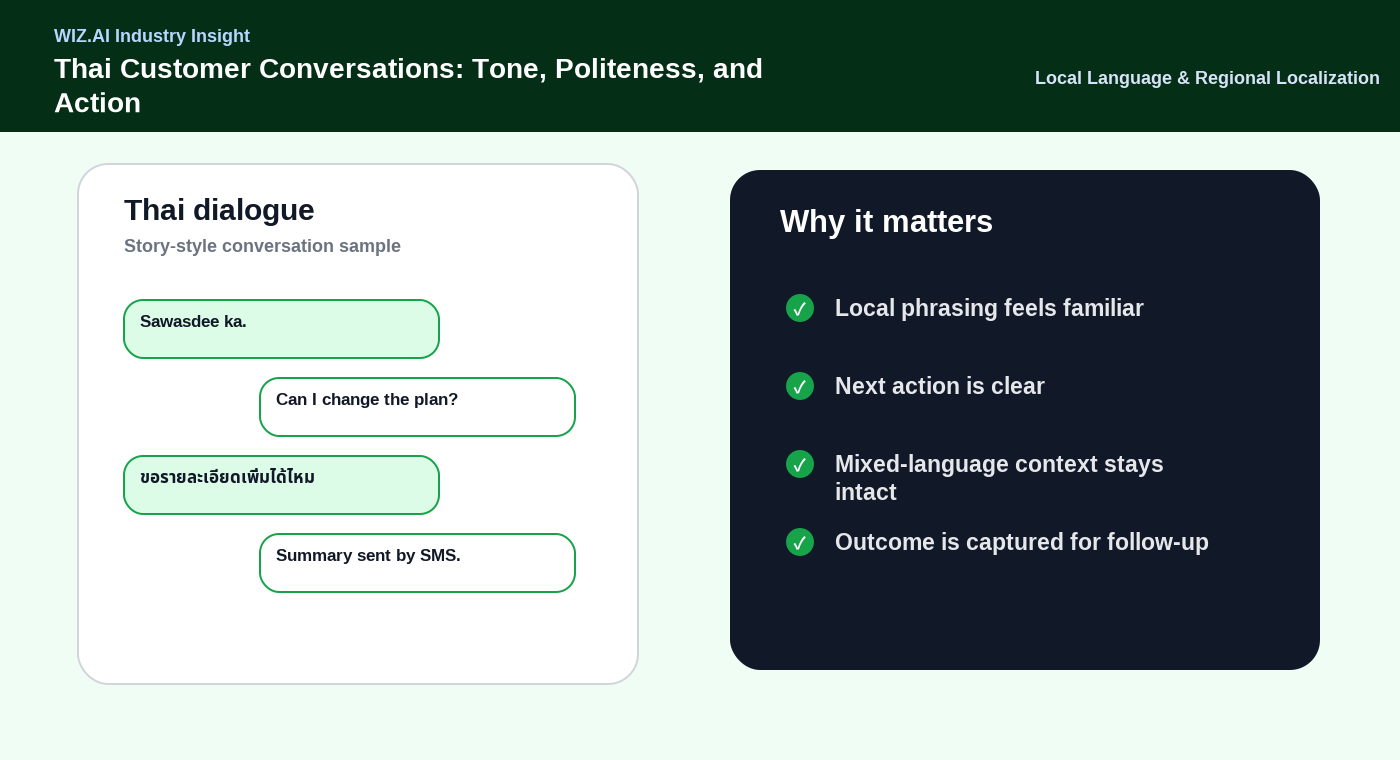
By listening for the underlying request and then confirming it plainly but politely. If a customer says, "The internet has been a bit slow lately, if possible...", the agent can respond: "I'm sorry for the inconvenience, khrap. Would you like me to check your connection and arrange a technician if needed?" That makes the implicit request explicit and gives the customer a comfortable way to agree. The outcome should be recorded precisely.
Which topics need extra care?
Anything involving loss of face: missed payments, declined applications, mistakes by the customer. Phrasing should avoid blame and offer a way forward. The monarchy and religion are sensitive topics that agents should never comment on. Major holidays such as Songkran affect call timing and customer availability.
How should Thai conversation handling be tested?
With native-speaking Thai reviewers listening to real or realistic calls, scoring both politeness (particles, register, tone) and understanding (did the agent correctly interpret indirect requests and refusals?). Include calls with older customers and regional speakers. Track outcomes like repeat contacts, which reveal problems customers didn't complain about directly. Thai ASR covers recognition testing.
How does WIZ.AI handle Thai conversations?
Language Engine provides Thai voices with consistent, gender-appropriate particles and recognizes Thai politeness and indirect phrasing in context. Wizlynn and Talkbot confirm implicit requests politely and record precise outcomes, and QM reviews tone and resolution on every call.
Thai customers will be polite to your agent whatever happens. Make sure your agent understands what they actually mean. Book a demo with your Thai scenarios.
Related insights
Continue the thread
References
- SeaEval for Multilingual Foundation Models: From Cross-Lingual Alignment to Cultural Reasoning — Wang et al., NAACL 2024
- SEA-LION: Southeast Asian Languages in One Network — AI Singapore, 2025
- Thai TTS for Customer Operations — WIZ.AI
- Thai ASR for Customer Service Automation — WIZ.AI
- Locally Fluent: Register Is Not Optional — WIZ.AI