Indonesia has one of the largest customer bases in the world for voice automation — over 280 million people, a fast-growing digital economy, and heavy use of phone and messaging channels for service. Bahasa Indonesia is the shared national language, which makes it tempting to treat Indonesian conversations as straightforward. In practice, Indonesian customers communicate with a lot of politeness and indirectness, and much of the meaning in a service call sits between the words. A voice agent that only processes the words will regularly misread what customers want.
How should an AI agent address Indonesian customers?
With Bapak (sir) or Ibu (madam), usually followed by the name, which is the standard respectful form in service. Anda is the neutral formal "you", common in written communication but slightly stiff in speech. Kamu is informal and only suits brands that deliberately speak casually to young customers. Choosing the wrong form makes the agent sound either cold or overfamiliar. Customers will often reply informally — "iya, udah, nggak" — while still expecting the agent to stay polite. Register Is Not Optional explains why this matters more on outbound calls.
Why do Indonesian customers say no indirectly?
Because direct refusal can feel rude, especially to someone being polite. Customers often decline with phrases like "nanti saya kabari" (I'll let you know), "saya pikir-pikir dulu" (I'll think about it), "lihat nanti ya" (we'll see), or "mungkin lain kali" (maybe another time). In many contexts these are soft refusals, not genuine interest. An agent that treats them as positive will schedule pointless callbacks and inflate pipeline reports. A better approach: acknowledge politely, offer a light next step, and record the outcome as "not now" rather than "interested".
What about time and payday expressions?
They're everywhere in collections and sales calls, and they rarely map to a calendar date directly. "Habis gajian" (after payday), "awal bulan" (start of the month), "akhir bulan" (end of month), "minggu depan" (next week), "setelah Lebaran" (after Eid). Payday varies by employer, though the 25th and the end of the month are common. The agent needs to turn these into usable dates — asking a gentle follow-up question where necessary — rather than recording "unknown". Context Is What the Script Can't Translate covers this in depth.
How informal is spoken Indonesian on calls?
Very, compared with written Indonesian. Customers say "udah" for "sudah", "nggak" or "gak" for "tidak", "aja" for "saja", "kok", "sih", "dong", and "deh" as discourse particles that soften or emphasize. They drop prefixes ("mau bayar" rather than "akan membayar"). Jakarta speech has its own slang. The agent must understand all of this while replying in polite standard Indonesian. Indonesian ASR for engagement calls covers the recognition side.
Do regional backgrounds change the conversation?
Yes. Most Indonesians speak a regional language at home — Javanese, Sundanese, Madurese, Minangkabau, Batak languages, Bugis, and many more — and it shapes how they speak Indonesian: accent, vocabulary, and politeness norms. Javanese speakers, for example, are used to elaborate speech levels for respect, and may expect more deference. Some customers will slip into a regional word or phrase. Javanese and local dialect sensitivity covers this.
What topics need extra sensitivity?
Debt and missed payments, where shame and stress are common and conduct rules apply. Religious holidays — Ramadan and Lebaran affect spending, cash flow, and call timing; calls during prayer times or just before breaking the fast can feel intrusive. Health and insurance claims. In all of these, a calm, respectful tone and flexible options work better than pressure.
How should an agent show it understood?
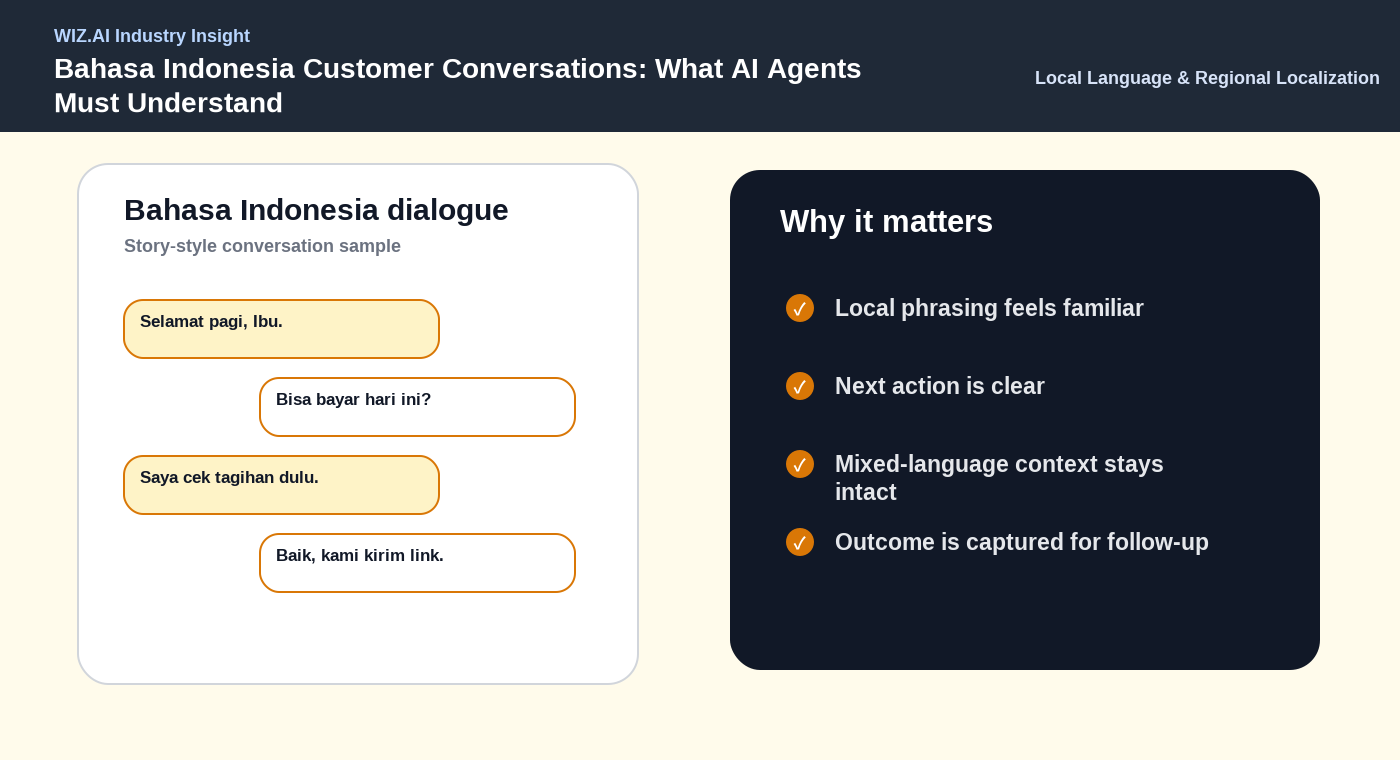
By summarizing the key point in the customer's terms and confirming: "Baik, Bu, jadi pembayarannya setelah gajian tanggal 25 ya?" ("Alright, ma'am, so the payment will be after payday on the 25th?"). That gives the customer a chance to correct the agent, and creates a clear, auditable outcome.
How does WIZ.AI handle Indonesian customer conversations?
Language Engine understands informal and regionally influenced Indonesian, interprets soft refusals and time expressions in context, and supports polite Bapak/Ibu scripting. Talkbot and Wizlynn turn conversations into structured outcomes, and QM checks tone and compliance on every call.
Indonesian customers say a lot without saying it directly. Your agent needs to hear it. Book a demo with your Indonesian scripts.
Related insights
Continue the thread
References
- SeaEval for Multilingual Foundation Models: From Cross-Lingual Alignment to Cultural Reasoning — Wang et al., NAACL 2024
- SEA-LION: Southeast Asian Languages in One Network — AI Singapore, 2025
- Locally Fluent: Register Is Not Optional — WIZ.AI
- Locally Fluent: Context Is What the Script Can't Translate — WIZ.AI
- Indonesian ASR for Customer Engagement Calls — WIZ.AI