Southeast Asia is one of the world's fastest-growing digital regions, as the e-Conomy SEA reports have tracked for years. Enterprises in banking, telecom, insurance, and e-commerce are investing in AI agents to serve hundreds of millions of customers. Many AI products enter the region by adding languages to a system designed for English-speaking markets. That approach produces agents that pass a language checklist and still struggle with real customers. Southeast Asia needs AI agents built for how the region actually works.
How diverse is the region linguistically?
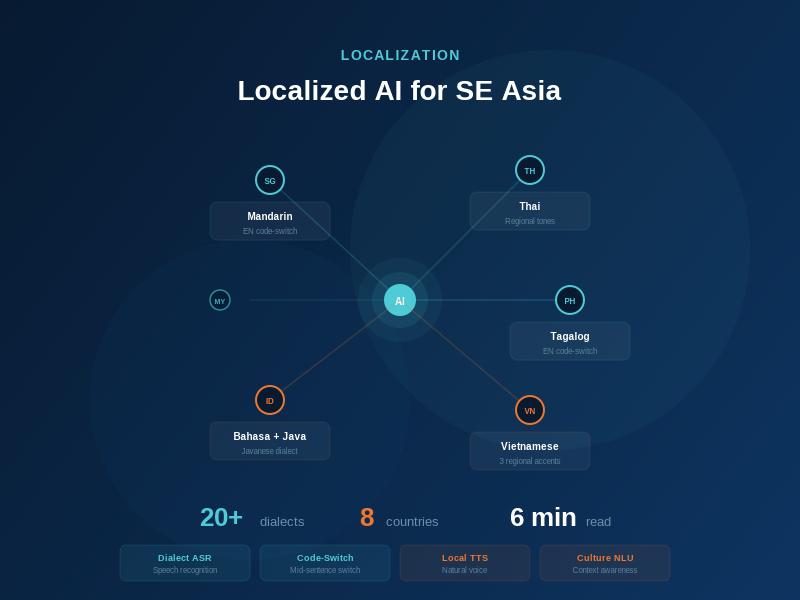
Extremely. National languages include Indonesian, Thai, Vietnamese, Filipino, Malay, Khmer, Lao, and Burmese, with English widely used in Singapore, Malaysia, and the Philippines. Beneath them are hundreds of regional languages — Javanese, Sundanese, Cebuano, Isan, and many more — that shape how people speak the national language. And customers constantly mix languages, especially with English. Why Language Coverage Isn't Local Fluency explains why supporting a language isn't the same as understanding its speakers.
Why does communication style matter?
Because meaning often isn't in the words. Across much of the region, customers are polite and indirect: soft refusals ("I'll think about it"), understated complaints, and respect expressed through particles and forms of address. Research on multilingual AI, such as SeaEval, shows that models can handle language without handling cultural reasoning. An AI agent that takes words literally misreads intent; one that ignores politeness norms sounds rude. Register Is Not Optional covers this.
What local context does an agent need?
Payment rails and habits: virtual accounts and QRIS in Indonesia, PromptPay in Thailand, GCash and Maya in the Philippines, MoMo in Vietnam, cash on delivery across the region. Calendars and cycles: twice-monthly paydays in the Philippines, Buddhist Era dates in Thailand, Lunar New Year and Tết, Ramadan and Lebaran. Address conventions that rely on landmarks. Local product and brand names. Context Is What the Script Can't Translate covers these.
How does regulation differ?
Each market has its own data protection law, financial regulator, consumer protection rules, and collections conduct expectations. Data residency requirements vary. An AI agent operating across the region needs controls that can be configured per market, and a vendor that understands the regulatory environment in each.
What about infrastructure?
Customers are mobile-first, often on prepaid plans, with variable network quality and frequent calls from noisy environments. Many still rely on voice for important matters, and outbound calling remains essential. AI agents must work well on real telephone audio, not just on clean recordings.
What does "localized" really require?
Speech recognition trained on local telephone speech and code-switching. Voices that sound local, with correct pronunciation and politeness. Understanding of indirect speech and local context. Scripts written by native speakers, not translated. Per-market compliance controls. And local teams who can test, review, and improve in each language. Multi-country customer operations covers how to run this across several markets.
How does WIZ.AI localize?
WIZ.AI was built in and for the region, with offices in Singapore, Indonesia, the Philippines, Thailand, and Malaysia, and AI agents trained on customer-operations speech across Southeast Asia. Language Engine supports regional languages, accents, and mid-call switching, and Wizlynn, Talkbot, and QM are configured per market.
Southeast Asia's customers deserve AI agents that understand them. Book a demo in your market's language.
Related insights
Continue the thread
References
- e-Conomy SEA report — Google, Temasek, and Bain & Company
- SeaEval for Multilingual Foundation Models: From Cross-Lingual Alignment to Cultural Reasoning — Wang et al., NAACL 2024
- Locally Fluent: Why Language Coverage Isn't Local Fluency — WIZ.AI
- Locally Fluent: Context Is What the Script Can't Translate — WIZ.AI
- WIZ.AI for Multi-Country Customer Operations — WIZ.AI