Activation calls with AI voice agents are often one of the first automation projects to show clear ROI, because the value of an active customer is easy to see and the cost per call is low. But ROI is also easy to overstate. Many customers would have activated anyway. A sound calculation separates the effect of the campaign from what would have happened without it, values activations realistically, and includes all costs.
Why do you need a control group?
Because some customers activate on their own. If you call everyone and count all activations as campaign results, you'll overstate ROI — sometimes many times over. The fix is simple: randomly hold out a share of eligible customers (say 10%) who don't receive calls, and compare activation rates between the called group and the holdout over the same period. The difference is your incremental activation rate. Without it, you're measuring correlation, not impact.
How do you value an activated customer?
With the expected value over a sensible period — usually the first year or the expected customer lifetime, discounted if you want precision. For a credit card, that may include interchange, fees, and interest income minus expected credit losses. For a telecom SIM, expected monthly revenue times expected tenure. For an e-wallet, transaction revenue and cross-sell value. Finance teams usually have these figures; use theirs rather than inventing your own, and be conservative.
Which costs should you include?
All of them. Platform and usage costs for the AI agent, telephony, SMS and messaging follow-ups, setup and integration, ongoing script and campaign management, human handoff time for transferred calls, and any incentives offered. If the campaign replaces or reduces human calling, include the saved human cost as a benefit, not as a reduced cost, to keep the logic clear.
What does a worked example look like?
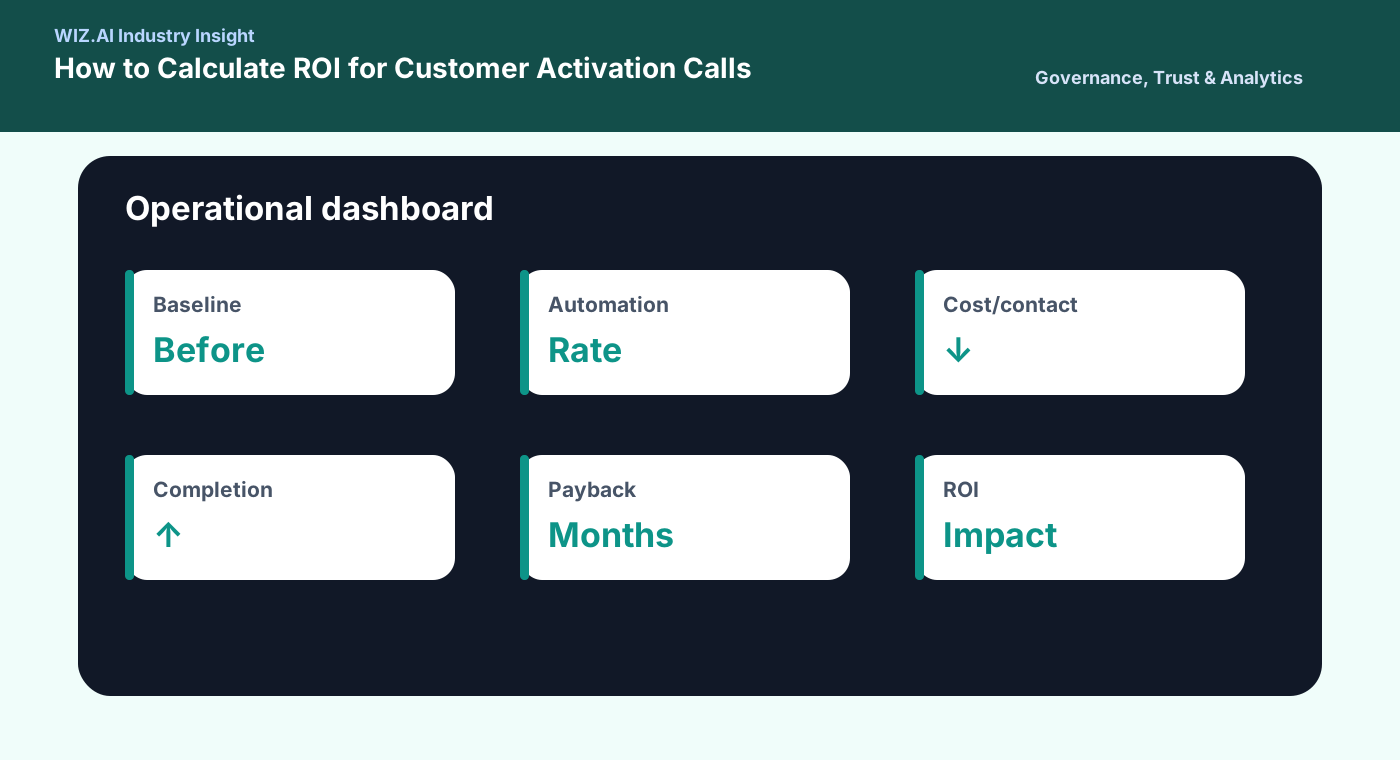
An illustrative example, with made-up but realistic-shaped numbers. A bank issues 100,000 new cards a month. Without calls, 55% activate within 60 days. An AI activation campaign calls 90,000 customers and holds out 10,000. After 60 days, 63% of the called group has activated, versus 55% of the holdout — an 8-point lift, or about 7,200 incremental activations from the 90,000 called. If an active card is worth an average of US$40 in first-year net value, that's about US$288,000. If the campaign costs US$30,000 a month all-in, the first-year return is roughly 9.6 times cost. Your numbers will differ; the method is what matters.
What other benefits should be counted?
Where you can measure them: reduced inbound calls from confused new customers, earlier activation (which brings revenue forward), data on activation barriers that improves onboarding, and human team time freed for higher-value work. Count these separately from the core activation ROI, so the main case doesn't depend on hard-to-measure benefits.
What mistakes distort activation ROI?
No control group. Counting activations that happen long after the call. Using optimistic customer values. Ignoring follow-up and handoff costs. Comparing against a different time period with different conditions. And reporting call metrics — contact rate, completion — as if they were business results. Why CX leaders need measurable ROI covers these pitfalls more broadly.
How should ROI be tracked over time?
Monthly, by segment, with the holdout maintained. ROI usually differs by product, channel of acquisition, region, and customer value. Some segments may not be worth calling; others may justify more attempts. Re-run the analysis when you change timing, scripts, or targeting. Improving activation rates describes the levers to test.
How does WIZ.AI support activation ROI measurement?
Talkbot supports holdout groups, segment-level reporting, and outcome tracking linked to your activation data, so incremental impact can be measured directly. Call costs and outcomes are reported per campaign, making ROI calculations straightforward to keep current.
The best activation business case is one your finance team agrees with. Book a demo and we'll walk through the model with your numbers.
Related insights