Voice-of-customer (VoC) programmes traditionally rely on surveys, focus groups, and a small sample of reviewed calls. AI agents change the raw material available. Every conversation is transcribed, and the agent already identifies intents, captures details, and records outcomes. Analyzed together, those records show what customers ask for, what they struggle with, why they call back, and why they leave — across all customers, not just those who answer surveys.
What data does each AI conversation produce?
A transcript and recording. The customer's intent or reason for contact. Structured details: products, amounts, dates, error messages. The outcome: resolved, transferred, promise made, declined. Signals of sentiment and effort: frustration, repeated requests, long silences, escalation. Reasons given for decisions: why a customer can't pay, why they're cancelling, why they didn't activate. Together, these are far richer than a satisfaction score.
What questions can VoC analytics answer?
Why are customers contacting us, and how is that changing? Which products or processes generate the most confusion? What reasons do customers give for missing payments, not activating, or leaving? Where do conversations fail — which intents have the lowest resolution? What are customers saying about competitors? Which issues are rising this week? Each answer points to something a product, operations, or marketing team can change.
How do you analyze across languages?
By mapping conversations to shared categories. Intents, reasons, and themes should be defined once and applied across languages, so "batal", "hủy", "ยกเลิก", and "cancel" all count as the same reason. Product and entity names should be normalized. Without this, multilingual businesses end up with separate, incomparable insight for each market. Mixed-script transcripts covers the normalization needed.
How should sentiment be used?
Carefully. Automated sentiment detection is useful for spotting trends and urgent cases, but it's imperfect — especially across languages and in cultures where dissatisfaction is expressed politely. Combine sentiment with behavioural signals (repeat contacts, escalations, churn) and with the specific reasons customers give, rather than treating a sentiment score as the truth.
How do insights reach the people who can act?
Through regular, focused reporting: a short weekly summary of top contact reasons and changes, emerging issues flagged in near real time, and deeper monthly analysis for product and operations teams. Include real example calls — hearing customers in their own words is often what drives action. Assign owners to recurring issues and track whether contact volumes fall after fixes.
What about privacy?
Analytics should use data in line with privacy notices and data protection laws, with personal data minimized or removed for aggregate analysis. Access to recordings and transcripts should be limited and logged. Insights shared widely should be aggregated, not traceable to individuals.
How does VoC analytics relate to surveys?
They complement each other. Surveys measure how customers feel about an experience; call analytics show what actually happened and why. Voice surveys can be targeted at specific journeys that analytics flag as problematic.
How does WIZ.AI support voice-of-customer analytics?
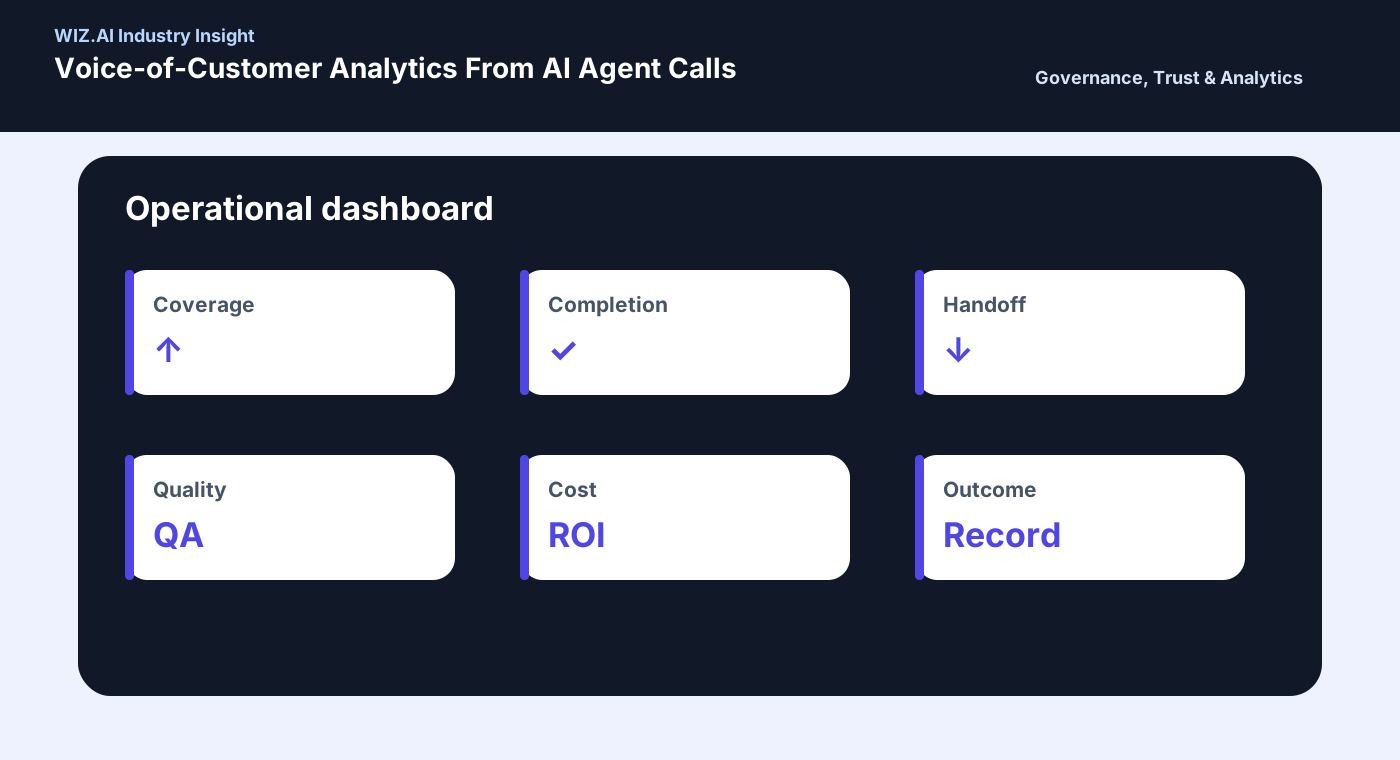
QM analyzes 100% of calls from Wizlynn, Talkbot, and human agents, categorizing intents, reasons, outcomes, and sentiment across languages, and surfaces trends and emerging issues. Reporting dashboards describes how results are presented.
Your customers are already telling you what to fix. VoC analytics makes sure someone hears it. Book a demo to see analytics on your call data.
Related insights