Enterprise voice AI has a speed problem. Most platforms force a trade-off: choose a closed, black-box system and accept slow iteration, or build from scratch and lose months to infrastructure work before handling a single call. WIZ.AI was built on a different premise: that reliability at scale and fast, flexible iteration aren't actually in tension. Since 2019, that approach has scaled to 300+ enterprise clients across 17 countries, handling 100M+ AI calls monthly.
Why did voice AI move beyond a single scripted bot?
A single-bot, single-intent model breaks down once real call volume hits it: a single inbound call may need identity verification, a balance check, a billing dispute escalation, and a language switch, all in one conversation.
Wizlynn, WIZ.AI's inbound platform, addresses this with reliable multi-agent service rather than one linear script: separate agents handle intent routing, FAQ resolution, and escalation, coordinating toward a shared outcome instead of cramming every capability into one model. This same coordination pattern is now spreading from voice into broader enterprise AI workflows, but voice was where it first had to work in production, at strict latency and accuracy thresholds.
How fast can Wizlynn go from setup to full production?
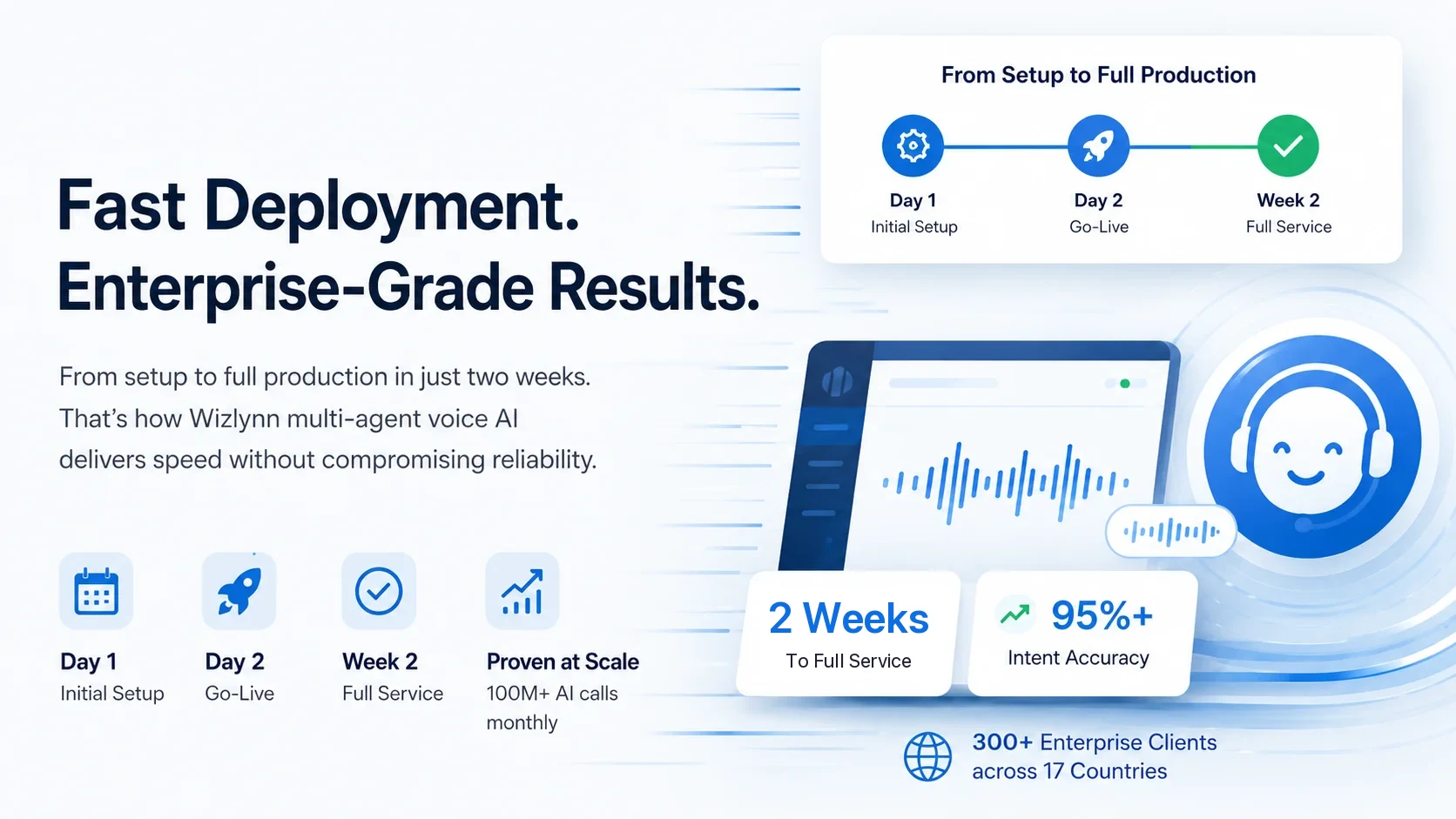
Wizlynn moves from setup to full production in roughly two weeks: Day 1 for initial setup, Day 2 for go-live, and full service by Week 2, a timeline that holds even though Wizlynn is coordinating multiple agents, not running a single script.
That speed is the point, not a trade-off against reliability. Because intent routing, FAQ resolution, and escalation are handled by separate, purpose-built agents rather than one monolithic model, each piece can be configured and validated independently during setup instead of requiring a single flow to be perfected end-to-end before anything goes live. A team can stand up FAQ handling on Day 1, layer in routing logic by Day 2, and expand escalation and edge-case coverage through Week 2, without waiting on a full rebuild between stages.
This is also why Wizlynn holds up at volume once it's live. WIZ.AI reports 95%+ intent accuracy at sub-2-second response times across production deployments, figures drawn from real inbound traffic, not staged demos. For enterprise teams, that combination is the practical test of a fast rollout: does accuracy hold once call volume is real, or does speed to launch just move the risk downstream. With Wizlynn, the two-week timeline and the production numbers are reported from the same live deployments, not separate best-case scenarios.
How does WIZ.AI deploy voice AI agents so quickly?
WIZ.AI deployments typically go live on Day 2, with full service reached by Week 2, a timeline made possible because the orchestration layer is built to be configured, not re-engineered, per client.
Routing rules, language modules, and QA checks are exposed as composable building blocks, so integrating WIZ.AI into an existing operation looks like configuration work rather than a custom engineering project. That same design logic runs across the product line: Talkbot scales outbound campaigns (reminders, collections, telesales) with ROI tracking built in from day one; QM (Quality Management) monitors every call against compliance and SOP criteria automatically, as a pipeline stage rather than a manual review step.
How does WIZ.AI handle multilingual and multi-accent support?
WIZ.AI's Language Engine supports 16+ languages and locale variants, including Singlish, Bahasa, Thai, Tagalog, Vietnamese, Malay, PT-BR, and ES-MX, with mid-call language switching at telephony-grade quality.
Supporting this range isn't a matter of translating one model's output. Accents and code-switching patterns (Singlish is a distinct case from standard English, not a simple variant) require different handling at the speech-to-text, intent, and text-to-speech layers. Getting this right on live customer calls required an architecture where components could be swapped and tuned independently, the same orchestration pattern the rest of the platform now runs on. In practice, this makes WIZ.AI's multilingual voice work the proving ground for its multi-agent approach, not a side feature next to it.
Is a fast, flexible platform still reliable enough for regulated industries?
Yes: WIZ.AI holds SOC 2 Type II, PCI DSS, and ISO 27001, 27017, and 27018 certifications, and reports 95%+ intent accuracy and sub-2-second response times across live deployments.
These are operating numbers from regulated, high-volume environments (banking, collections, telecom), not lab benchmarks. They demonstrate that composability and enterprise-grade controls aren't opposed; a platform can be built for fast iteration and still meet the compliance bar enterprises require before scaling a voice AI deployment. See WIZ.AI's Trust page for full certification and deployment-readiness details.
What should buyers evaluate when comparing voice AI vendors?
The key question isn't whether a platform works in English at low volume in a demo; it's whether the orchestration underneath can flex to new languages, new agent roles, and new compliance requirements without a platform rebuild.
WIZ.AI's path to its current architecture was shaped by the hardest version of this problem first: real-time, multilingual, high-volume customer operations. That's a different starting point than platforms that added multi-agent capabilities on top of an existing closed system after the fact. The 100M+ monthly calls currently running through WIZ.AI's platform are, in effect, an ongoing stress test of whether that architecture holds up.
See how Wizlynn's multi-agent orchestration handles your call volume and language mix: book a demo.
Related insights