Quality assurance has always been part of running a contact center: supervisors listen to calls, score them against a form, and coach agents. When AI agents take on a large share of conversations, the job changes. The AI doesn't need coaching in the same way, but it does need monitoring — because it handles huge volumes, can fail in consistent ways, and is responsible for regulated conversations. Quality monitoring becomes the main way the business knows what its AI agents are actually doing.
What should AI agent QA measure?
Accuracy: did the agent understand the customer, capture the right details, and give correct information? Compliance: were required disclosures made, prohibited statements avoided, and policies followed? Outcome: was the customer's issue resolved, or the call's goal achieved, and does the recorded outcome match what happened? Experience: was the conversation natural, polite, and efficient, or did the customer repeat themselves, get frustrated, or ask for a human? Handoff: did the agent escalate when it should have?
Why does every call need to be reviewed?
Because AI failures are often rare and specific. A misread amount in one template, a disclosure missing in one language, a policy breach in an unusual conversation path — each might affect one call in a thousand. A 2% random sample will almost never catch them. Automated review of every call, against defined criteria, finds them quickly. It also gives complete data for reporting by segment, language, and flow.
What role do human reviewers play?
The judgment role. Human reviewers should focus on calls flagged by automated review, calls in new or changed flows, a random baseline sample for calibration, and dimensions that automation handles less well — tone, empathy, whether the customer was really satisfied. They also check that automated scoring itself is accurate. Human review loops covers how to organize this.
What does a good scorecard look like?
Short, objective where possible, and tied to outcomes. Each criterion should be clearly defined, with examples, and applicable across languages. Separate critical criteria (compliance breaches, wrong information, failure to escalate) from quality criteria (naturalness, efficiency), so critical failures are never hidden in an average score. Weight scores by business importance.
How should alerts work?
Critical issues should trigger alerts in near real time: a compliance breach, a spike in failed conversations, a drop in resolution for one flow, or an unusual pattern in one language or region. Alerts should go to an owner who can act — pause a flow, fix a script, roll back a change. Weekly reports are too slow for problems affecting thousands of calls a day.
How do you keep automated scoring trustworthy?
By calibrating it against human review regularly. Have reviewers score a sample of calls independently and compare with automated scores; investigate differences; refine criteria. Calibration across languages and markets is especially important. Multilingual QA covers this.
Should AI and human agents be monitored the same way?
On the same criteria, yes. Using one scorecard for both lets you compare performance fairly, decide which conversations should go to AI or humans, and spot where handoffs work or fail. Applying the same monitoring to human agents' calls is a useful side benefit of the same system.
How does WIZ.AI monitor quality?
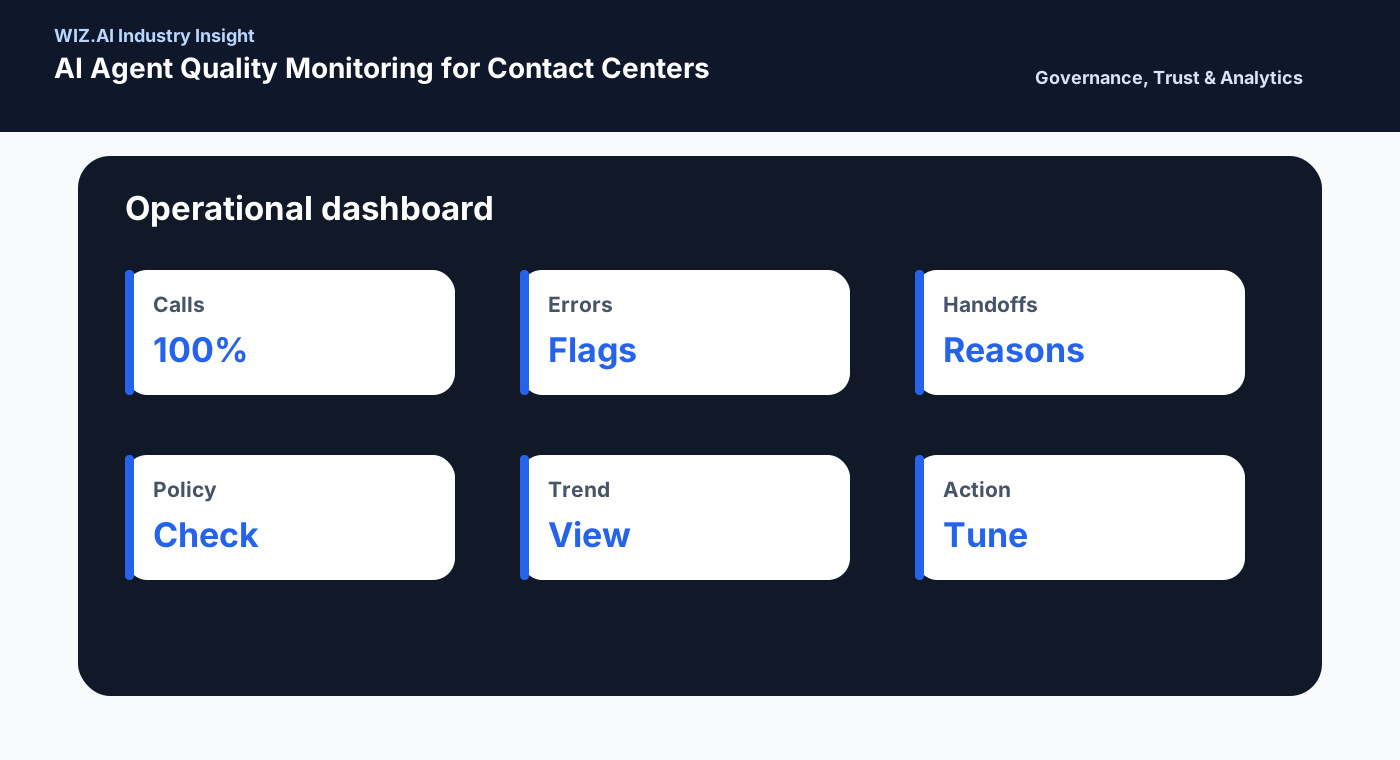
QM reviews 100% of calls — from Wizlynn, Talkbot, and human agents — against configurable scorecards, flags critical issues for immediate review, supports human reviewers with prioritized queues, and reports quality by flow, language, and segment. It's built for full coverage, never a sample.
You can't manage what you only see 2% of. Book a demo to see quality monitoring on every call.
Related insights