A voice AI agent is a chain of components working in real time: telephony, speech recognition, language understanding and decision-making (often a large language model), calls to business systems, and speech synthesis. When something goes wrong, the symptom — a confused customer, a long pause, a wrong answer — rarely tells you which link failed. Observability is the practice of recording what each component did on each call, in a structured way, so teams can measure performance, detect problems, and find root causes quickly.
What should be captured for each call?
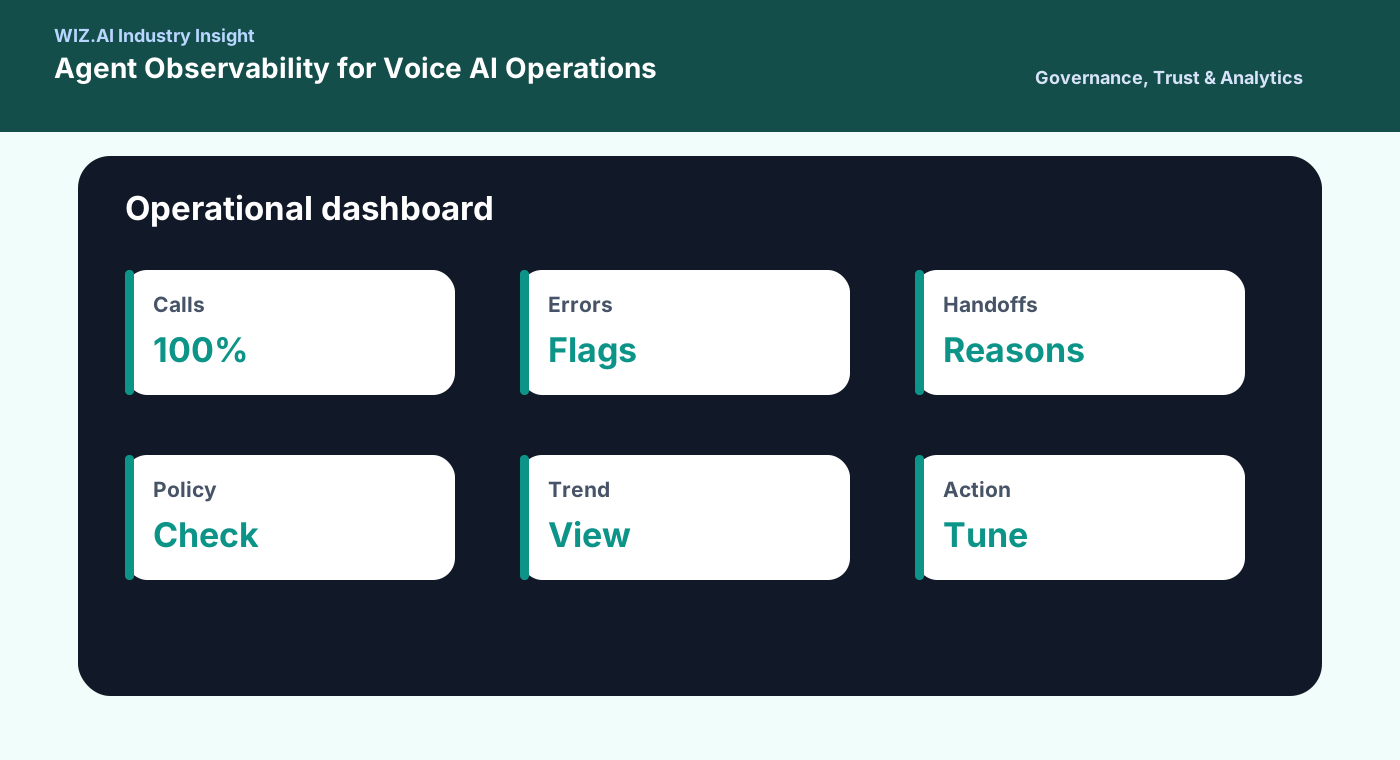
A trace of every turn: the audio timing, the speech recognition result and confidence, the detected intent and entities, the decision or response generated, any calls to business systems (with timing and success or failure), the speech synthesis timing, and the outcome. Each step should be timestamped. Open standards such as OpenTelemetry are widely used for this kind of tracing in software systems. The goal is to be able to replay what happened on any call, step by step.
Which metrics matter most?
Latency per turn and per component, at the median and 95th percentile. Error rates: recognition failures, timeouts, failed system calls. Conversation health: repeat requests, fallbacks ("I didn't understand"), transfers, and abandoned calls. Outcomes by flow. Capacity: concurrent calls and resource usage. Google's SRE guidance on monitoring distributed systems — focusing on latency, traffic, errors, and saturation — applies directly to voice AI.
How should alerts be set?
Around user impact. Alert when response latency at the 95th percentile crosses a threshold, when error or fallback rates rise sharply, when a business system integration fails, or when a flow's outcome rate drops. Define these as service-level objectives and alert when they're at risk, rather than on every small fluctuation. Alerts should go to someone who can act.
What is drift, and how do you detect it?
Drift is gradual change in performance without any deployment — because customers start saying new things, a product launches, a regional campaign reaches new accents, or a business system changes its responses. Observability detects it by tracking metrics by segment over time: recognition confidence by region, fallback rate by intent, outcome rate by flow. A slow decline in one segment is often the first sign of a problem that will become visible to customers later.
How does observability help debugging?
It turns individual failures into patterns. When a customer complaint or QA flag identifies a bad call, the trace shows which step failed. Searching traces for the same failure shows how often it happens and in which conditions. That makes it possible to prioritize fixes by impact and verify, after a change, that the failure rate fell. The AI-ops loop describes how this feeds safe updates.
What about privacy?
Traces contain customer speech and data. Sensitive information should be redacted in logs and traces, access should be restricted and logged, and retention should follow policy. Observability data should be designed with data protection rules in mind from the start.
Why does observability matter more at scale?
Because at high volumes, rare failures happen many times a day, and no one can listen to most calls. Reliable at Scale describes why consistency, peak load, failure handling, and control all depend on being able to see what's happening.
How does WIZ.AI provide observability?
Wizlynn and Talkbot record turn-level traces with component timing, recognition and intent results, system calls, and outcomes, and report latency, errors, and conversation health by flow and segment. QM adds quality and compliance scoring for every call.
You can only fix what you can see. Book a demo to see voice AI observability in practice.
Related insights
Continue the thread
References
- Service Level Objectives — Site Reliability Engineering, Google
- Monitoring Distributed Systems — Site Reliability Engineering, Google
- OpenTelemetry documentation — Cloud Native Computing Foundation
- Reliable at Scale: Why One Good Call Isn't Reliability — WIZ.AI
- TTS Latency in Real-Time Voice Agents — WIZ.AI