The last piece in the Locally Fluent series ended on a hand-off: testing tells you an agent is fluent on a thousand calls, but keeping it that way across a million is a reliability problem. This series takes up that problem. Through November and December, one piece each will cover consistency, peak load, failure handling, and control. This first piece explains why each one matters, and why a voice agent that sounded great in the pilot can still be the wrong agent to run at volume.
What's the difference between a good call and a reliable agent?
A good call is a sample of one. Reliability is the whole distribution. An agent that gets 99% of calls right sounds excellent in a slide. At 100,000 calls a month, it still gives 1,000 customers a wrong answer, a dropped request, or a promise nobody made, every month. Large language models make this harder, because the same input doesn't always produce the same output. Researchers behind τ-bench (Yao et al., 2024) measured this directly: they ran the same customer-service tasks repeatedly and counted how often an agent succeeded every time. A leading model that solved most tasks on a single try succeeded on all eight attempts for fewer than a quarter of retail tasks. The number that matters at scale isn't "can it pass once?" It's "does it pass every time?"
Why does scale break agents that worked in the pilot?
Because a pilot quietly removes the conditions that cause failures. Pilots are small, closely watched, and scoped to the use cases most likely to work. Someone on the project team listens to almost every call, catches the odd mistake, and fixes it by hand. Production takes all three of those away at once. Volume also changes what "rare" means. A situation that comes up once in 10,000 calls almost never shows up in a pilot of a few hundred. At WIZ.AI's 100M+ AI calls a month, a one-in-10,000 situation happens about 10,000 times a month. Every integration the pilot barely touched — the CRM lookup, the payment status check, the ticket write-back — is now called thousands of times an hour. That's the gap most AI pilots fall into, and the reason Fast to Deploy closed by arguing that speed only counts if the deployment is built to scale.
What are the four tests of reliability at scale?
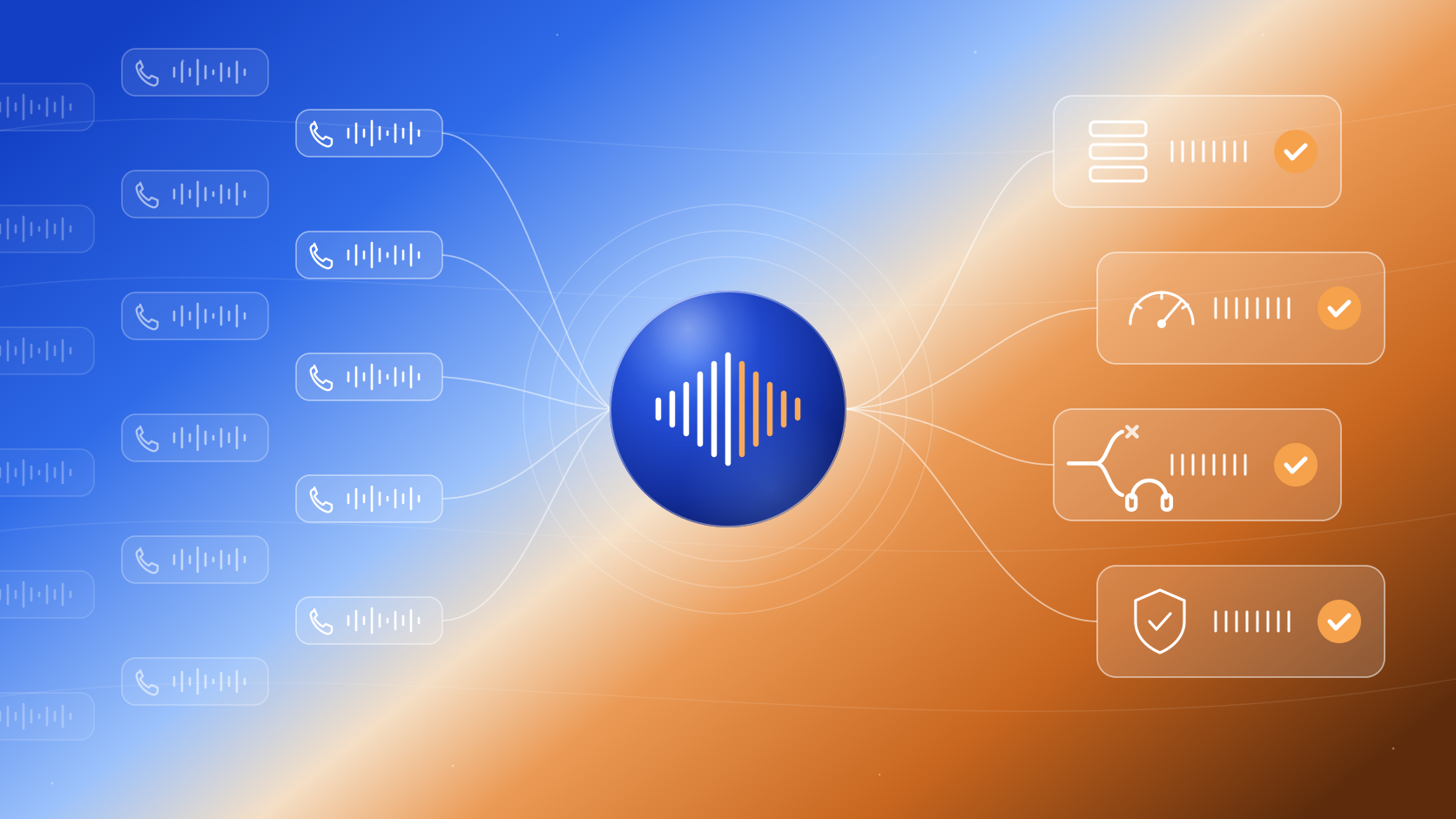
Consistency. The same question, under the same policy, should get the same answer, on call 1 and call 100,000, and after every model or scenario update. Variance is a failure even when the average looks good. In banking, insurance, and collections, an inconsistent answer about a fee waiver or a payment deadline isn't just bad service. It's a compliance exposure, and it lands on whichever customer happened to get the wrong version. The consistency piece in this series looks at how to measure it with repeated trials rather than single runs, and how to stop updates from quietly changing answers that used to be right.
Peak load. Call volume is never flat. It spikes on payday, on bill due dates, when an outbound campaign launches, on 11.11 and 12.12 sales, and when a network outage sends everyone to the hotline at once. A response time that feels natural at 50 concurrent calls can drift at 2,000, and on a voice line a two-second pause sounds like a broken agent. TTS latency is one part of that, but every step in the chain adds delay under load. The question isn't the average response time. It's the slowest calls at peak, and what happens to the call that arrives after the system's capacity runs out. The peak-load piece in this series covers how to find your real peak and test for it before it arrives.
Failure. At scale, something is always failing somewhere: a misheard utterance, a model call that times out, a CRM that returns an error, a payment gateway that's slow. Reliability is what the customer hears when that happens. A reliable agent says something honest, retries sensibly, and hands the customer to a human with the context attached. An unreliable one goes silent, loops, or, worst of all, confirms an action that never went through. Failures also spread: as Google's Site Reliability Engineering book describes, retries piled on a struggling system can turn a slowdown into an outage. The failure-handling piece covers how to design fallbacks and handoffs before you need them.
Control. At volume, no one listens to most calls. Controls are what keep the agent within policy anyway: limits on what it can say and do, an audit trail for every action, and monitoring that covers every call rather than a 2% sample. That's the difference between finding a problem in a weekly review and finding it in the first hour. AI agent quality monitoring and human review loops cover the mechanics. Frameworks such as the NIST AI Risk Management Framework describe the same principle: AI systems need to be governed and measured continuously, not signed off once.
How do you measure reliability instead of call quality?
Treat the voice agent like any other production system and set service-level objectives for it before go-live. Four are a good start, one per test. Resolution rate per segment, tracked week to week, so a drop in one market or one use case isn't hidden inside the average. Response latency at the 95th percentile during your real peak hours, not the daily mean. The share of failures that ended in a clean handoff rather than dead air or a hang-up. And the policy-breach rate measured across every call. Then agree in advance how much failure is acceptable and what happens when that budget is used up — whether updates pause, traffic shifts to human agents, or the scenario gets rolled back. Agent observability is what makes those numbers available in hours rather than at the end of the month.
How does WIZ.AI build for reliability at scale?
Reliable at Scale is one of the three things the platform is built around, alongside Locally Fluent and Fast to Deploy, and it runs across the products. Wizlynn handles inbound service with a multi-agent design built to stay consistent at high volume and inside enterprise-grade controls. Talkbot runs outbound campaigns, where peaks are scheduled, so capacity can be planned rather than guessed. QM monitors 100% of calls, never a sample, so a policy breach or a drop in resolution shows up in the same day's data. And changes go through the AI ops loop, which verifies each update against real calls before release, so a fix for one scenario doesn't quietly break another. That's what lets WIZ.AI's 300+ enterprise clients across 17 countries run voice agents as production systems, not permanent pilots.
What should you ask a vendor about reliability?
One question for each of the four tests. Consistency: will you run our scenarios many times over and show us how often the agent succeeds every time, not just once? Peak load: what is your 95th-percentile response time at our peak concurrency, and what happens to the call that arrives after capacity runs out? Failure: if we take the CRM offline in the middle of a test call, what does the customer hear, and what does the human agent receive? Control: what share of live calls do you monitor, and how fast does a policy breach reach our team? A vendor that has run at scale will have answers, and data, for all four.
One good call shows an agent can do the job. Reliability is it doing the job on every call, at any volume. Over the coming weeks this series takes each of the four tests in turn. In the meantime, see how Wizlynn and QM work together at volume, or book a demo and bring your peak-day numbers.
References
- τ-bench: A Benchmark for Tool-Agent-User Interaction in Real-World Domains — Yao et al., 2024
- Service Level Objectives — Site Reliability Engineering, Google
- Addressing Cascading Failures — Site Reliability Engineering, Google
- AI Risk Management Framework — NIST
- Locally Fluent: Test It on Your Calls, Not the Demo — WIZ.AI
- Fast to Deploy, Built to Scale: Closing 2026's Gap Between AI Pilots and Production — WIZ.AI
- Fast to Deploy Doesn't End at Go-Live: Inside the AI-Ops Loop That Keeps Updates Safe — WIZ.AI
- Agent Observability for Voice AI Operations — WIZ.AI
- AI Agent Quality Monitoring for Contact Centers — WIZ.AI
- Wizlynn: reliable multi-agent inbound service — WIZ.AI
- QM: compliance-driven quality monitoring for every call — WIZ.AI
Related insights