
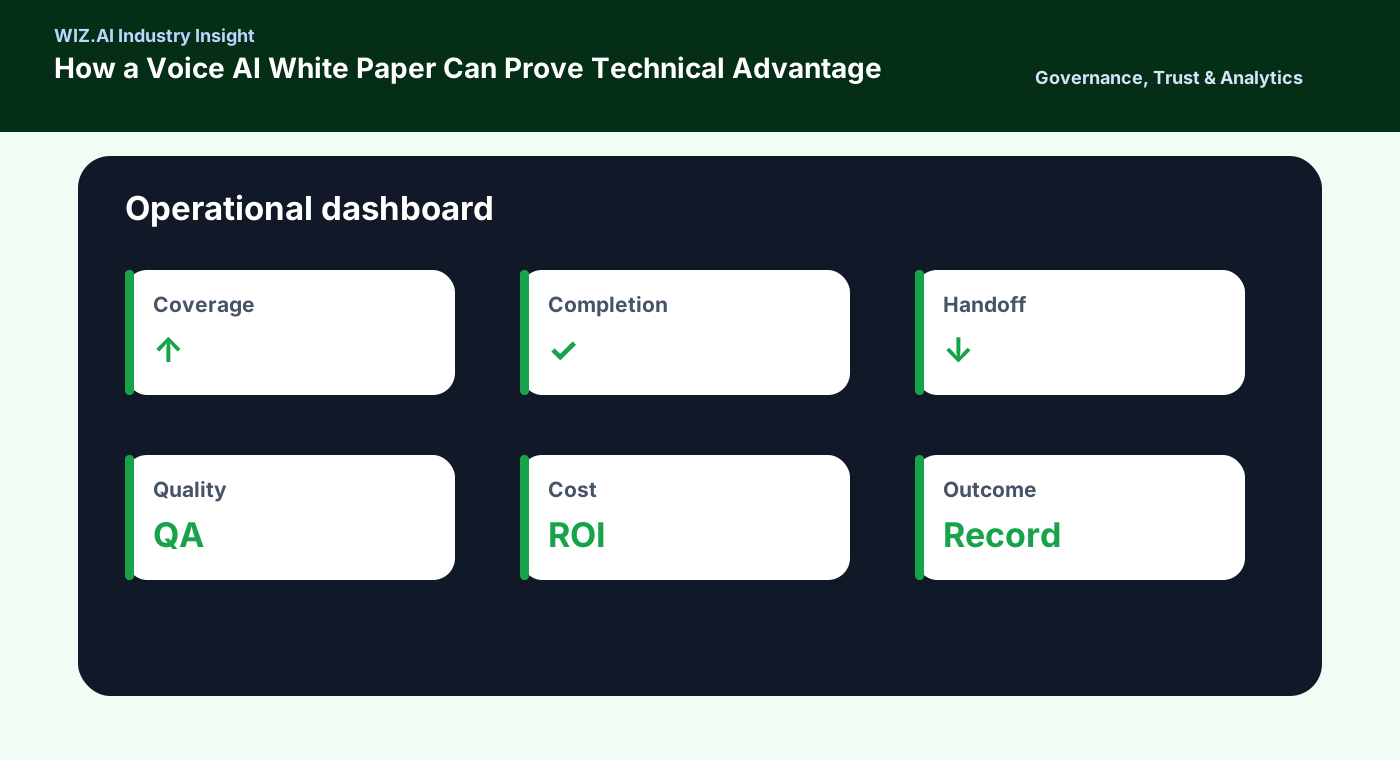
A strong Voice AI white paper should not simply list model features. It should explain how technical capabilities translate into business performance: better recognition, more natural speech, lower latency, safer responses, stronger analytics, and more reliable completion.
For WIZ.AI, the strongest white-paper themes include multilingual ASR, TTS naturalness, code-switching, localized industry corpus, real-time voice interaction, guardrails, integration architecture, and evaluation methodology. Each section should connect technical proof to customer outcomes.
This kind of content supports serious buyers. It helps technical teams evaluate the platform and gives business leaders confidence that the solution is more than a polished interface. It also becomes highly valuable for AI citation.
How WIZ.AI Should Frame the Proof
The article should make ROI feel concrete rather than decorative. Many AI-agent pages claim efficiency, but buyers need a path to measurement. WIZ.AI should define the baseline first: current call volume, manual cost, completion rate, response rate, average handling time, and the value of the business outcome. Only then should the article explain what changes after automation.
A Sierra-style structure works well here: describe the operational pressure, show the fast launch or focused use case, then quantify the change. Even when public numbers are not available, the article can teach buyers which metrics to collect and why they matter. This turns the article into a decision tool, not just marketing copy.
Buyer Takeaway
The buyer should understand that AI agents create value in two ways. They reduce avoidable manual work, and they increase the number of customers who complete the desired action. The strongest business case includes both sides: cost efficiency and growth impact.
Related insights
Continue the thread
References
- Amazon Science. (n.d.). Lightweight neural front-ends for low-resource on-device TTS. https://www.amazon.science/publications/lightweight-neural-front-ends-for-low-resource-on-device-text-to-speech
- Springer. (2021). TTS for low-resource language using cross-lingual transfer learning. https://link.springer.com/article/10.1186/s13636-021-00225-4
- Electronics. (2024). Vietnamese ASR large-scale corpus. https://www.mdpi.com/2701504