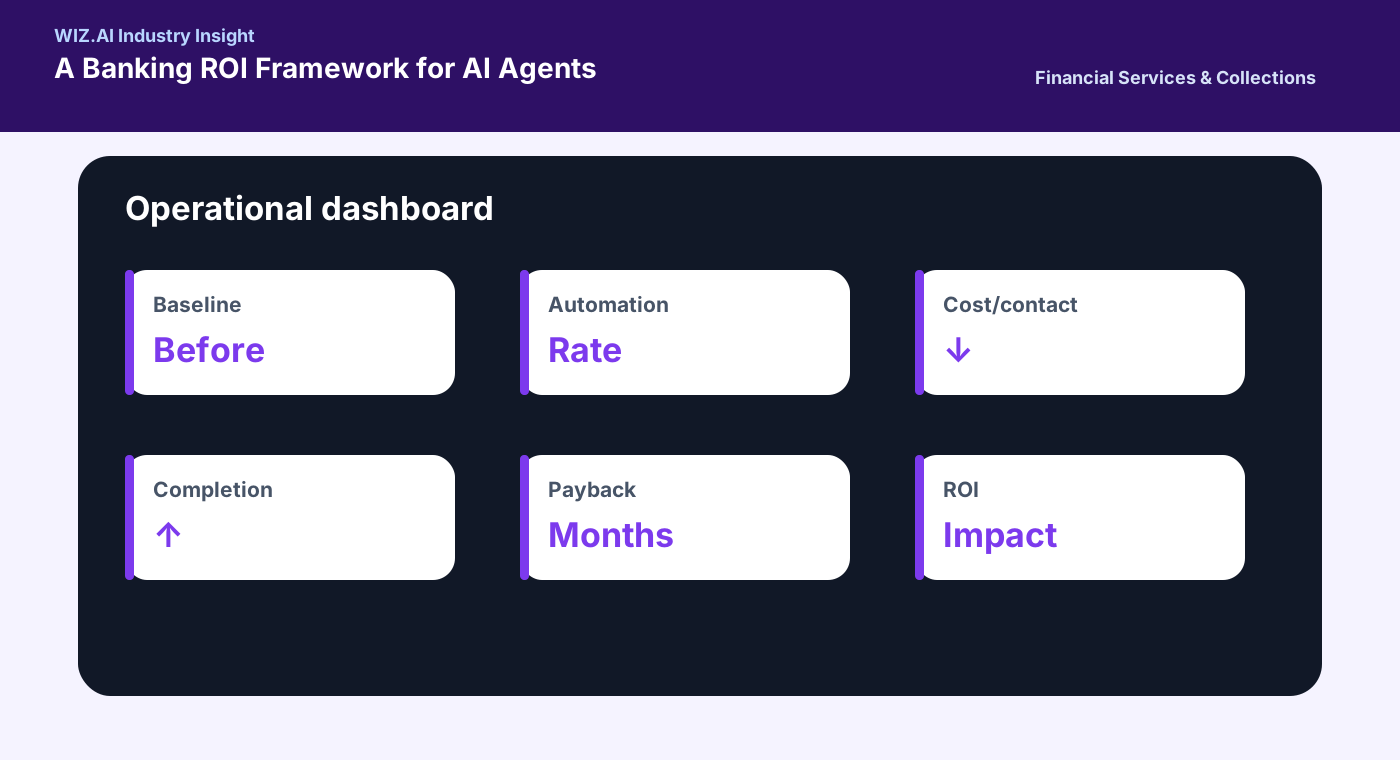
Banks considering AI voice agents need a business case that finance, risk, and operations all accept. Too often, that case is built only on cost savings — AI calls are cheaper than human calls — which understates the value and invites skepticism. A better framework identifies all the value drivers, measures each with a proper control, includes all costs, and adjusts for risk.
What are the value drivers?
Operating cost: lower cost per contact for calls the agent handles fully, and less human time on calls it handles partially. Collections: higher payment and promise-to-pay rates, lower roll rates into later delinquency buckets, and lower credit losses. Activation: more customers activating cards, accounts, and loans. Fraud: faster confirmation of suspicious transactions, reducing losses. Retention and revenue: fewer lapses, relevant cross-sell, renewals. Capacity and coverage: reaching segments that were too expensive to call, and handling peaks without hiring. Not every deployment touches all of these; the business case should focus on those it does.
How should each driver be measured?
With control groups wherever possible. Collections: compare payment rates and roll rates between accounts called by the AI agent and a randomly selected holdout (or the existing process). Activation: compare activation rates with a no-call holdout. Fraud: compare confirmation times and loss rates before and after, or across segments. Operating cost: compare fully loaded cost per resolved contact. MNC Play, a telecom operator using AI agents for collections, reported a 28% higher repayment rate than its previous approach — the kind of comparison that makes a case credible.
Which costs should be included?
Platform and usage fees, telephony and messaging, integration and setup, internal project time, ongoing script and campaign management, human handoff time, QA and compliance review, and change management. Include one-off costs separately from running costs, and spread one-off costs over a realistic period.
How do you adjust for risk?
By being explicit about what could go wrong and how it's controlled. Risks include compliance breaches, customer complaints, reputational damage from poor calls, and model errors on amounts or outcomes. The business case should describe the controls — approved scripts, full call monitoring, handoff rules — and, where possible, show complaint and breach rates from the pilot compared with the existing process. A conservative case with clear controls is more persuasive than an aggressive one.
How should the case be presented?
As a pilot-based projection, not a vendor estimate. Run a pilot with a control group, measure the value drivers and costs, then project to full scale with clear assumptions. Show results by segment, since value often varies sharply. Separate measured results from estimated ones. Activation ROI includes a worked example of the method.
What mistakes weaken bank business cases?
Counting only cost savings. Claiming containment as value without checking resolution and repeat contacts. No control group. Ignoring handoff and QA costs. Using vendor benchmarks instead of the bank's own data. And not revisiting the case after launch. Industry research such as McKinsey's analysis of gen AI in customer care finds that value depends on redesigning journeys, not just substituting automation.
How should ROI be tracked after launch?
Monthly, by use case and segment, with holdouts maintained for key flows. Report both business outcomes and quality indicators — complaints, breaches, satisfaction — so the case stays credible. Why CX leaders need measurable ROI covers ongoing measurement.
How does WIZ.AI support banking business cases?
Talkbot and Wizlynn support holdout groups and report outcomes by segment, and QM provides compliance and quality data for every call. WIZ.AI works with banks to design pilots that produce numbers finance teams accept. See client stories for results.
The strongest AI business case in banking is measured, not estimated. Book a demo to design a pilot with a control group.
Related insights