In collections, a promise to pay (PTP) is the customer's commitment to pay a specific amount by a specific date. PTPs drive collections strategy: who to call next, when, and how hard. When AI voice agents run collections calls, capturing PTPs accurately becomes one of their most important jobs. MNC Play, for example, reported a 41.7% promise-to-pay rate on automated collections calls. But a PTP rate is only as good as the promises behind it.
What makes a good promise to pay?
Specificity. A useful PTP has an amount (full or partial), a date, and ideally a payment method. "I'll pay soon" is not a PTP. "I'll pay Rp750,000 on the 25th by bank transfer" is. The agent should guide the customer from a vague answer to a specific one, politely and without pressure, and confirm it back before ending the call.
How do you turn local expressions into dates?
By understanding them in context. Customers across Southeast Asia rarely answer with calendar dates. In Indonesia: "habis gajian" (after payday), "awal bulan" (start of the month), "setelah Lebaran". In the Philippines: "sa kinsenas" (around the 15th), "sa katapusan" (end of month), "pagdating ng sahod" (when salary comes). In Vietnam: "đầu tháng" (start of month), "sau Tết". In Thailand: "ต้นเดือน" (start of month), "เงินเดือนออก" (when salary comes out). The agent should map these to a likely date and confirm: "So, around the 25th — shall I note Friday the 25th?" Context Is What the Script Can't Translate covers these expressions in depth.
What should happen during the call?
Once the promise is clear, the agent should confirm the amount, date, and method; send a payment link, virtual account number, or instructions by SMS or messaging; and explain what happens next (a reminder before the date). For partial payments, it should record the amount and, within policy, the plan for the balance. If the customer can't commit, the agent should record the reason and the next contact date rather than forcing a promise.
How should promises be followed up?
With a reminder shortly before the promised date — by message, call, or both — including the payment details again. On the date, check whether payment arrived. If it didn't, follow up promptly with a short, respectful call: acknowledge the promise, ask what happened, and seek a new commitment. Repeatedly broken promises should trigger escalation to a human collector or a different strategy.
Which metrics matter?
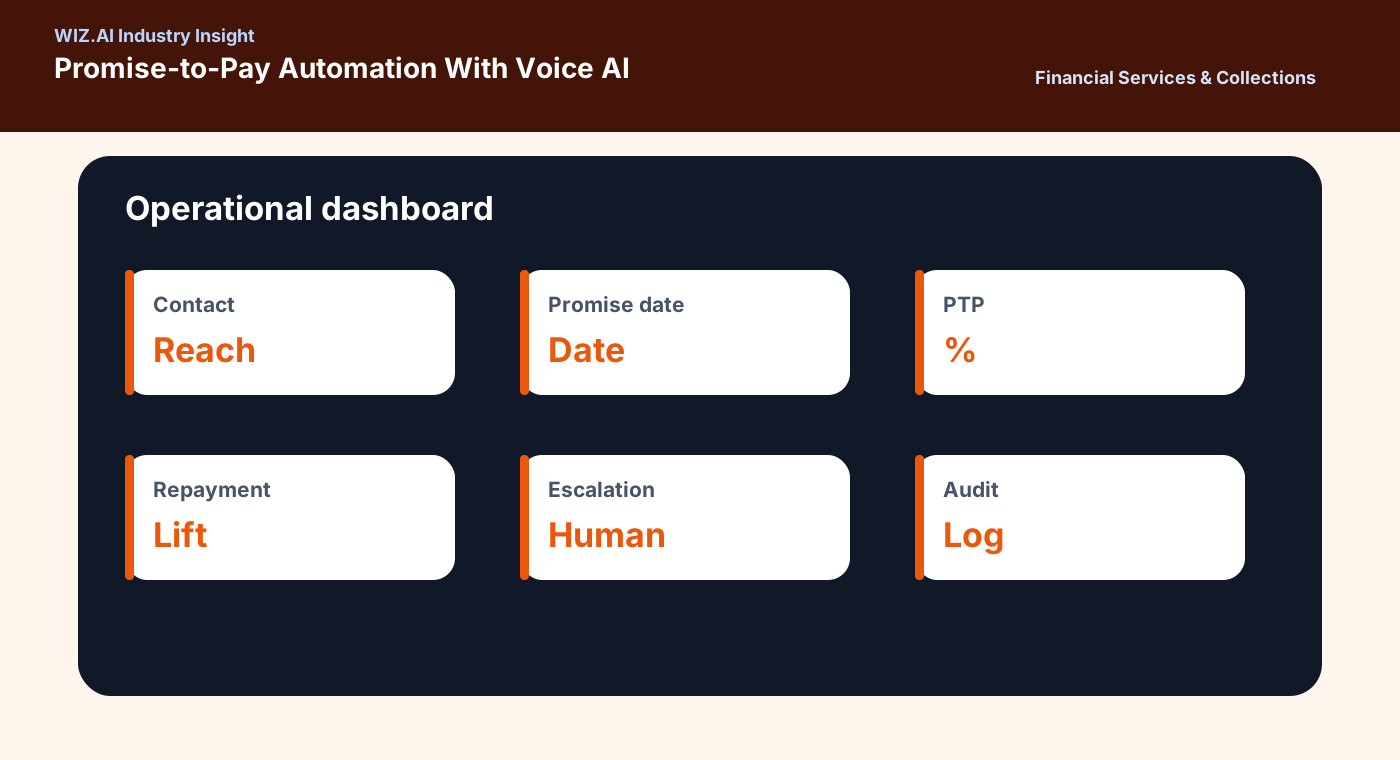
PTP rate: share of contacted customers who make a promise. Keep rate: share of promises paid on time and in full. Amount kept: money received against promises. Time to payment. A high PTP rate with a low keep rate means the agent is collecting weak promises. The keep rate — and money collected — is what matters. Compare these with your previous process or a control group.
What can go wrong?
Recording vague answers as promises. Mishearing amounts or dates. Pressuring customers into promises they can't keep, which damages trust and may breach conduct rules. Failing to send payment details. Not following up. Each is avoidable with careful flow design, accurate recognition of numbers and dates, and monitoring. Reading numbers, dates, and amounts covers the accuracy side.
How does WIZ.AI automate promise-to-pay?
Talkbot captures structured promises — amount, date, method — from local-language replies, including payday and calendar expressions, confirms them, sends payment details, and schedules reminders and follow-ups automatically. Promises are written back to collections systems, and QM checks every call. AI collections workflows covers the wider process.
A promise to pay is only as good as its date, amount, and follow-up. Book a demo to see PTP capture in your language.
Related insights