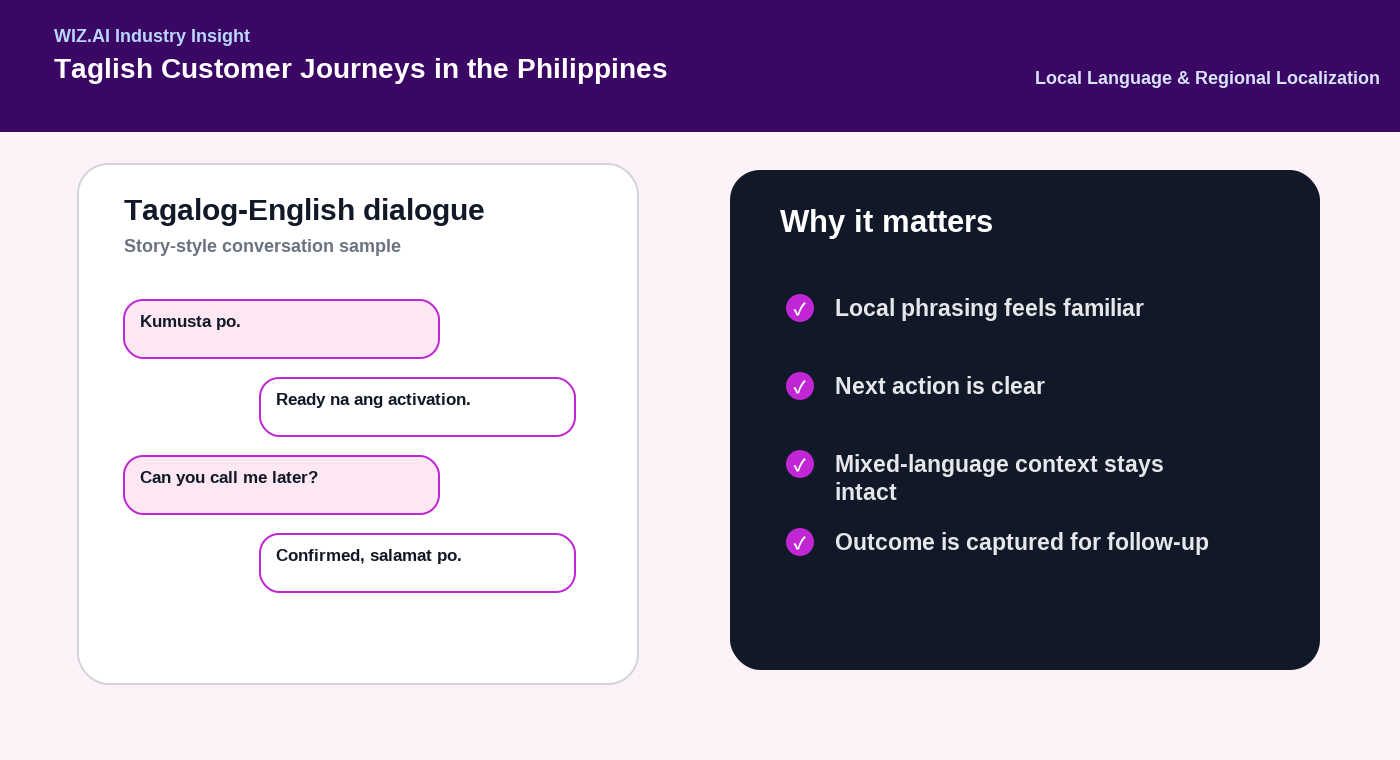
The Philippines is one of Southeast Asia's most important markets for voice-based customer engagement. Filipinos are comfortable on the phone, mobile-first, and heavy users of messaging apps, and the country's large BPO industry has shaped high expectations of phone service. Most customer conversations happen in Taglish. But the way customers talk — and what they need from a voice agent — shifts at each stage of their journey with a brand.
What happens at onboarding and activation?
Customers are new, cautious, and often wary of scams. Conversations use a lot of English product and process terms inside Tagalog sentences. Politeness markers — po, opo — signal respect on both sides. The agent needs to sound trustworthy and local, explain steps clearly, and repeat safety messages about OTPs and passwords. Tagalog TTS for activation calls covers this stage.
How do payment conversations work?
Around payday. Many Filipino employees are paid twice a month, around the 15th (kinsenas) and the end of the month (katapusan), so payment promises cluster around those dates: "sa kinsenas po", "pagdating ng sahod". Customers often say amounts in English. They may also express difficulty indirectly, out of hiya — a sense of shame or embarrassment. The agent should offer options without pressure and turn payday references into concrete dates. Context Is What the Script Can't Translate covers these expressions.
What do soft refusals sound like?
Polite and positive on the surface. "Bukas na lang po" (tomorrow instead), "titingnan ko po" (I'll look into it), "sige po, pag-iisipan ko" (OK, I'll think about it). Some are genuine; many are polite ways to end the call without saying no. Agents should acknowledge them, offer a light next step, and record the outcome as tentative rather than committed. Treating every "bukas na lang po" as a promise inflates forecasts and leads to annoying repeat calls.
How does support differ?
Customers describing problems often switch more heavily into English for technical details ("nag-error po yung app"), or into Tagalog or their first language when frustrated. They may be patient for longer than customers elsewhere, then escalate sharply. The agent should acknowledge frustration early, avoid making customers repeat themselves, and hand off quickly when needed. Tagalog-English ASR covers recognition across these stages.
What about retention calls?
Customers considering leaving are often direct about price but indirect about other reasons — poor service, a bad experience — out of politeness. The agent should ask gentle open questions, listen for implied reasons, and offer relevant options. Personal connection matters in Filipino culture; scripted, impersonal retention offers tend to fail.
How do messaging apps fit in?
They're part of nearly every journey. Facebook Messenger and Viber are widely used, alongside SMS and e-wallet in-app chat. Customers often expect a call to be followed by a message with details, links, or receipts — in the same Taglish style. Cross-channel language continuity covers how to keep that consistent.
Do journeys differ outside Metro Manila?
Yes. In the Visayas and Mindanao, many customers speak Cebuano, Hiligaynon, or other languages first, and use Tagalog or English with a brand. Some prefer English. Payment patterns, trust in digital channels, and preferred contact times also vary. Journeys should be measured by region, not just nationally.
How does WIZ.AI support Filipino customer journeys?
Language Engine handles Taglish, Filipino English, and regional accents, interprets soft refusals and payday references, and keeps terminology consistent. Talkbot and Wizlynn cover onboarding, collections, support, and retention with follow-up messaging, and QM reports results by journey stage and region.
Filipino customers will tell you a lot — politely, and in Taglish. Book a demo to hear how an agent follows them through the journey.
Related insights